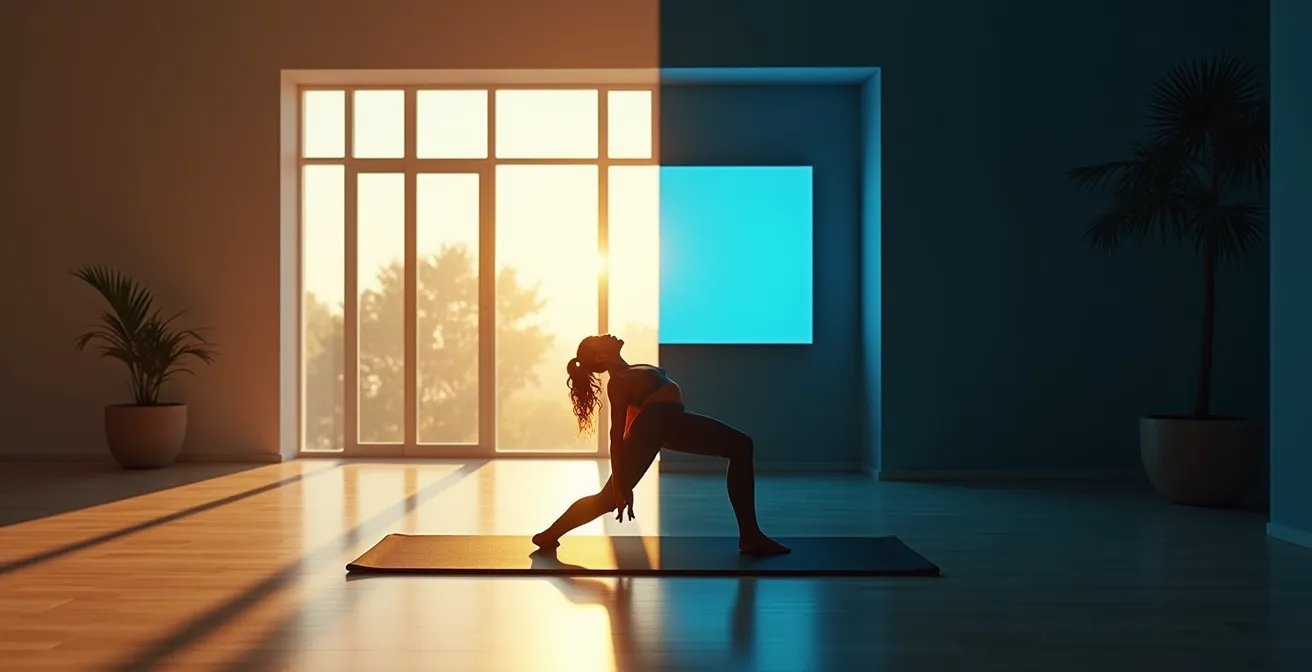
The exhaustion you feel after a ‘relaxing’ evening of TV is no accident; you’re numbing your nervous system, not restoring it.
- Passive relaxation (like scrolling or watching shows) keeps your brain in a state of low-grade stress and fails to engage your body’s recovery systems.
- Active relaxation involves deliberate techniques that consciously shift your body from a “fight-or-flight” state to a “rest-and-digest” state, leading to true physiological recovery.
Recommendation: Stop measuring rest by the hours you spend on the couch and start measuring it by the intentional, science-backed actions you take to down-regulate your nervous system.
You’ve finished a grueling day of work. You collapse onto the sofa, grab the remote, and sink into a six-hour streaming binge. You call it “relaxing,” but when you finally drag yourself to bed, your mind is buzzing and you feel a familiar, wired-and-tired exhaustion. The next morning, you wake up feeling just as drained as before. This cycle is the silent hallmark of modern burnout, and it’s rooted in a fundamental misunderstanding of what it means to rest. As a burnout recovery coach, I see this constantly: high-performers who are incredibly disciplined in their work but completely lost when it comes to recovery.
The common advice is to “disconnect,” “take a break,” or “meditate,” but these platitudes fail to address the core problem. You feel guilty when you’re not productive, so your “rest” becomes another task to optimize, or you swing to the opposite extreme—total mental checkout with passive consumption. The problem is that your nervous system doesn’t know the difference between a work deadline and a cliffhanger in a TV show; both can keep it in a state of low-grade alert. You are confusing numbing with restoration.
But what if the key wasn’t simply choosing a “better” activity, but learning how to operate the control panel of your own nervous system? True relaxation isn’t an activity you choose, but a physiological state you must consciously engineer. It’s not about doing nothing; it’s about doing something very specific that signals to your body it’s safe to power down and repair. This guide moves beyond the simplistic “active vs. passive” debate to give you a set of protocols to deliberately shift your body from a state of chronic stress to one of deep, measurable restoration.
For those who prefer a condensed format, this guided breathing exercise from Dr. Andrew Huberman is an excellent introduction to one of the most powerful active relaxation techniques discussed in this article. It’s a perfect starting point to feel the difference between passive rest and a deliberate physiological state-shift.
To help you master this skill, we will deconstruct the science of true recovery. This article provides a complete toolkit, from immediate stress-dumping techniques to long-term environmental strategies, all designed to put you back in control of your energy and focus. The following sections break down each component of this system.
Summary: Your guide to engineering true physiological rest
- How to Activate Your Vagus Nerve to Switch Off Fight-or-Flight Mode?
- Meditation for Skeptics: What to Do If You Can’t “Clear Your Mind”?
- Optimizing Your Bedroom for Sensory Deprivation and Deep Rest
- The 24-Hour Digital Sabbath: What Happens to Your Brain When You Unplug?
- When to Take a Break: The Ultradian Rhythm Rule You Are Ignoring
- Why Blue Light in Your Living Room Is Keeping You Awake?
- The Physiological Sigh: How to Dump Stress Chemistry in 30 Seconds?
- How to Plan Nature Excursions That Reset Your Circadian Rhythm?
How to Activate Your Vagus Nerve to Switch Off Fight-or-Flight Mode?
Your inability to relax isn’t a personal failing; it’s a physiological state. Your body is likely stuck in the sympathetic nervous system—the “fight-or-flight” mode designed for acute threats. The antidote is to consciously activate its counterpart, the parasympathetic nervous system, responsible for “rest-and-digest.” The master control for this system is a long, wandering nerve called the vagus nerve. Learning to stimulate it is the single most powerful skill for managing stress.
Unlike passive rest, which hopes for relaxation to happen by chance, active relaxation is about intentionally signaling safety to your body. As research on active relaxation shows, these strategies condition the body to activate the parasympathetic nervous system on demand. Stimulating the vagus nerve acts like a “gear shift” for your physiology, moving you from high alert to a state of calm recovery. This isn’t just a feeling; it’s a measurable change that slows your heart rate, improves digestion, and reduces inflammation.
There are several ways to manually engage this nerve. Simple, physical actions are often the most effective because they bypass the overthinking mind. One of the quickest methods is exposure to cold. Splashing your face with cold water for 15-30 seconds triggers the “mammalian diving reflex,” an ancient survival mechanism that immediately slows the heart and activates the vagus nerve. Another powerful tool is specific breathing patterns, which directly influence heart rate variability—a key marker of vagal tone. By learning these simple inputs, you gain a reliable “off switch” for your body’s stress response.
Meditation for Skeptics: What to Do If You Can’t “Clear Your Mind”?
The best moments in our lives are not the passive, receptive, and relaxing times.
– Mihaly Csikszentmihalyi, Flow: The Psychology of Optimal Experience
For many high-performers, the advice to “meditate” is a source of immense frustration. You sit down, try to “clear your mind,” and are immediately flooded with to-do lists, anxieties, and random thoughts. You end up more stressed than when you started, convinced you’ve failed. This is a common trap because it’s based on a misconception. The goal of meditation isn’t to achieve a blank mind; it’s to change your *relationship* with your thoughts.
For skeptics, a more effective entry point is the “Open Awareness” technique. Instead of fighting your thoughts, you simply label them. When a thought about work appears, you silently say to yourself, “thinking.” When you feel a physical sensation like restlessness, you label it “feeling.” This small act of noticing without judgment removes the pressure to achieve an impossible standard of mental silence. It transforms meditation from a battle against your mind into an exercise in detached observation.
Case Study: The Open Awareness Technique for Beginners
A study on mindfulness practices highlighted this perfectly. Beginners who were taught to use the ‘open awareness’ technique—simply labeling thoughts as ‘thinking’ and sensations as ‘feeling’ without trying to clear their mind—reported significantly less frustration and had much better adherence to their practice. They found meditation more accessible because the pressure to achieve a “blank mind state” was removed, allowing them to engage with the process rather than fight it.
This approach aligns perfectly with active relaxation. It is not a passive zoning out but an engaged, gentle redirection of your focus. You are actively training your brain to stop over-identifying with every thought that arises. It’s a mental workout, not a mental vacation, and for the overactive mind of a high-performer, it’s a far more realistic and effective strategy for building resilience.
Optimizing Your Bedroom for Sensory Deprivation and Deep Rest
Your brain’s ability to switch off at night is profoundly influenced by its environment. If your bedroom is a source of constant, low-level sensory input—light, noise, temperature fluctuations—your nervous system never gets the all-clear signal to enter deep, restorative sleep. The goal is to transform your bedroom into a sanctuary of sensory deprivation, minimizing all inputs to give your brain the best possible chance to recover.
This process begins with light. Even tiny amounts of light, especially from the blue end of the spectrum, can suppress the production of melatonin, your sleep hormone. This means covering or removing all electronic devices with status lights. Temperature is another critical factor; the ideal range for sleep is a cool 60-67°F (15-19°C), as a drop in core body temperature is a key signal for initiating sleep. Finally, consider sound. While some people prefer silence, others benefit from a consistent, masking sound like pink noise, which has a deeper frequency than white noise and is often perceived as more natural, like rainfall.

As the image above suggests, even texture plays a role in creating a restful environment. Natural, breathable fabrics like cotton, bamboo, or wool can improve thermal regulation and comfort. The final 30-45 minutes before sleep should be a dedicated “landing strip” protocol, where you systematically reduce all sensory inputs: dim the lights, lower the volume on any sounds, and disengage from stimulating cognitive tasks. This isn’t about luxury; it’s about creating the biological preconditions for your brain and body to perform their essential nightly repairs.
The 24-Hour Digital Sabbath: What Happens to Your Brain When You Unplug?
The single greatest saboteur of modern rest is the hyper-connected device in your pocket. Its constant stream of notifications, updates, and infinite-scroll content keeps your brain’s dopamine and cortisol systems on a relentless hamster wheel. The most powerful intervention to break this cycle is a true 24-hour digital sabbath: a full day, from sundown to sundown, with all screens turned off. This isn’t just “taking a break from your phone”; it’s a deep neurochemical reset.
What happens when you truly unplug? The initial hours are often uncomfortable. You’ll likely experience restlessness, anxiety, and a powerful fear of missing out (FOMO). This is a withdrawal symptom, and it’s a sign the protocol is working. Your brain, accustomed to constant stimulation, is protesting the silence. This is the moment most people give in. But if you push through, something remarkable happens. After the 12-hour mark, a profound mental clarity begins to emerge. Your attention span lengthens. Your thoughts become deeper and less fragmented. Creativity, long-smothered by constant input, starts to bubble to the surface.
Case Study: Burnout Prevention for Content Creators
This effect is well-documented among high-demand professionals like YouTube content creators. Those who implement regular digital sabbaths report a dramatic reduction in burnout symptoms. They consistently describe the initial 3-4 hours as marked by restlessness, followed by a surge of creative insights and mental clarity after about 12 hours. For them, it’s not a luxury but a crucial business practice for sustaining creativity and well-being.
A digital sabbath is the ultimate form of active relaxation because it forces you to find restoration in the real world—in conversations, in nature, in hobbies, or in simple boredom. It starves the part of your brain that craves novelty and feeds the part that needs deep focus and connection. Planning for this experience is crucial to its success.
Your Action Plan for a Successful Digital Sabbath
- Points of contact: Inform key contacts you’ll be unreachable for 24 hours to manage expectations and prevent emergencies.
- Collecte: Inventory your analog alternatives. Prepare books, journals, board games, or project materials *before* the sabbath begins.
- Coherence: Define your “why.” Write down what you hope to gain from the experience (e.g., mental clarity, more presence) to stay motivated.
- Mémorabilité/émotion: Plan at least one engaging, non-digital activity you’re excited about, such as a hike, a special meal, or a creative project.
- Plan d’intégration: As the sabbath ends, don’t just dive back in. Spend 15 minutes setting clear intentions and boundaries for your device use for the week ahead.
When to Take a Break: The Ultradian Rhythm Rule You Are Ignoring
Most high-performers either power through their day without breaks or take them randomly when they feel exhausted. Both approaches are wrong. Your energy doesn’t operate like a gas tank that slowly depletes; it functions in cycles. Throughout the day, your brain moves through ultradian rhythms: 90- to 120-minute cycles of high-frequency brain activity followed by a 15- to 20-minute period of low-frequency activity. Ignoring the need for a break during that low-frequency trough is a direct path to burnout.
Working through this natural dip forces your body to rely on stress hormones like cortisol and adrenaline to maintain performance. You might feel productive in the short term, but you’re accumulating a significant physiological debt. Honoring this rhythm by taking a deliberate, active break every 90 minutes is transformative. It’s not about stopping work; it’s about working *with* your biology. Studies confirm the benefits: a 2024 study found that employees who took 15-minute breaks every 90 minutes reported 23% higher job satisfaction and 17% lower stress levels.
The crucial part, however, is the *quality* of the break. Scrolling social media or checking news headlines is passive rest; it keeps your cognitive load high and does little to restore you. An active rest break is designed to do the opposite: reduce cognitive load and activate the parasympathetic nervous system. This could be a short walk, a few minutes of stretching, or simply looking out a window at a natural scene. The key is to switch from focused, narrow attention to a broad, open awareness.
This table, based on an analysis of ultradian break strategies, breaks down how to match the break activity to its duration for maximum restorative effect.
| Break Duration | Active Rest Options | Passive Rest (Avoid) | Expected Outcome |
|---|---|---|---|
| 5 minutes | Physiological sigh sequence, desk stretches | Social media scrolling | Quick stress reset |
| 10 minutes | Short walk, stair climbing | News browsing | Creative unblocking |
| 20 minutes | Meditation, nature viewing | TV watching | Full cognitive restoration |
Why Blue Light in Your Living Room Is Keeping You Awake?
You’ve probably heard about the dangers of blue light from your phone or laptop before bed. But the problem is far more pervasive. Your entire living environment, especially your living room where you “wind down,” is likely a minefield of circadian-disrupting blue light that is actively sabotaging your ability to rest. This goes far beyond the obvious screens.
A complete audit of a modern living room reveals multiple overlooked sources. The tiny LED status lights on your TV, soundbar, and gaming consoles emit a powerful, narrow-band blue light (around 470nm) that is particularly effective at suppressing melatonin. Smart home displays, even when “asleep,” often pulse with light or maintain a backlit glow. Even the “cool white” or “daylight” LED bulbs in your lamps are flooding your evening environment with the same spectrum of light as the midday sun, sending a powerful “wake up” signal to your brain when it should be preparing for sleep.
Case Study: The Hidden Light Polluters
A comprehensive living room light audit reveals just how many sources we ignore. Beyond screens, culprits include the status lights on appliances, the glowing logos on electronics, and even streetlights filtering through windows. These seemingly minor sources can collectively disrupt your circadian rhythm. The solutions are surprisingly simple and low-tech: using a small piece of black electrical tape to cover status lights, positioning smart displays to face the wall at night, and installing effective blackout curtains can dramatically reduce this hidden light pollution.
To truly signal to your body that the day is over, you need to implement a “color temperature transition” protocol in the hours leading up to bed. This involves systematically shifting the color and intensity of your home’s lighting from cool and bright to warm and dim, mimicking a natural sunset.
- 3 hours before bed: Switch all primary lights to a warm white setting (around 3000K).
- 2 hours before bed: Dim these lights to 50% intensity and activate “night mode” on any essential devices.
- 1 hour before bed: Transition entirely to very warm, amber-hued lighting (2200K or less), equivalent to candlelight or a fireplace.
- 30 minutes before bed: For any necessary navigation, use only red-spectrum night lights, which have virtually no impact on melatonin.
The Physiological Sigh: How to Dump Stress Chemistry in 30 Seconds?
When you’re in the midst of a stressful moment—a difficult meeting, an overwhelming inbox—you don’t have time for a 20-minute meditation. You need a tool that works immediately to offload the rising tide of stress chemistry. The most effective, evidence-based tool for this is the physiological sigh. This is not a deep breath; it’s a specific breathing pattern your body naturally uses to reset itself during sleep or moments of high emotion.
A physiological sigh is a type of deep breath characterized by a double inhalation, followed by a single, longer exhalation.
– Dr. Andrew Huberman, Neuroscientist, Stanford University
The mechanism is beautifully simple. Your lungs are filled with tiny sacs called alveoli, which are responsible for exchanging oxygen and carbon dioxide. Under stress, these sacs can collapse, reducing your ability to offload CO2 efficiently. The physiological sigh works by using a double inhale to reinflate these collapsed alveoli. The first inhale is deep, followed by a second, shorter “top-up” inhale through the nose. This forces the maximum number of alveoli to open. The subsequent long, slow exhale through the mouth then allows for a highly efficient dumping of carbon dioxide, which in turn sends a powerful calming signal to the brain and heart.

The effect is almost instantaneous. Just one to three cycles can immediately lower feelings of anxiety and physiological arousal. It is the fastest known voluntary way to shift your body out of a sympathetic state. The power of this technique is backed by significant research. For example, Stanford University research demonstrates that just 5-minute daily cyclic sighing sessions can significantly enhance mood and reduce physiological arousal over time. This makes it both a powerful in-the-moment rescue tool and a practice for building long-term stress resilience.
Key Takeaways
- True rest is not passive consumption but an active, physiological state-shift you must engineer.
- Your nervous system has an “off switch” (the vagus nerve) that you can learn to control with specific techniques like breathing and cold exposure.
- Your environment—especially light, sound, and temperature—sends powerful signals to your brain that either support or sabotage your ability to rest and recover.
How to Plan Nature Excursions That Reset Your Circadian Rhythm?
Exposure to nature is one of the most potent forms of active relaxation, working on multiple physiological levels simultaneously. It’s not just about “getting fresh air.” It’s about providing your brain and body with specific inputs that reduce cognitive load, reset your internal clock, and lower stress hormones. A planned nature excursion is a powerful tool for deep restoration, especially for a mind fatigued by urban or digital environments.
One of the key mechanisms at play is the “fractal fluency” effect. Natural patterns—the branches of a tree, the shape of a coastline, the structure of a cloud—are composed of fractals. Your brain is hardwired to process these patterns with extreme efficiency, requiring very little energy. In contrast, processing the harsh, geometric shapes of an urban environment requires significant cognitive effort. This is why a walk in a park can feel so much more restorative than a walk down a city street. Research shows that exposure to these natural patterns can reduce cognitive load by up to 60%, freeing up mental resources and measurably reducing cortisol levels.
To maximize the benefits, you should structure your nature exposure around your body’s circadian rhythm. This means using different types of nature experiences at specific times of day to send the right signals to your brain. This protocol turns a simple walk into a targeted biological intervention:
- Morning (6-8 AM): A 20-minute walk with direct sunlight exposure, without sunglasses. This is the most important signal for circadian anchoring, locking in your wake-sleep cycle for the day.
- Midday (12-2 PM): An “awe walk,” where you intentionally focus on vast landscapes like an open sky or a wide vista. This has been shown to reduce inflammation markers.
- Late Afternoon (4-6 PM): Engage in active nature tasks like gardening or outdoor yoga. This helps process the day’s stress and prepares the body for evening relaxation.
- Sunset: Directly view the sunset for a few minutes. The shift in light color and angle provides a powerful cue for your brain to begin producing melatonin.
Even if you’re in a dense urban environment, you can seek out “pocket parks” or use high-quality recordings of nature sounds (especially those in the 40-60 Hz range) to gain some of these benefits. The key is to be intentional, treating nature not as a backdrop but as a vital component of your recovery toolkit.
You now have a complete toolkit of science-backed protocols to move from simply numbing your exhaustion to actively engineering your recovery. These are not quick fixes but skills to be practiced. True rest is not a reward for hard work; it is the foundation upon which sustainable high performance is built. To begin your recovery, the next step is to choose one of these protocols—whether it’s the physiological sigh, the morning sun walk, or the bedroom light audit—and implement it consistently. Start small, be deliberate, and reclaim your rest.
Frequently Asked Questions on Active Relaxation and Rest
What’s the difference between pink noise and white noise for sleep?
Pink noise has a deeper, more balanced frequency that mimics natural sounds like rainfall, while white noise contains all frequencies equally. Studies show pink noise may improve deep sleep quality more effectively than white noise.
How long should the ‘Landing Strip’ pre-sleep protocol take?
The ideal pre-sleep wind-down period is 30-45 minutes, gradually dimming lights, reducing sound levels, and decreasing cognitive stimulation to ease the transition from wakefulness to sleep.
Which bedroom temperature is optimal for deep rest?
Research suggests 60-67°F (15-19°C) is ideal for most people, as cooler temperatures signal the body to produce melatonin and prepare for sleep.