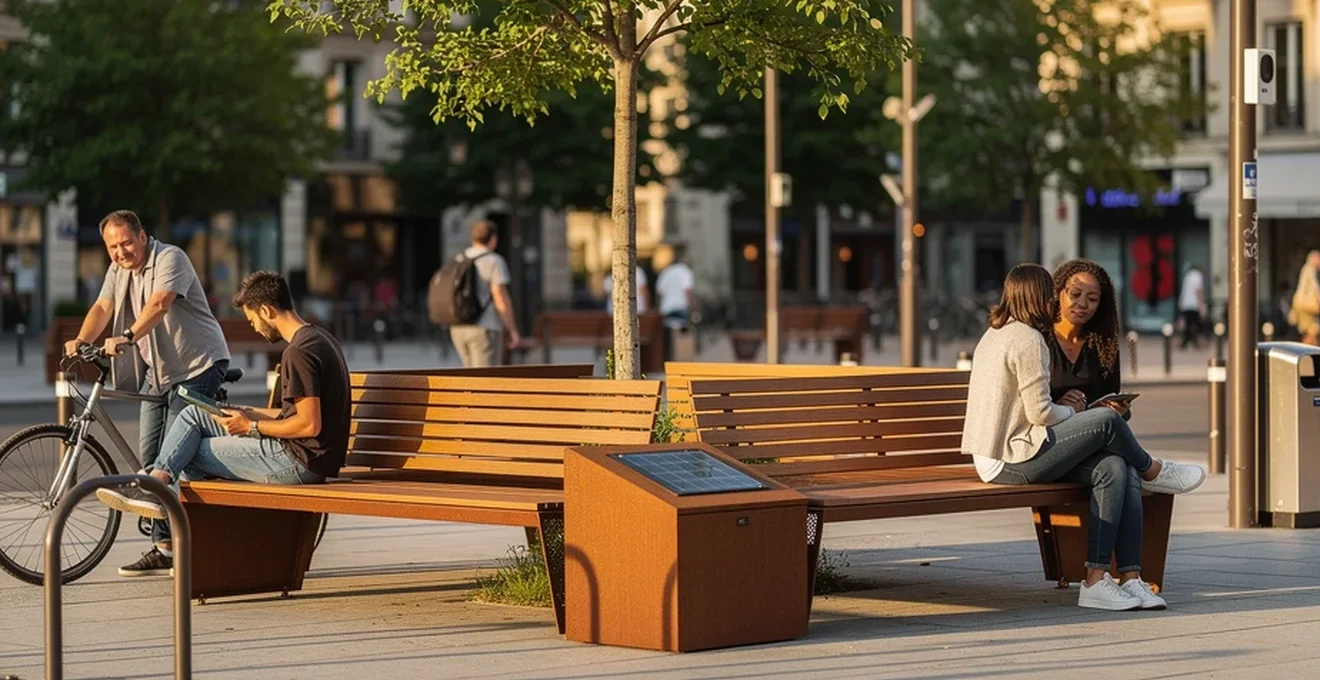
Urban furniture shapes how people experience streets, parks and squares long before they consciously notice it. A well-placed bench, a shaded seating cluster or a clearly lit pathway can determine whether a public space feels welcoming or forgettable. Local authorities and urban designers increasingly recognise that street furniture is not a decorative afterthought but a strategic tool for placemaking, accessibility and community wellbeing. This matters more than ever as high streets compete with online retail and councils face tighter budgets, meaning every bench, bin and light fixture must justify its cost through durability, function and design quality. This article examines the theory behind successful public realm design, the main categories of urban furniture, the materials that keep them standing for decades, and the accessibility and technology standards shaping the next generation of street furniture. It also looks at how leading European cities have put these principles into practice.
Defining urban furniture within placemaking theory
Urban furniture refers to the fixed and semi-fixed objects installed in public spaces to support everyday activity: benches, litter bins, lighting, bike racks, shelters and signage among them. Placemaking theory treats these elements as more than functional add-ons. They are instruments for shaping how people move through, linger in and relate to a space. Rarely is street furniture purely decorative; it consistently carries social, economic and environmental value, giving a location a distinct sense of place rather than allowing it to blend into a generic streetscape dominated by national retail chains.
Distinguishing street furniture from landscape architecture elements
Street furniture and landscape architecture are closely related but not identical disciplines. Landscape architecture typically concerns the broader spatial and ecological structure of a site — topography, planting schemes, hard and soft surfacing, drainage. Street furniture sits within that framework as the discrete, often manufactured objects that people directly interact with: a bench, a bin, a bollard. The two disciplines overlap significantly, particularly where furniture is integrated into planting or structural elements, such as seating built around tree pits in urban landscapes. Effective public realm projects treat furniture selection as an extension of the landscape strategy rather than a separate, late-stage decision.
Jan gehl’s Human-Scale design principles applied to public realm
Human-scale design principles emphasise that public spaces should be planned around the pace, senses and comfort of the pedestrian rather than the convenience of vehicles or abstract masterplanning. Applied to street furniture, this means seating positioned where people naturally pause, lighting calibrated to walking speed rather than motorway standards, and clusters of amenities that invite people to stay rather than simply pass through. When a local authority creates attractive rest and waiting areas, it sends an implicit message of welcome, encouraging visitors to check their phones, snack or simply watch the world go by rather than treating the high street as a task to complete quickly.
William H. whyte’s triangulation concept and social catalysts
Triangulation describes the process by which an external stimulus — a piece of art, a performer, an interesting object — prompts strangers to interact as if they already knew one another. Street furniture can act as this catalyst. Carefully placed clusters of benches and seating in public places create opportunities for sociability and outdoor interaction that might not otherwise occur. This value has become increasingly precious as people respond to the pressures of modern life by returning to simpler, more traditional communal activities: sitting together, chatting, watching passers-by.
Core typologies of urban furniture systems
Public spaces rely on several recurring categories of furniture, each addressing a distinct practical need while contributing to the overall character of the environment.
Seating solutions: benches, modular units and parklets
Seating is arguably the most fundamental typology. A public space without adequate seating rarely functions well, regardless of how attractive its landscaping might be. Benches and picnic tables create welcoming environments for relaxation and socialisation, and their value extends well beyond parks to smaller urban gardens, pedestrianised streets and areas defined mainly by planters. Individualised bench design carries an intrinsic message about how much a location values its visitors, promoting equality of opportunity by offering rest points for elderly people and those with mobility issues, while giving parents of young children a natural vantage point to supervise play.
Lighting infrastructure: bollards, Pole-Mounted fixtures and smart LED systems
Lighting extends the usability of a public space well beyond daylight hours. Well-lit pathways and public areas encourage more people to enjoy the outdoors after dark, whether in a small pocket garden or a large park. Beyond safety and visibility, lighting also contributes to the atmosphere of a space, with bollards and pole-mounted fixtures often doubling as design features that reinforce a location’s character. Increasingly, lighting infrastructure incorporates solar power and smart controls, reducing public energy consumption while maintaining consistent illumination.
Waste management units and litter bin placement strategy
Litter bins rarely attract attention, but they are essential to keeping public spaces clean and inviting. Strategically placed bins encourage responsible waste disposal and prevent the kind of litter accumulation that quickly undermines an otherwise well-designed space. Placement strategy matters as much as the bin itself: inconveniently sited bins lead people to carry rubbish further than they should, while thoughtful positioning near seating, entrances and high-footfall routes keeps spaces genuinely tidy rather than merely equipped.
Bicycle racks, cycle shelters and Micro-Mobility docking stations
Supporting active and sustainable transport is now a core function of street furniture. Properly placed bicycle racks make parks and town centres more accessible to cyclists and encourage both children and adults to choose cycling for everyday journeys and leisure. Investment in secure bike parking can help reduce traffic congestion and pollution while delivering better physical and mental health outcomes for users — a direct extension of the broader push towards healthier, greener streets.
Bus shelters, kiosks and wayfinding signage totems
Shelters, kiosks and signage perform a communication function as much as a practical one. Bus shelters protect people from the weather while waiting, kiosks can support local commerce, and wayfinding totems and information boards direct the flow of people and vehicles, reducing accident risk and helping visitors orient themselves. These elements also promote community events and local information, reinforcing the identity of a place rather than presenting it as a set of interchangeable retail units.
Material selection and durability engineering
Material choice determines how long street furniture lasts, how much it costs to maintain, and how well it fits its environmental context. Durable, low-maintenance materials reduce the need for frequent replacement or repair, which is essential given the constant exposure of outdoor furniture to weather and heavy public use.
Corten steel and weathering resistance in outdoor installations
Weathering steel develops a stable, protective oxide layer that resists further corrosion, making it a popular choice for outdoor structures that need to withstand years of exposure with minimal upkeep. Its distinctive rusted appearance also gives designers a way to introduce warmth and texture into otherwise hard urban surfaces, ageing visibly but predictably over time rather than degrading unpredictably.
Recycled HDPE plastic versus hardwood timber sourcing
Sustainability is now a central consideration in material selection. Recycled plastic — including high-density polyethylene — offers a low-maintenance, weather-resistant alternative to timber, and its use directly reduces waste destined for landfill. Timber remains popular for its natural aesthetic, but responsible sourcing matters: wood certified by the Forest Stewardship Council ensures that timber furniture does not come at the cost of forest degradation. Specifiers increasingly favour materials from renewable sources or with a demonstrably lower carbon footprint, reflecting a broader expectation that public procurement should be ethically sound as well as cost-effective.
Anti-vandalism coatings and Graffiti-Resistant finishes
Vandalism and theft remain persistent challenges for public street furniture, with graffiti, intentional damage and the theft of smaller items such as bins and bike racks all common, particularly in areas lacking strong community engagement. Anti-vandalism coatings and graffiti-resistant finishes help protect the appearance and structural integrity of installations, reducing the cost and frequency of repairs. Securing smaller, higher-risk items in place, combined with engagement from local law enforcement and community watch initiatives, can further limit these losses.
Precast concrete fabrication for High-Traffic zones
Precast concrete offers exceptional durability for benches, planters and bollards in areas subject to heavy footfall or vehicle-adjacent risk. Its robustness makes it well suited to zones where furniture must also perform a protective function — for instance, discouraging unauthorised vehicle access — without necessarily sacrificing aesthetic appeal when finished thoughtfully.
Universal accessibility and inclusive design standards
Street furniture that fails to account for the full range of public users undermines the inclusivity that public spaces are meant to embody. Universal design principles ensure that benches, paths and amenities work for the elderly, for people with disabilities, and for parents managing small children, rather than serving only the able-bodied majority.
BS 8300 compliance for street furniture in the UK
In the UK, accessible design guidance sets out expectations for the built environment, including street furniture, to ensure it can be used safely and comfortably by disabled people. Compliance with recognised accessibility standards should be treated as a baseline requirement in public procurement rather than an optional enhancement, particularly given local authorities’ obligations to provide equitable access to communal spaces.
Wheelchair-accessible bench heights and armrest positioning
Practical accessibility features make a tangible difference to daily use. Benches with armrests provide crucial support for elderly people or those with mobility issues when sitting down or standing up, while varied seat heights accommodate a wider range of physical needs. Wide, smooth paths free of architectural barriers, together with easily accessible bins and low-level bike racks, further ensure that people using wheelchairs or other mobility aids can navigate a space with confidence.
Tactile paving integration near seating clusters
Tactile paving near seating clusters and key pedestrian routes helps orient visually impaired users, signalling changes in direction, hazards or points of interest. Integrating this paving thoughtfully alongside benches and rest areas ensures that accessibility features work together as a coherent system rather than as isolated, disconnected interventions.
Smart technology integration in contemporary street furniture
Technology is increasingly embedded into street furniture, adding layers of functionality that extend well beyond a piece’s traditional purpose and aligning public space design with the broader ambitions of smart cities.
Solar-powered charging benches and soofa smart bench case studies
Solar-powered charging benches allow visitors to power a phone or laptop while resting outdoors, turning a simple seat into a reason to spend an afternoon working or socialising in a park rather than indoors. This kind of feature reflects a wider trend towards benches that collect solar energy or even harvest rainwater, reducing environmental impact while adding tangible public value.
Iot sensors for footfall analytics and air quality monitoring
Sensor-equipped street furniture can quietly gather data on how a space is used — footfall patterns, air quality, even noise levels — giving planners evidence to refine future interventions. This kind of monitoring supports a more responsive approach to public realm management, allowing authorities to adjust furniture placement, lighting or maintenance schedules based on actual usage rather than assumption.
Interactive digital kiosks and augmented reality wayfinding
Interactive kiosks and digital displays combine wayfinding with local information, events promotion and even artistic content, blending functionality with creative expression. Some initiatives have paired digital displays directly with traditional street furniture designs, demonstrating how technology and physical infrastructure can be integrated without one overwhelming the other.
Case studies from leading european public realm projects
Examining how established cities have approached urban furniture reveals recurring principles: careful curation, community involvement, and a willingness to treat furniture as integral to the wider urban strategy rather than a finishing touch.
Copenhagen’s superkilen park and multicultural furniture curation
Superkilen in Copenhagen brought together street furniture and objects sourced from dozens of countries, reflecting the diverse communities living around the park. Rather than commissioning a uniform aesthetic, the project curated benches, signage and play equipment from across the world, turning the park itself into an expression of the neighbourhood’s multicultural identity. This approach demonstrates how furniture selection can go beyond function to actively represent and celebrate the people who use a space.
Barcelona’s superblocks and tactical urbanism interventions
Barcelona’s superblock model reclaims street space from through-traffic to prioritise pedestrians and community activity, often using low-cost, tactical furniture — planters, temporary seating, painted surfaces — to test and demonstrate new uses for reclaimed roads before permanent infrastructure is installed. This incremental approach allows city planners to gauge community response and adjust designs before committing to costly permanent installations, reducing risk while still delivering meaningful public realm improvements relatively quickly.
London’s south bank regeneration and bespoke seating commissions
Regeneration along London’s South Bank has relied heavily on bespoke seating commissions designed to suit the specific character and heavy footfall of the riverside setting, rather than relying on generic off-the-shelf furniture. This bespoke approach illustrates a broader principle relevant to any public realm project: careful selection of furniture, tailored to a location’s specific needs and identity, delivers a stronger return on investment than standardised solutions, both in terms of visitor experience and long-term durability.