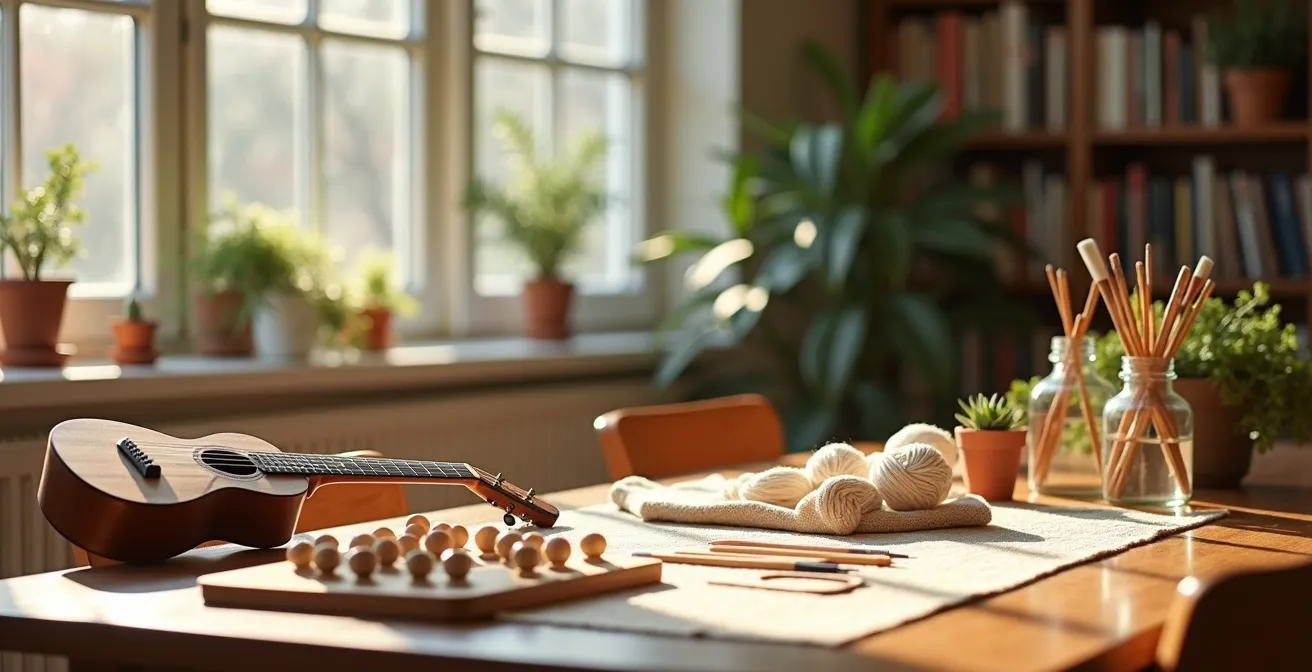
The key to stress reduction isn’t finding more time to relax—it’s choosing hobbies that actively engage your brain’s restorative systems, a concept known as “Deep Play.”
- Passive consumption, like watching TV, often fails to lower cortisol because it doesn’t provide the “restorative friction” your mind needs to disengage from work-related stress.
- Activities with a manageable learning curve and clear social components, like board games or local workshops, are neurologically superior for producing calming hormones like oxytocin.
Recommendation: Instead of defaulting to distraction, intentionally select a hobby based on its ability to offer cognitive unloading, creative recharging, or social connection to effectively counter burnout.
For many stressed professionals, the end of the workday brings a familiar paradox: you’re too exhausted to do anything, yet the passive “relaxation” you choose leaves you feeling just as drained. You collapse on the couch, convinced that binge-watching a series is the only way to recharge. We’re often told to simply “find a hobby,” but this advice rarely addresses why so many of our leisure activities fail to provide genuine psychological restoration. The problem isn’t a lack of options; it’s a fundamental misunderstanding of what our brains truly need to recover from chronic stress.
The common solutions—mindlessly scrolling through social media, watching TV, or even forcing a half-hearted workout—often act as mere distractions rather than true restorative practices. But what if the secret to effectively lowering your cortisol levels wasn’t about finding a “relaxing” activity, but an engaging one? The answer lies in moving beyond passive consumption and embracing the science of “Deep Play”—a state of immersive, intrinsically motivated activity that actively counters the neurological patterns of stress. This guide will deconstruct the common hobby traps and provide a psychological framework for choosing a pastime that genuinely recharges your batteries, builds resilience, and protects you from burnout.
This article explores the psychological and neurological differences between pastimes that drain you and those that restore you. We will navigate through the science of restorative leisure to help you make an informed choice that fits your life.
Summary: A Psychologist’s Guide to Choosing a Cortisol-Reducing Hobby
- Why Watching TV Is Not Recharging Your Batteries After Work?
- Violin or Ukulele: Which Instrument Offers the Best Learning Curve for Adults?
- Board Games vs Video Games: Which Builds Stronger Real-Life Bonds?
- The Side Hustle Trap: Why You Should Not Monetize Your Favorite Hobby?
- Optimizing Your Weekend: Blocking Time for “Deep Play”
- When to Take a Break: The Ultradian Rhythm Rule You Are Ignoring
- Digital Minimalism or Conscious Connectivity: Which Suits a Busy Career?
- Why Local Artistic Workshops Are the Best Way to Beat Adult Loneliness?
Why Watching TV Is Not Recharging Your Batteries After Work?
After a long day of high-stakes decisions and constant mental effort, collapsing in front of the television feels like a deserved reward. It’s passive, requires zero effort, and offers an escape. However, from a neurological perspective, this common habit is more of a temporary anesthetic than a true restorative process. The core issue is its lack of restorative friction—a gentle, engaging challenge that shifts your brain out of its stressed, ruminative state. Watching TV keeps your brain in a mode of passive consumption, which is not effective at discharging the accumulated cortisol from your workday.
True psychological recovery requires a shift from passive observation to active engagement. Your brain needs an activity that is compelling enough to interrupt the cycle of work-related thoughts but not so demanding that it becomes another source of stress. Hobbies that involve using your hands, solving a low-stakes problem, or learning a simple new skill provide this perfect balance. They activate different neural pathways, promoting neurogenesis (the creation of new neurons) and giving the overtaxed executive functions of your prefrontal cortex a much-needed break.
Think of it as the difference between standing under a running faucet and actually taking a swim. While the first might feel momentarily soothing, the second involves your whole body and mind, leaving you feeling genuinely refreshed. Passive media consumption is the faucet; an engaging hobby is the swim. This is why you can watch TV for three hours and still feel mentally fatigued, whereas an hour spent gardening or sketching can leave you feeling energized and clear-headed. The goal is not to numb your mind, but to gently redirect its focus toward something intrinsically rewarding.
Violin or Ukulele: Which Instrument Offers the Best Learning Curve for Adults?
Choosing to learn a musical instrument as an adult is a fantastic way to engage in “Deep Play,” but the choice of instrument can be the difference between a rewarding journey and a frustrating dead-end. For stressed professionals, the ideal instrument offers a manageable learning curve and quick initial rewards. The violin and ukulele represent two very different paths. The violin, with its fretless neck and demanding bowing technique, requires immense patience. It can take months of dedicated practice before producing a consistently pleasant sound. This high barrier to entry can feel like another high-pressure job, potentially increasing stress rather than alleviating it.
The ukulele, in contrast, is neurologically friendlier for a beginner. With just a few simple chords, which are ergonomically easier to form than violin fingerings, you can play a recognizable song within days or even hours. This rapid feedback loop provides a powerful dopamine hit, reinforcing the new habit and building a sense of accomplishment. This is crucial for adults whose time is limited and whose motivation can be fragile. The low-stakes, high-reward nature of the ukulele makes it an excellent tool for cognitive unloading, allowing you to quickly enter a state of flow without the pressure of perfection.

The physical experience also differs significantly. The posture required for violin playing is complex and can be uncomfortable at first. The ukulele is light, portable, and can be played in a relaxed position, making it a more accessible choice for unwinding after a day hunched over a desk. Ultimately, the choice depends on your personal goals and stress levels. If you crave deep, long-term mastery and have the resilience to push through initial frustration, the violin can be immensely rewarding. But for most professionals seeking immediate stress relief, the ukulele offers a gentler, more direct path to the restorative benefits of making music.
Your Action Plan: Self-Assessment for Choosing an Instrument
- Evaluate current stress levels: High stress may benefit from the ukulele’s quicker rewards and lower cognitive load.
- Consider available practice time: A daily 10-15 minute session is effective for the ukulele, while the violin often requires 30 minutes or more to see progress.
- Assess your patience threshold: Be honest about whether you can tolerate months of practice (violin) versus days (ukulele) to produce pleasant sounds.
- Think about your physical comfort: The ukulele’s ergonomics are generally simpler and less demanding than the precise posture needed for the violin.
- Match to your musical goals: If your dream is to play folk or pop songs for fun, the ukulele is a perfect fit; for classical ambitions, the violin is the classic choice.
Board Games vs Video Games: Which Builds Stronger Real-Life Bonds?
In the quest for connection, both board games and video games offer social outlets, but they engage our social-bonding hormones in fundamentally different ways. The key difference lies in the power of physical presence. Board games, by their very nature, require players to be in the same room, facilitating direct eye contact, shared laughter, and non-verbal communication. This physical co-presence is a powerful catalyst for the release of oxytocin, often called the “love hormone,” which is crucial for building trust and social bonds.
In fact, the tangible nature of board games is directly linked to this hormonal response. A Baylor University study found that oxytocin levels rose from 3.86 to 4.88 nanograms per milliliter when couples played board games together. This is because the shared physical space and tactile experience of moving pieces create natural opportunities for connection that are often absent in a digital environment. While cooperative video games can certainly foster teamwork and camaraderie, the interaction is mediated through screens and headsets, which can filter out the subtle social cues that deepen real-life relationships.
The following table breaks down how each activity impacts the key components of social bonding.
| Aspect | Board Games | Video Games |
|---|---|---|
| Oxytocin Release | High (physical presence required) | Moderate (depends on cooperation) |
| Eye Contact | Frequent | Rare |
| Physical Touch | Natural opportunities | Limited/None |
| Social Friction | High (requires planning) | Low (instant connection) |
| Connection Quality | Deep but less frequent | Frequent but potentially shallow |
This isn’t to say video games are socially inferior; they offer low-friction, instant connectivity that can be invaluable for maintaining long-distance friendships. However, for stressed professionals looking to combat loneliness and build a strong local support network, the high-quality, oxytocin-rich interactions of a board game night are neurologically more potent. The shared vulnerability of learning a new game face-to-face and navigating its challenges together creates a more profound and lasting sense of connection.
The Side Hustle Trap: Why You Should Not Monetize Your Favorite Hobby?
In a culture that glorifies productivity and “hustle,” it can be tempting to turn a beloved hobby into a source of income. You’re great at baking? Start selling cakes. You love photography? Offer weekend photoshoots. While it seems like a win-win, this shift fundamentally alters the psychological function of the activity, a phenomenon I call the “Extrinsic Motivation Trap.” When a hobby is done purely for joy, it is intrinsically motivated. You do it because the process itself is the reward. This is the very essence of “Deep Play” and the key to its stress-reducing power.
The moment you introduce an external motivator—money, client deadlines, customer expectations, social media validation—the neurological landscape changes. The activity moves from the brain’s restorative, creative centers to its evaluative, performance-driven ones. It becomes a job. The pressure to perform, meet standards, and manage logistics introduces a new layer of cortisol-inducing stress that negates the hobby’s original purpose. Your sanctuary of play becomes another source of obligation.
As leisure psychologist Dr. Kate Hanley notes in her research on stress reduction, this is a predictable neurological shift.
When an activity shifts from intrinsically motivated to extrinsically motivated, it fundamentally changes the neurological response from restorative to stressful.
– Dr. Kate Hanley, Stress reduction and hobby monetization research
Protecting your hobby from monetization is an act of self-preservation. It’s about carving out one area of your life that is deliberately and unapologetically unproductive in a financial sense. This “useless” activity is, in fact, incredibly useful for your mental health. It serves as a buffer against burnout, a space for pure self-expression, and a reminder that your worth is not tied to your output. If you need extra income, it’s often psychologically healthier to find a side hustle that is separate and distinct from the activity you rely on for genuine restoration.
Optimizing Your Weekend: Blocking Time for “Deep Play”
For many professionals, weekends become a frantic scramble of errands, social obligations, and “catching up,” leaving little room for true rest. To combat this, the concept of “Deep Play” offers a structured approach to ensure you get the psychological restoration you need. Deep Play is not about aimless relaxation; it is an immersive, engaging activity that allows you to enter a state of flow. The key is to intentionally block time for it, just as you would for an important meeting. Instead of leaving your leisure to chance, you create a “play menu” with different categories of activities that serve distinct restorative functions.
Researchers in mental health often group these activities into categories. You might have:
- Cognitive Unloaders: Simple, repetitive, manual tasks that quiet the mind, such as kneading dough, gardening, or sanding a piece of wood.
- Creative Rechargers: Activities that allow for non-judgmental expression and problem-solving, like improvisational music, painting, or creative writing.
- Awe Inducers: Experiences that connect you to something larger than yourself, prompting a sense of wonder. This can be as simple as stargazing, hiking in a new place, or visiting a museum. Spending even a short time in nature can significantly improve mood and focus.

By creating a “menu” of these options, you can choose an activity based on what your nervous system needs at that moment. Feeling mentally cluttered? Choose a Cognitive Unloader. Feeling uninspired? Opt for a Creative Recharger. The goal is to build a diverse portfolio of restorative practices. Blocking out a two-hour “Deep Play” session on a Saturday morning, dedicated to one of these activities without distraction, can be more effective at reducing cortisol than an entire day of unstructured, passive rest. It’s a deliberate investment in your mental capital.
When to Take a Break: The Ultradian Rhythm Rule You Are Ignoring
The feeling of being “in the zone” while working on a project or engaging in a hobby can be exhilarating. However, pushing through for hours on end without a break is counterproductive and a primary driver of cortisol buildup. Many people are familiar with circadian rhythms (our 24-hour sleep-wake cycle), but few pay attention to their ultradian rhythms. These are shorter, 90- to 120-minute cycles of rising and falling energy that occur throughout the day. At the peak of the cycle, your focus is sharp. At the trough, your brain’s performance naturally declines.
Ignoring this natural cycle and forcing yourself to continue is a direct recipe for stress. Your body interprets this override as a threat, releasing cortisol to push you through. Over time, this chronic override leads to burnout. The solution is to work *with* these rhythms, not against them. This means engaging in focused activity—whether for work or a hobby—for about 90 minutes, followed by a short, 15-20 minute break. This isn’t laziness; it’s a strategic way to manage your energy and hormone levels. In fact, research on ultradian rhythms demonstrates that taking a break every 90 minutes can reduce cortisol levels by up to 20%.
The key is learning to recognize your body’s signals that you’re entering an ultradian trough. Pushing past these signals is what causes the stress response. Watch for these subtle cues:
- A sudden increase in mistakes or typos.
- An overwhelming urge to daydream or check your phone.
- A sudden craving for a snack, coffee, or other stimulants.
- A feeling of physical restlessness or fidgeting.
- Finding yourself re-reading the same sentence or line of code multiple times.
When you notice these signs, don’t fight them. Step away from the activity. Stretch, walk around, get some water, or simply stare out a window. This brief period of disengagement allows your brain to consolidate information and replenish its energy stores, setting you up for another productive 90-minute cycle. This applies equally to your hobbies; even a fun activity becomes stressful if you ignore your body’s natural need for rest.
Digital Minimalism or Conscious Connectivity: Which Suits a Busy Career?
In a hyper-connected world, the role of technology in our leisure time is a double-edged sword. For some, the constant notifications and blue light are a primary source of stress. For others, digital tools are a gateway to community and learning. The right approach depends on your personality and how easily you feel overwhelmed. Two primary strategies emerge: Digital Minimalism and Conscious Connectivity.
Digital Minimalism is the practice of radically reducing your digital engagement to focus on offline, tactile activities. This approach is best for individuals who feel perpetually overstimulated and find that any screen time, even for leisure, contributes to their cognitive load. It involves creating a sanctuary away from the digital world through hobbies like pottery, gardening, painting, or woodworking. The complete disconnect from screens provides the most significant potential for cortisol reduction by eliminating a major environmental stressor.
The following table outlines which approach might be best for different personality types and their impact on cortisol.
| Approach | Best For | Hobby Examples | Cortisol Impact |
|---|---|---|---|
| Digital Minimalism | Easily overwhelmed individuals | Pottery, gardening, painting | Maximum reduction through complete disconnect |
| Conscious Connectivity | Creative extroverts | Online guitar lessons, virtual book clubs | Moderate reduction with boundaries |
Conscious Connectivity, on the other hand, acknowledges that technology can be a valuable tool for hobbies, especially for creative extroverts or those seeking community. The key is to use it with intention and firm boundaries. This could mean using an app to learn guitar, participating in a virtual book club, or following an online drawing tutorial. The risk of this approach is the potential for distraction and the blurring of lines between intentional use and mindless scrolling. A powerful technique to mitigate this is the “Digital Sunset.”
Case Study: The Digital Sunset Ritual
The “Digital Sunset” involves setting a hard stop for all screen use (phone, tablet, computer, TV) at a specific time each evening, typically 1-2 hours before bed. Studies have shown that the blue light from screens interferes with melatonin production, the hormone that regulates sleep. By implementing an 8 PM digital sunset, participants in various sleep studies have reported not only better sleep quality but also measurably lower evening cortisol levels within just a few weeks, creating a calmer transition into a restorative night’s sleep.
Key Takeaways
- True rest comes from “Deep Play”—engaging, intrinsically motivated hobbies—not passive consumption like watching TV.
- Monetizing a hobby (the “Side Hustle Trap”) turns play into work, replacing restorative intrinsic motivation with stressful extrinsic pressure.
- Working with your body’s natural 90-minute ultradian rhythms, by taking strategic breaks, is crucial for preventing cortisol buildup during both work and leisure.
Why Local Artistic Workshops Are the Best Way to Beat Adult Loneliness?
As careers become more demanding and social lives increasingly digital, many adults experience a profound sense of loneliness. While virtual communities offer a form of connection, they often lack the hormonal and psychological impact of in-person interaction. Local artistic workshops—whether in pottery, painting, or printmaking—offer a powerful, multi-layered solution to this modern ailment. They combine the stress-reducing benefits of a manual, creative task with the deep-seated human need for tangible social connection.
The magic of a workshop lies in its ability to facilitate effortless social bonding. Unlike a networking event where conversation can feel forced, a workshop provides a shared, low-stakes goal. Participants work alongside each other, creating natural opportunities for small talk, shared struggles (“Is my pot supposed to look this lopsided?”), and mutual encouragement. This type of supportive, in-person environment is a potent trigger for cortisol reduction. In fact, multiple studies have shown that supportive social interactions can lower cortisol levels by up to 30%, and the structured yet relaxed setting of a workshop is an ideal incubator for such connections.
This isn’t just a feeling; it’s a biological phenomenon. The physical interactions, shared materials, and collaborative problem-solving inherent in a workshop create a rich social tapestry. As Dr. Karen Melton, a researcher on family bonding, explains, these small moments have a significant impact.
The physical interactions in workshops take place without prompting and create small, meaningful ways to interact that have implications for everyday family bonding.
– Karen Melton, Ph.D., Journal of Marriage and Family study on social bonding
For a stressed professional, joining a weekly pottery class isn’t just about learning a new skill. It’s a scheduled commitment to both creativity and community. It provides a third space—separate from home and work—that is dedicated to play, growth, and genuine human connection, making it one of the most effective antidotes to the burnout and isolation of modern adult life.
Ultimately, the most effective way to lower your cortisol is to shift your mindset from “relaxing” to “restoring.” This requires an intentional choice to engage in activities that provide cognitive, creative, or social nourishment. Start by auditing your current hobbies: do they leave you feeling energized or just numb? By applying the principles of Deep Play and choosing activities that offer a gentle challenge and intrinsic reward, you can transform your leisure time from another obligation into your most powerful tool against stress.