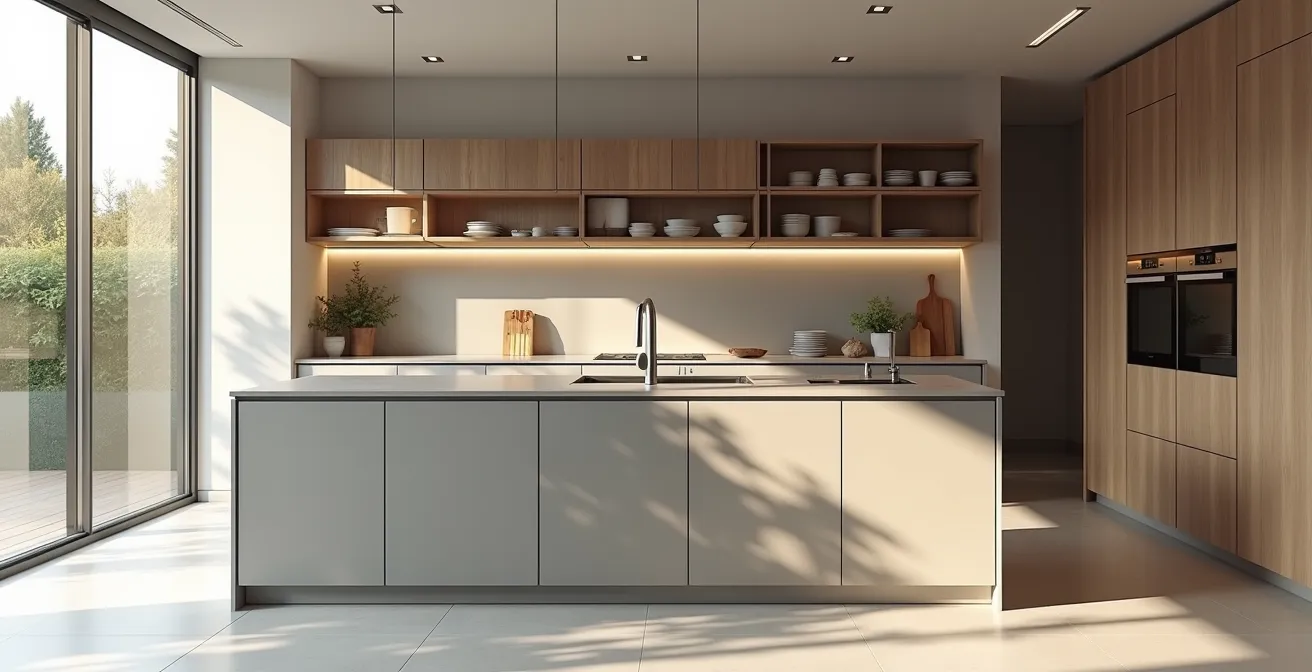
A truly efficient kitchen isn’t defined by its smart gadgets, but by an intelligent layout that prioritizes your actual workflow and reduces energy waste.
- The classic “work triangle” is often less effective than creating dedicated “work zones” for prep, cooking, and cleaning.
- Focusing on infrastructure like outlet placement and window insulation provides a greater return on investment than most high-cost smart appliances.
Recommendation: Before buying any new appliance, map your most common cooking movements to identify ergonomic bottlenecks. Solving these will save you more time than any gadget.
The dream of the “smart kitchen” is often sold as a collection of talking refrigerators and app-controlled ovens. We’re told that technology is the ultimate shortcut to culinary efficiency. Many homeowners invest thousands in high-tech appliances, believing they are buying back precious time. Yet, the frustration of a cramped, illogical workspace persists. The daily dance of dodging open cabinet doors, searching for a free outlet, and walking miles between the pantry and the prep counter doesn’t disappear with the purchase of a Wi-Fi-enabled toaster.
This common experience points to a fundamental misunderstanding. The classic advice focuses on the “work triangle”—the three points of the sink, stove, and refrigerator—but often treats it as a rigid, static rule. It also pushes a gadget-first mentality, where the solution to any inefficiency is assumed to be another device. But what if the secret to a kitchen that genuinely saves you time and energy isn’t about the widgets, but the workflow? What if the smartest design choices are the ones you can’t see?
This guide takes a different approach. We will deconstruct the hype and focus on the ergonomic principles that create a truly functional, high-tech culinary workspace. We’ll explore why a layout that anticipates your movements, optimizes energy consumption, and plans for the future is a far better investment than the latest flashy appliance. It’s time to shift the focus from a “smart” kitchen to an intelligent one.
This article will guide you through the critical decisions that shape an intelligent kitchen. We will analyze everything from the real value of smart appliances and their security risks to the foundational choices in layout, energy efficiency, and future-proofing that deliver tangible benefits every day.
Summary: A Guide to Designing an Intelligent Kitchen Workspace
- Why Smart Fridges Are Often a Waste of Money for Average Families?
- The Security Risks of IoT Kitchen Devices You Haven’t Considered
- Optimizing Your Kitchen Layout to Reduce Energy Bills by 15%
- Island vs Peninsula: Which Layout Works for a 150 Sq Ft Kitchen?
- Planning Electrical Outlets for Appliances That Don’t Exist Yet
- Knife Skills vs Gadgets: What Actually Speeds Up Prep Time?
- Double Glazing vs Triple Glazing: Is the Extra Cost Worth It in Mild Climates?
- Why Switching to Home Cooking Saves You $200/Month?
Why Smart Fridges Are Often a Waste of Money for Average Families?
The smart refrigerator is often presented as the crown jewel of the modern kitchen. With features like integrated touch screens, internal cameras, and AI-driven recipe suggestions, it promises a revolution in how we manage our food. It’s no surprise that smart refrigerators captured over 35.0% of revenue share in the market in 2024, making them a dominant force. However, for the average family, this significant investment rarely translates into a proportional increase in daily convenience or efficiency. The core function of a refrigerator is to keep food cold, and premium, non-smart models often offer better energy efficiency and storage design for a fraction of the price.
The primary issue lies in the gap between advertised features and real-world usage. A large screen for recipes and calendars can be easily replaced by a tablet, which is portable and not tied to a single, expensive appliance. Internal cameras that show what you have are often obstructed once the fridge is full, and the novelty wears off quickly. As seen with the launch of high-end models like the Samsung Family Hub 8.0, the high initial investment and complex setup present significant barriers. While its 32-inch screen and advanced AI are technologically impressive, these features don’t solve fundamental problems for most users, such as finding space for weekly groceries or reducing food waste through better organization.
Ultimately, the “smart” features of a refrigerator are software-based and have a much shorter lifespan than the appliance’s mechanical components. In five years, the cutting-edge screen will be slow and outdated, while a high-quality compressor could run for fifteen. For most families, a better use of that budget is investing in a highly energy-efficient standard refrigerator and using the savings to improve the kitchen’s ergonomic layout or purchase smaller, more impactful tools. A smart fridge is a luxury, not a prerequisite for an intelligent kitchen.
The Security Risks of IoT Kitchen Devices You Haven’t Considered
As we connect more of our kitchen appliances to the internet—from coffee makers to ovens—we create a network of convenience. However, each new device also represents a potential new entry point for security threats. This isn’t theoretical; a 2025 analysis recorded over 820,000 daily IoT attacks, and many of these target devices with weak, default security settings. A compromised smart oven or microwave could be co-opted into a botnet, used to attack other devices on your home network, or even expose your personal data and Wi-Fi credentials to bad actors. The risk extends beyond data theft to potential physical hazards if a device’s core functions are manipulated remotely.
The problem is that many manufacturers prioritize features and speed-to-market over robust security protocols. This leaves the user responsible for securing their own devices, a task most people are not prepared for. An intelligent kitchen design must therefore incorporate a strategy for digital hygiene. This means treating the security of your network with the same seriousness as the physical safety of your kitchen. It involves creating a secure-by-design environment that protects your entire home from the vulnerabilities introduced by a single, poorly secured gadget.

This abstract visualization highlights the concept of layered security. The central hub represents your router, with concentric rings acting as firewalls or isolated networks. Each connected device is a potential weak point, but by containing them within protected zones, you can prevent a breach in one from compromising the entire system. This requires a proactive approach to network management.
Action Plan: Securing Your Smart Kitchen
- Change default passwords: Immediately update the factory-set passwords on all new devices, as these are publicly known and a primary attack vector.
- Update firmware regularly: Check manufacturer websites for security patches, as over 60% of IoT breaches exploit unpatched firmware. Do not assume updates are automatic.
- Implement network segmentation: Create a separate Wi-Fi network exclusively for your IoT devices to isolate them from sensitive computers and phones.
- Review device permissions: Scrutinize what data each device’s app is collecting and disable any unnecessary permissions.
- Use a comprehensive security solution: Employ a network-level security service, like NETGEAR Armor or a similar product, to monitor all connected devices for threats.
Optimizing Your Kitchen Layout to Reduce Energy Bills by 15%
An intelligent kitchen layout does more than just save you steps; it can significantly reduce your energy consumption. While the market for energy-efficient smart appliances is growing at a predicted 8.5% CAGR, the placement of these appliances is just as crucial as their star rating. The concept of an “Energy Triangle” is a modern evolution of the work triangle, focusing on the interplay between your refrigerator, your oven, and your home’s major sources of heat gain or loss, primarily windows. Placing a heat-generating appliance like a dishwasher or oven right next to a refrigerator forces the fridge’s compressor to work harder to maintain its internal temperature, wasting electricity.
Similarly, placing a refrigerator in direct sunlight from a poorly insulated window has the same effect, increasing its energy consumption by a measurable amount. The goal is to create thermal zones within your kitchen. Keep “cold” appliances away from “hot” appliances and heat sources. This simple ergonomic principle can reduce the energy consumption of your major appliances by up to 15% without any change in your usage habits. It’s a one-time design decision that pays dividends for the life of the kitchen.
This optimization extends to ventilation. Proper placement of a range hood not only improves air quality but also reduces the load on your home’s HVAC system by efficiently removing heat and steam at the source. When planning your layout, think about the energy workflow as much as the cooking workflow. Grouping appliances by thermal output and considering their proximity to windows and vents is a foundational step in creating a kitchen that is both environmentally and financially sustainable.
Island vs Peninsula: Which Layout Works for a 150 Sq Ft Kitchen?
In a compact kitchen of around 150 square feet, the choice between an island and a peninsula is one of the most consequential layout decisions. It fundamentally dictates traffic flow, workspace availability, and the overall feeling of the room. A peninsula, which is connected to a wall on one end, naturally directs traffic and is often better for single-cook kitchens. It provides continuous counter and cabinet space, maximizing storage. However, it can also create a bottleneck and visually close off the kitchen from adjacent living areas.
An island, on the other hand, creates multiple traffic paths and is excellent for households with multiple cooks. It can become a social hub and a highly flexible work zone. As noted in kitchen design analyses, an island can house a sink or cooktop, effectively becoming one point of the work triangle and creating a highly efficient station. The primary challenge is space. An island requires adequate clearance on all sides—a minimum of 36 to 42 inches is recommended for comfortable workflow. For a 150 sq ft kitchen, this means the island itself may need to be quite small to maintain these clearances, potentially limiting its utility.
To make the right choice, you must prioritize function over form. It’s not about which option looks better in a magazine, but which one best supports your personal workflow. The following table provides a decision-making framework based on practical considerations.
| Consideration | Kitchen Island | Kitchen Peninsula |
|---|---|---|
| Traffic Flow | Allows for flow on all sides; better for multi-cook scenarios. | Directs traffic along one path; can create a bottleneck. |
| Workspace | Creates a central, accessible prep zone from multiple angles. | Offers a long, continuous stretch of counter space. |
| Spatial Feel | Promotes an open, airy feel connecting to other rooms. | Can partially enclose the kitchen, creating a more defined space. |
| Storage | Offers cabinet space below but breaks up continuous cabinetry. | Maximizes continuous lower and potentially upper cabinet runs. |
| Utilities | Requires running electrical/plumbing through the floor, which is more complex and costly. | Utilizes existing wall access for utilities, simplifying installation. |
Planning Electrical Outlets for Appliances That Don’t Exist Yet
One of the biggest mistakes in kitchen design is underestimating future electrical needs. With the smart kitchen appliance market projected to reach a value of $66.45 billion by 2034, the number of devices requiring power will only increase. Planning outlets only for your current appliances is a recipe for a future cluttered with power strips and extension cords. A truly intelligent kitchen is future-proofed, with a flexible and robust electrical infrastructure designed to accommodate technologies that haven’t even been invented yet.
The strategy is to think in terms of “power zones” rather than individual outlets. Instead of placing a single outlet behind the coffee maker, install a strip of outlets along the backsplash in your primary prep area. Consider integrating outlets directly into a kitchen island or even using pop-up outlets that retract into the countertop when not in use. It’s also critical to think beyond standard plugs. Including dedicated USB-C charging ports in your backsplash is essential for charging phones and tablets, which are now common kitchen tools for recipes and entertainment.
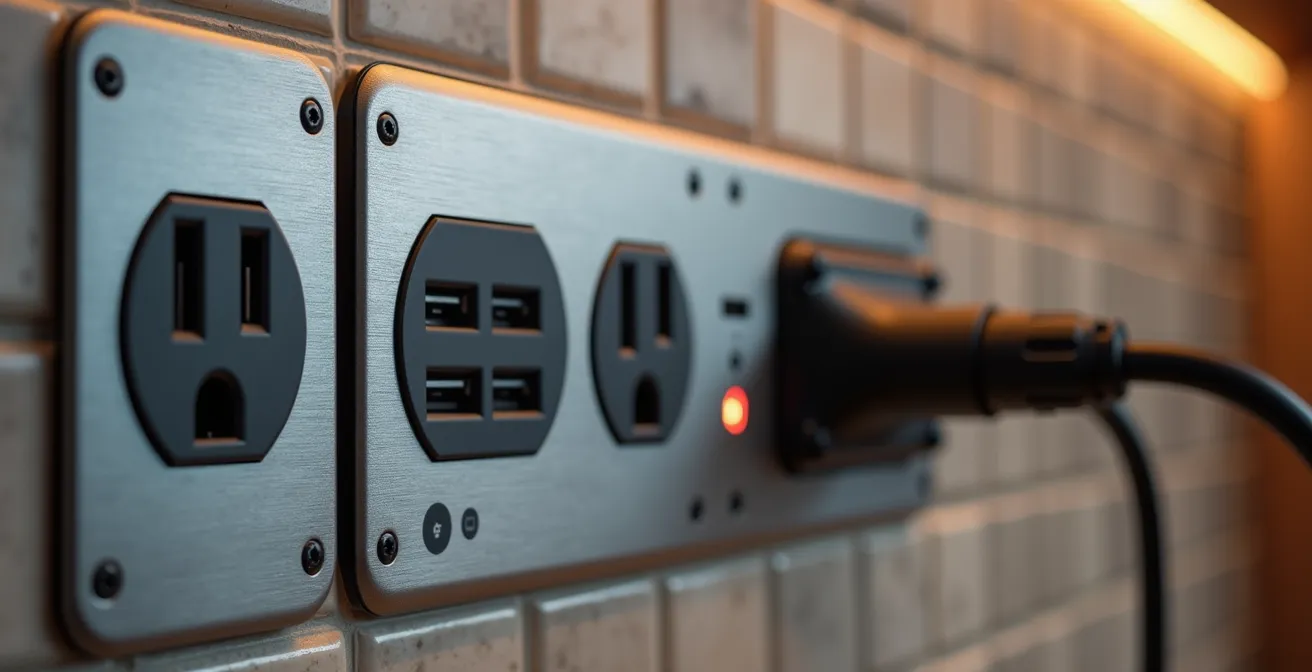
Furthermore, plan for dedicated circuits for high-draw appliances. A separate 20-amp circuit for countertop appliances like air fryers or high-speed blenders can prevent tripped breakers. When renovating, it’s far more cost-effective to run extra wiring for potential future needs—like an under-cabinet smart display or a second dishwasher—than it is to open up walls later. This kind of infrastructure-first planning ensures your kitchen remains functional and clutter-free as technology evolves.
Knife Skills vs Gadgets: What Actually Speeds Up Prep Time?
The market is saturated with gadgets promising to chop, slice, and dice faster than you ever could by hand. From automatic onion choppers to spiralizers, the allure of a technological shortcut for tedious prep work is strong. However, in many cases, the time spent setting up, using, and cleaning a specialized gadget negates any time saved during the actual task. For many experienced home cooks, a sharp, high-quality chef’s knife and a solid foundation of knife skills remain the fastest and most versatile tools in the kitchen.
A knife doesn’t require electricity, has no complex parts to clean, and can be used for nearly any cutting task. Mastering a few basic cuts—the dice, the julienne, the mince—provides a level of speed and control that few single-purpose gadgets can match. The key is not to view it as an “either/or” choice between skills and gadgets, but to understand which tool is right for the job. A food processor is undeniably faster for pureeing a soup or making pesto, but for dicing a single onion for a sauce, a knife is almost always more efficient.
Ultimately, the greatest time-saver is not the tool itself, but the environment in which it is used. This is where ergonomic design becomes paramount. As kitchen design experts have noted, the layout is the true efficiency multiplier.
The true time-saver isn’t the tool but the layout. A prep station where knife work and gadget work are seamlessly integrated saves more time than any single tool.
– HGTV Kitchen Design Experts, HGTV Kitchen Design Trends Report
Creating a dedicated “prep zone” with your cutting board, knives, compost bowl, and most-used gadgets all within arm’s reach is the secret. When your workflow is optimized, both your knife skills and your gadgets become more effective. The focus should be on minimizing movement and decision-making during the task, which is achieved through smart layout, not just smart tools.
Double Glazing vs Triple Glazing: Is the Extra Cost Worth It in Mild Climates?
Windows are a critical, yet often overlooked, component of an intelligent kitchen design. They affect not only natural light but also thermal efficiency and noise levels. The choice between double and triple glazing depends heavily on your climate, but its impact goes beyond simple heating bills. In a kitchen, a poorly insulated window can become a “thermal leak” that directly impacts appliance performance. Smart kitchen design studies reveal that refrigerators placed near inefficient windows can be forced to work 15-20% harder in summer months just to maintain their internal temperature.
In mild climates, where the temperature difference between inside and outside is less extreme, the additional upfront cost of triple glazing for its thermal benefits alone may be hard to justify. However, there are other factors to consider. Triple glazing offers superior acoustic insulation, reducing outside noise by up to 40 decibels compared to single glazing. For kitchens facing a busy street, this can dramatically improve the comfort and tranquility of the space.
Furthermore, high-performance glazing has a direct impact on the usability of smart appliances. The added layer in triple glazing often includes coatings that reduce glare. This is crucial for the visibility of touch screens on smart ovens, microwaves, and refrigerators. A screen that is unreadable due to sun glare is functionally useless, leading to cooking errors from misread temperatures or settings. Therefore, even in a mild climate, the decision to invest in triple glazing should be based on a holistic assessment of thermal load on appliances, acoustic comfort, and the usability of your kitchen’s technology.
Key Takeaways
- An intelligent kitchen prioritizes workflow and ergonomics over the sheer number of smart devices.
- Proper layout, including thermal zoning and future-proofed electrical planning, offers a greater long-term return than high-cost gadgets.
- Securing your IoT devices with practices like network segmentation and strong passwords is a non-negotiable part of modern kitchen design.
Why Switching to Home Cooking Saves You $200/Month?
The promise of significant monthly savings is a powerful motivator for cooking at home, but it’s an ambition that often fails due to a single, critical bottleneck: time. An inefficient kitchen can make preparing a meal feel like a chore, pushing busy professionals towards expensive takeout and delivery options. This is where an intelligent kitchen design delivers its most profound return on investment. By optimizing workflow and integrating time-saving technology effectively, you make home cooking a realistic and sustainable habit, unlocking those savings.
The market’s 16.3% compound annual growth rate for smart kitchen appliances is driven in part by this desire for efficiency. Thoughtful appliance integration can dramatically cut down on active cooking and prep time. For example, case studies on smart automation show that a well-designed workflow can reduce a 4-hour weekend batch cooking session to just 90 minutes. This time savings is what makes the goal of avoiding takeout, and thus saving upwards of $200 per month, achievable for people with demanding schedules.

An intelligent kitchen enables this lifestyle shift. It’s not about one magical appliance, but a holistic system. A well-placed prep zone reduces chopping time. An efficient dishwasher makes cleanup faster. A convection steam oven cooks food more quickly and with better results. Each element works together to lower the barrier to entry for cooking a meal from scratch. The ultimate benefit of a smart kitchen isn’t the technology itself, but the freedom and financial benefit it provides by making home cooking a joy rather than a burden.
To apply these principles, begin by mapping your own kitchen’s most common workflows. Identify the bottlenecks and sources of frustration in your daily routine. Designing a truly intelligent kitchen starts with understanding your own movements, not with a shopping list of gadgets.