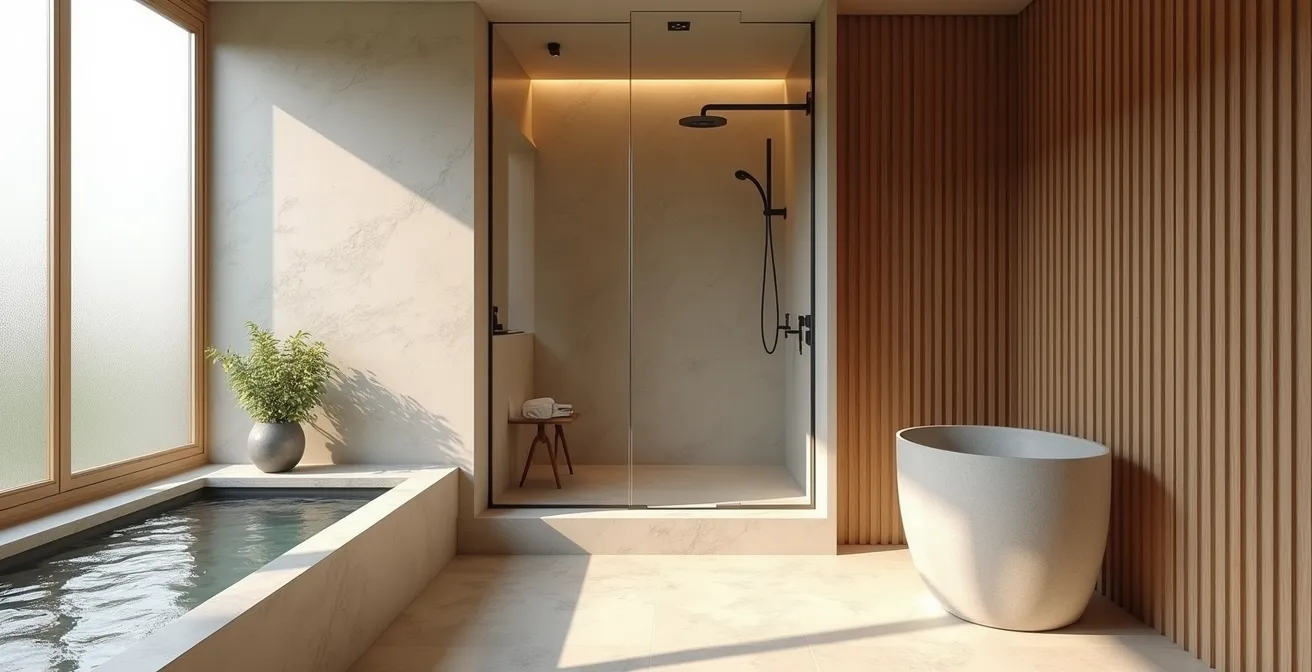
Transforming a tiny bathroom into a spa is an act of sensory engineering, not just decoration.
- Strategic choices in lighting, water systems, and materials have a greater impact on relaxation than superficial aesthetic touches.
- Optimizing hidden infrastructure like plumbing and ventilation unlocks the budget for high-end fixtures and prevents common issues like mold.
Recommendation: Prioritize system-level decisions that manipulate the perception of space and a feeling of wellness before selecting any surface-level finishes.
The challenge of a 50-square-foot bathroom feels universal to apartment dwellers: a space so compact it seems purely functional, a world away from the serene escape of a spa. The common advice—use light colors, add a large mirror, find clever storage—scratches the surface but misses the soul of a true retreat. These are cosmetic fixes for a volumetric problem. A real transformation isn’t about making the space look bigger; it’s about making it *feel* boundless, a sanctuary for mental relaxation.
The secret lies not in what you add, but in what you engineer. We must move beyond decoration and into the realm of sensory design. What if the temperature of your light could cue your brain for sleep? What if the plumbing layout could pay for your dream showerhead? The key is to treat the bathroom not as a room to be filled, but as a holistic system where light, water, air, and texture work in concert to create a ritual pathway from the stress of the day to a state of deep rest.
This guide will deconstruct the process of creating a spa retreat within a limited footprint. We will explore the system-level decisions that deliver true luxury and tranquility, proving that the most impactful elements of a spa are often the ones you can’t see, but can profoundly feel. It’s time to stop decorating and start engineering your personal sanctuary.
To guide you through this transformation, we will break down the essential components, from the science of light and water to the practicalities of plumbing and materials. The following sections provide a clear roadmap for making strategic, high-impact choices.
Summary: Engineering a Spa Retreat in a Tiny Footprint
- Why Lighting Temperature in Your Bathroom Affects Your Sleep Quality ?
- The Water Pressure Problem That Ruins Most Rainfall Shower Installations
- Freestanding Tub vs Walk-In Steam Shower: Which Adds More Resale Value ?
- The Grout Mistake That Leads to Black Mold in Spa Bathrooms
- Optimizing Your Plumbing Layout to Afford High-End Fixtures
- Optimizing Your Bedroom for Sensory Deprivation and Deep Rest
- The Mold Risk That Comes With Sealing Your House Too Tightly
- How to Layer Lighting to Make Small Rooms Feel Bigger ?
Why Lighting Temperature in Your Bathroom Affects Your Sleep Quality ?
The first step in our sensory engineering project is to control light. We often think of bathroom lighting in purely functional terms—is it bright enough for grooming? But the color temperature of your light is a powerful biological signal. Cool, blue-toned light mimics daylight and boosts alertness, while warm, yellow-toned light signals to your brain that it’s time to wind down. Using the wrong light in the evening can actively disrupt your body’s natural sleep-wake cycle.
The science is clear: exposure to harsh, cool light at night inhibits the production of melatonin, the hormone that governs sleep. In fact, research shows that 6500K light suppresses nocturnal melatonin far more significantly than warmer 3000K light. Your bright vanity light, perfect for the morning, becomes a saboteur to your sleep when used before bed. A true spa bathroom uses light to create a “ritual pathway” toward rest, not jolt the senses.
To achieve this, you must implement a layered, controllable lighting scheme that changes with the time of day. This isn’t about a single dimmer switch; it’s about a staged routine that guides your body into a state of relaxation. Think of it as creating an artificial sunset inside your home, a critical transition for anyone living in a dense urban environment.
- Stage 1 (7-8 PM): Use bright, clean 4000K vanity lights for tasks like skincare and preparing for the next day. This is your functional lighting.
- Stage 2 (8-9 PM): Switch to a warmer 3000K overhead light, dimmed to around 50% intensity. This marks the beginning of the wind-down period.
- Stage 3 (9 PM onward): Activate only the warmest, most ambient light. This should be 2700K or lower, using accent lighting like under-vanity strips or small, targeted fixtures to create a twilight-like glow, preparing the body for deep sleep.
The Water Pressure Problem That Ruins Most Rainfall Shower Installations
After light, the next critical sensory input is water. A rainfall showerhead is a hallmark of the spa experience, promising a gentle, drenching cascade. However, the reality in many apartments is a disappointing, weak drizzle. This is often due to a fundamental misunderstanding of the relationship between flow rate, pipe pressure, and fixture design. Simply swapping a standard showerhead for a large rainfall model without addressing the underlying system is a recipe for failure.
The primary constraint is the federally mandated 2.5 GPM (gallons per minute) maximum flow rate for showerheads, a standard in place since 1994 to conserve water. While modern rainfall heads are designed to work within this limit, they require adequate water pressure to distribute those 2.5 gallons evenly across a large surface. In older buildings or high-rise apartments with lower pressure, the water lacks the force to provide that immersive experience.
This macro shot reveals the distinct patterns of water droplets, a visual testament to the power of a well-engineered shower system. The clarity and form of each stream are critical to the sensory experience.

Fortunately, technology offers solutions. The choice is not just about the showerhead itself, but the technology within it. Understanding these options is key to achieving that authentic rainfall feel even in a challenging plumbing environment. This is a system-level decision that defines the quality of your daily ritual.
| Feature | Air-Injection Technology | High-Flow Valves |
|---|---|---|
| Water Usage | 1.8-2.0 GPM | 2.5 GPM |
| Pressure Feel | Enhanced through air mixing | Authentic rainfall |
| Best For | Low-flow homes, eco-conscious | High water pressure homes |
| Cost | $150-400 | $200-600 |
Freestanding Tub vs Walk-In Steam Shower: Which Adds More Resale Value ?
The centerpiece of any bathroom, the tub or shower, is the largest consumer of your 50 sq ft footprint. This decision is a delicate balance between personal desire, spatial reality, and long-term investment. While a freestanding tub evokes classic luxury, it can devour precious floor space and make a small room feel cramped. A walk-in shower, especially one equipped with steam functionality, offers a different kind of daily indulgence and can be a smarter choice for both perceived space and resale value.
The market is shifting. While families with young children still often require at least one bathtub in the home, the master bathroom is increasingly seen as an adult sanctuary. Data shows that for this space, practicality and a high-end shower experience are highly valued. In fact, a National Association of Home Builders survey reveals that 56% of homebuyers prefer a stall shower without a tub in the master bathroom. A luxurious, well-designed walk-in shower can be a stronger selling point than a tub that will be seldom used.
For those who cannot part with the idea of a soak, the solution lies in smarter design, not compromise. Traditional freestanding tubs are spatially inefficient. A more strategic approach is to look at alternative models that offer a full-body immersion in a smaller footprint.
Case Study: The Japanese Ofuro Tub’s Space Efficiency
A recent renovation of a 50 sq ft bathroom illustrates this principle perfectly. The original plan included a standard 60-inch freestanding tub, which would have consumed 15 sq ft of precious floor area. Instead, the designer opted for a Japanese-style Ofuro soaking tub. Though much shorter, its deeper design required only 9 sq ft. This single decision freed up 6 additional square feet for easier movement and a larger vanity, dramatically increasing the perceived spaciousness of the room while still delivering a profoundly luxurious and immersive bathing experience.
The Grout Mistake That Leads to Black Mold in Spa Bathrooms
Nothing shatters the illusion of a clean, serene spa faster than the sight of black mold creeping into grout lines. In a small, high-humidity environment like a 50 sq ft bathroom with a steam shower, grout is a primary vulnerability. Its porous nature makes it a perfect breeding ground for mold and mildew, turning a sanctuary into a constant maintenance battle and a potential health hazard.
The traditional solution of small mosaic tiles, while often associated with spas, creates a vast network of grout lines that are nearly impossible to keep pristine. The design mistake is choosing aesthetics without considering the material’s performance in a high-moisture context. The key to a low-maintenance, perpetually clean spa bathroom is to minimize or eliminate grout altogether. This is a system-level decision that prioritizes hygiene and sensory purity over traditional tiling patterns.
Modern materials offer a range of seamless, waterproof solutions that provide the clean, monolithic look of a high-end spa without the maintenance nightmare of grout. These options create continuous surfaces that are easy to clean and inherently resistant to mold growth, preserving the integrity of your sanctuary.
- Large-Format Slabs: Using large porcelain or stone slabs (e.g., 3×6 feet or larger) for walls and floors dramatically reduces the number of seams.
- Waterproof Microcement: This trowel-applied finish creates a completely seamless, concrete-like surface that is both durable and waterproof.
- Tadelakt Plaster: A traditional Moroccan lime plaster, Tadelakt is naturally water-repellent and provides an authentic, organic spa aesthetic with zero grout lines.
- Solid Surface Materials: Products like Corian allow for the creation of integrated wall panels and even sinks, forming a single, unbroken surface that is non-porous and exceptionally hygienic.
Optimizing Your Plumbing Layout to Afford High-End Fixtures
The dream of a spa bathroom is often dashed by the price tags on high-end fixtures. A thermostatic shower system, a wall-mounted toilet, or designer faucets can consume a significant portion of the budget. However, the secret to affording these luxuries lies not in finding cheaper alternatives, but in making strategic, cost-saving decisions about the hidden infrastructure: the plumbing.
As noted designer Carlos David states in the ELLE Decor Design Guide, “The cost of adding pipes later is prohibitive; the cost of adding them now is minimal.” This highlights a core principle: planning the plumbing layout intelligently from the start is the most powerful tool for budget optimization. The most effective strategy is the “wet wall,” where all plumbing fixtures (sink, toilet, and shower) are consolidated onto a single wall. This dramatically reduces the labor and materials required for plumbing runs, freeing up thousands of dollars that can be reallocated to the fixtures you can see and touch every day.
Case Study: Wet Wall Concentration Cost Savings
During a bathroom renovation, a project team consolidated all fixtures onto one ‘wet wall.’ This simple move reduced the estimated plumbing costs by $3,200. These substantial savings were then redirected to purchase a high-end thermostatic shower system ($1,800) and premium designer faucets ($600), elevating the entire experience while still leaving the project $800 under its original budget. This demonstrates how investing in smart planning yields visible luxury.
Another powerful strategy is the use of wall-mounted fixtures. While they have a higher initial cost, they offer a significant return by manipulating the perception of space. By lifting the toilet and vanity off the ground, the entire floor is visible, making the room feel larger, more open, and significantly easier to clean. This gain in perceived spatial volume is a luxury in itself.
| Aspect | Wall-Mounted Fixtures | Floor-Mounted Fixtures |
|---|---|---|
| Initial Cost | 20-30% higher | Standard pricing |
| Floor Space Gain | +2-3 sq ft perceived space | No change |
| Cleaning Ease | 90% faster floor cleaning | Standard cleaning time |
| ROI at Resale | 65-75% | 50-60% |
Optimizing Your Bedroom for Sensory Deprivation and Deep Rest
The ultimate purpose of your spa bathroom is to initiate a state of profound relaxation that culminates in deep, restorative sleep. The ritual doesn’t end when you turn off the shower; it continues as you transition into your sleep environment. To fully capitalize on the benefits of your spa, the bedroom must be optimized as a complementary sanctuary of sensory deprivation.
The transition from a warm, steamy bathroom to a cool, dark bedroom is a powerful biological trigger for sleep. In fact, sleep research demonstrates that a core body temperature drop of 1-2°F after a warm bath or shower is one of the key mechanisms that initiates sleep onset. Your spa ritual and your bedroom environment should work together to facilitate this thermal shift. This means blackout curtains, minimal electronic light, and a cool ambient temperature.
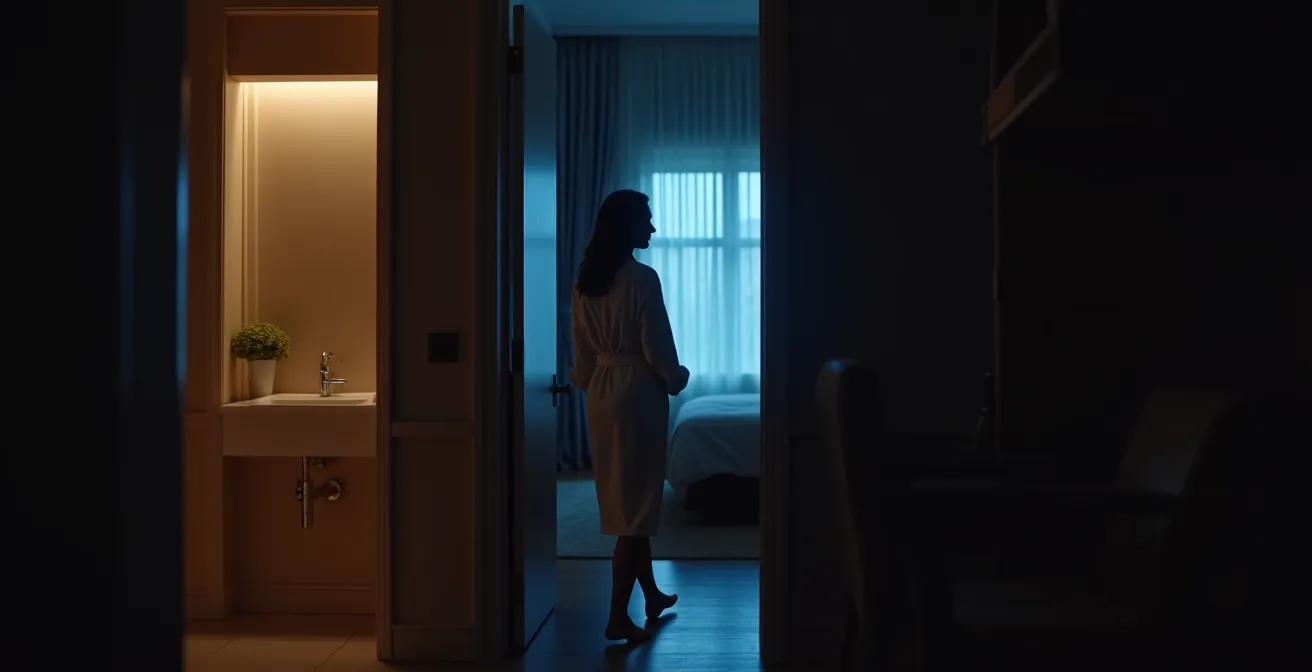
This image captures the essence of the “ritual pathway”—the seamless transition from the warm glow of the spa bathroom to the calm, dark sanctuary of the bedroom, a journey designed to guide the body and mind toward rest.
Beyond temperature and light, scent is another powerful tool for anchoring this ritual. By consistently using a specific scent in the bathroom during your evening routine and then carrying it over to the bedroom (via a pillow mist, for example), you can create a strong Pavlovian response. Over time, the scent itself becomes a trigger for relaxation and sleep.
Your Action Plan: Creating a Scent Anchor for Sleep
- Select Your Signature Blend: Choose a calming essential oil blend. A classic combination is lavender (35% for relaxation), cedarwood (35% for its grounding properties), and bergamot (30% to ease anxiety).
- Establish the Bathroom Association: Diffuse this blend in your bathroom for 20-30 minutes during your evening shower or bath routine.
- Bridge to the Bedroom: Create a simple pillow mist by adding 5-10 drops of the same oil blend to a 4oz spray bottle of distilled water. Lightly mist your pillows just before bed.
- Reinforce the Connection: Use this two-part scent ritual consistently every night. It takes approximately 21 days to establish a strong associative link in the brain.
- Audit for Competing Scents: Ensure there are no other strong, competing fragrances in the bedroom (e.g., from laundry detergents or other scented products) that could dilute the signal.
The Mold Risk That Comes With Sealing Your House Too Tightly
As we create our perfect, sealed-off spa sanctuary, we must address a critical paradox: the very act of sealing a space for thermal and acoustic comfort can create a trap for humidity, leading to the mold we fought so hard to avoid. Modern, energy-efficient homes and apartments are often so airtight that they lack the natural ventilation needed to expel the immense amount of moisture generated by a steam shower or a long, hot bath.
The standard solution, a noisy bathroom fan, often gets neglected because it disrupts the tranquil spa atmosphere. People simply don’t use them. However, silent ventilation technology has evolved significantly. Modern fans under 1.0 sone operate at less than 28 decibels, which is quieter than a whisper. Investing in an ultra-quiet, humidity-sensing fan ensures that ventilation happens automatically and silently, preserving both the air quality and the serenity of the space.
For the ultimate in air quality management, especially in tightly sealed homes, a more advanced system-level solution is required. An Energy Recovery Ventilator (ERV) is the gold standard for maintaining a healthy indoor environment without compromising energy efficiency.
Case Study: The ERV System in a Spa Bathroom Installation
The owners of a tightly sealed, energy-efficient home installed a spa bathroom and were concerned about humidity. They opted for an Energy Recovery Ventilator (ERV) system. The ERV actively exhausted the moist, stale air from the bathroom while transferring up to 70% of the heat energy from the outgoing air to the fresh, incoming air. Over six months, humidity levels remained consistently below the 50% mold-growth threshold, and the home’s heating costs were reduced by 15%. The system provided superior air quality without the noise or heat loss of a traditional exhaust fan.
Key Takeaways
- True spa luxury in a small space comes from sensory engineering—manipulating light, water, and sound—not just surface-level decoration.
- System-level decisions about hidden infrastructure like plumbing and ventilation are the most powerful tools for optimizing your budget and ensuring long-term success.
- The ultimate goal of a spa bathroom is to be the starting point of a “ritual pathway” that prepares the body and mind for deep, restorative rest.
How to Layer Lighting to Make Small Rooms Feel Bigger ?
We return to light, the most powerful tool for manipulating the perception of space. In a 50 sq ft bathroom, a single overhead light fixture flattens the room, casting shadows and making it feel smaller and more utilitarian. The designer’s secret to creating a sense of volume and luxury is to layer different types of light, each with a specific job, to draw the eye, create depth, and add a touch of drama.
As HGTV design expert Nicole Hirsch explains, “Uplighting draws the eye upward, creating a sense of height, lift, and theatricality that feels luxurious and spacious.” This single technique—washing a wall or ceiling with light—can fundamentally change the perceived dimensions of the room. Instead of thinking about illuminating the room, think about sculpting it with light and shadow. A well-designed, layered lighting plan is the most effective way to make a small space feel expansive.
A successful scheme incorporates four distinct layers, which work together to provide flexibility for both function and mood. This framework moves beyond a simple on/off switch to a dynamic system that adapts to your needs throughout the day, from bright and functional in the morning to soft and serene at night.
- Layer 1 – Ambient: This is your general illumination, typically from a dimmable overhead fixture. Choose a warm color temperature (2700K) to create a welcoming base layer of light.
- Layer 2 – Task: This is your bright, functional light for grooming. Position sconces or vertical fixtures at eye level on either side of the mirror to eliminate shadows. Use a cleaner, but still warm, 3000K light here.
- Layer 3 – Accent: This is the “magic” layer. Use linear LED strips or small spotlights to graze textured walls, highlight architectural details, or backlight a mirror. This creates depth and visual interest.
- Layer 4 – Decorative: This is the “jewelry” of the room. A single, beautiful statement fixture, like a small pendant or an elegant sconce, acts as a focal point, adding personality and a touch of luxury.
By giving each layer its own switch and ensuring key layers are dimmable, you gain complete control over the atmosphere. You can use all four for a bright, welcoming space, or just the accent and decorative layers for that low-light, end-of-day spa glow we established as our goal.
Begin applying these sensory engineering principles today. By making strategic, system-level choices, you can transform your limited space into a truly unlimited sanctuary for mind and body.