
Contrary to popular belief, a 20% contingency fund is not a strategy—it’s an admission of defeat. Your budget fails because of a weak process, not bad luck.
- The biggest financial drains are unmade decisions and an incorrect work sequence, which lead to expensive rework.
- A cheap contractor quote is often the most expensive one in the long run, hiding costs in vague terms and allowances.
Recommendation: Stop focusing on the total dollar amount and start mastering the operational sequence of your project. True budget control is about preventing problems, not just paying for them.
Every homeowner planning a major renovation shares the same nightmare: the budget spiraling out of control. You’ve heard the advice—get three quotes, watch for hidden costs, and, most importantly, have a 15-20% contingency fund ready for “the unexpected.” I’ve been in this business for decades, and I’m here to tell you that relying on a contingency fund is planning to fail. It’s a buffer for poor planning, not a tool for success. The real disasters aren’t a single, dramatic catastrophe; they’re a slow bleed caused by a thousand small, unmade decisions and a fundamental misunderstanding of how a project actually comes together.
The common wisdom focuses on the money. My approach focuses on the work. Your budget doesn’t just evaporate. It gets eaten alive by rework, change orders, and the domino effect of a poor sequence. The key to keeping your finances intact isn’t about pinching pennies on materials; it’s about enforcing a rigid operational discipline from day one. It’s about knowing what red flags in a contractor’s quote will guarantee future pain and understanding why the order in which you renovate rooms can make the difference between a livable process and months of chaos.
But what if the very premise of some renovations—like a high-end kitchen remodel—is flawed when it comes to return on investment? This guide is built from years on job sites, not from behind a desk. We’ll dismantle the common myths and give you the framework a professional uses. We will move beyond the spreadsheets and into the structural realities that truly dictate costs. You’ll learn to think like a contractor, spot the traps, and take control of your project’s timeline and budget before the first sledgehammer swings.
This article provides a strategic roadmap, breaking down the critical decisions that protect your investment. Below is the structure we will follow to transform you from a worried homeowner into a savvy project manager.
Summary: How to Manage a Full Home Renovation Without Exceeding Your Budget?
- Why Kitchen Renovations Don’t Always Add Value to Your Home Appraisal ?
- Trendy Modern vs Classic Traditional: Which Style Ages Better ?
- The Red Flags in Contractor Quotes That Signal Future Disasters
- In Which Order Should You Renovate Rooms to Live Comfortably During Work ?
- Solving Common Layout Mistakes Without Tearing Down Walls
- Optimizing Your Kitchen Layout to Reduce Energy Bills by 15%
- Sequencing Your Insulation Work: Roof, Walls, or Windows First ?
- Why Standard Paint Might Be the Source of Your Chronic Headaches ?
Why Kitchen Renovations Don’t Always Add Value to Your Home Appraisal ?
The most common myth I have to bust for clients is that a kitchen renovation is a guaranteed-to-profit investment. The reality is far more nuanced. The market is flooded with stories of massive returns, but this often applies to minor, strategic updates, not complete, high-end overhauls. The data is clear: there’s a huge difference in return on investment (ROI) between a cosmetic facelift and a gut renovation. In fact, a recent report shows a staggering 96% ROI for minor kitchen updates versus only 50% for major upscale remodels in 2024. This means for every dollar you spend on a massive, custom job, you might only get fifty cents back at resale.
The primary reason for this discrepancy is the “neighborhood ceiling.” Your home’s value is capped by the prices of comparable homes in your area. You can install the most luxurious Italian marble countertops and top-of-the-line appliances, but if no other house on your street has them, an appraiser won’t give you full credit. You risk over-improving for your market. For example, if comparable homes sell for $200,000 and those with a decent updated kitchen sell for $215,000, spending $30,000 on your remodel is simply lighting money on fire. You will never recoup that extra $15,000.
A smart renovation adds value by bringing your home up to the neighborhood standard or slightly above it, not by trying to turn it into a property from a different zip code. The goal should be a clean, functional, and broadly appealing space. Anything more is a personal luxury, not a financial strategy.
Trendy Modern vs Classic Traditional: Which Style Ages Better ?
One of the earliest decisions you’ll make is the aesthetic direction, and it has more financial impact than you think. The tension between a trendy, modern look and a classic, traditional style is a major fork in the road. While bold, contemporary designs can be exciting, they are also the most likely to look dated in five to ten years. This creates a domino effect of costs down the line when you or a future buyer feels compelled to update it again. Think of the avocado green appliances of the 70s or the Tuscan-themed kitchens of the early 2000s—they were the height of fashion, and then they became a liability.
To understand the difference, consider the visual language of each style. The image below contrasts the two, highlighting the timeless elements of classic design against the fleeting nature of some modern trends.
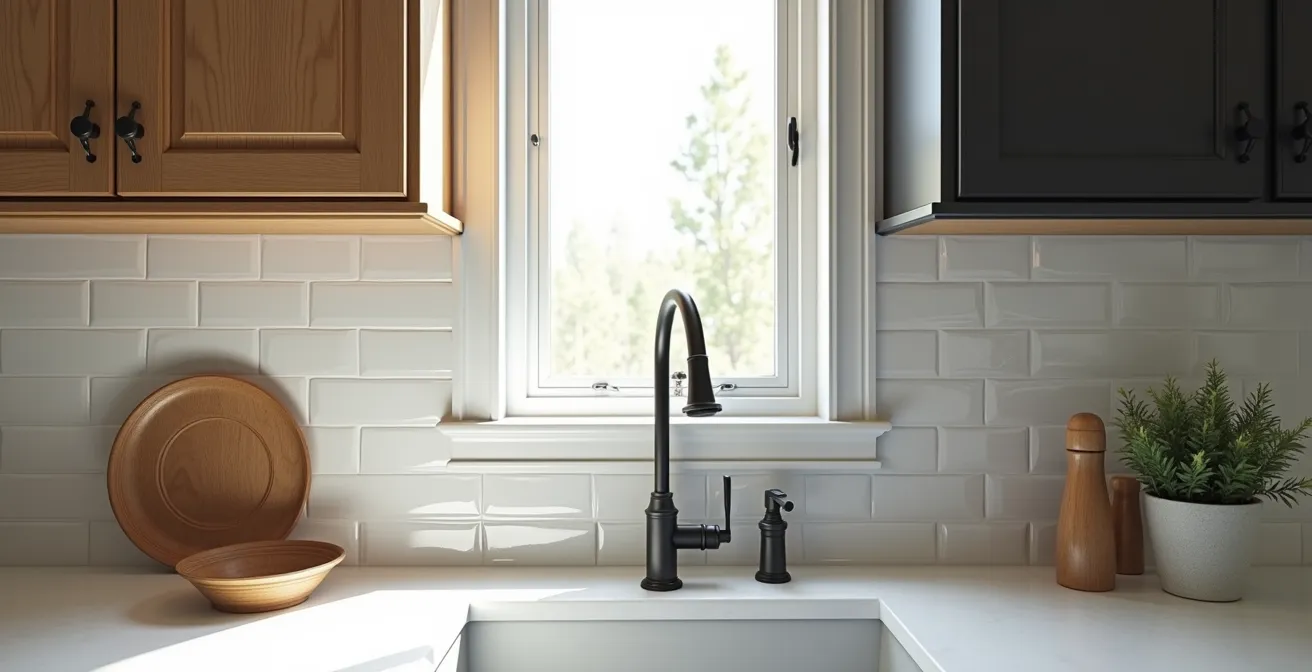
Classic or transitional styles, which incorporate timeless elements like shaker cabinets, subway tile, and neutral color palettes, have far greater staying power. They create a neutral canvas that appeals to the widest possible range of buyers. A potential homeowner can easily project their own style onto a classic kitchen with accessories and paint, but they see a highly specific, trendy design as a huge, expensive project they’ll have to tackle. Durability of style is as important as the durability of materials. Your goal is to make choices that maximize long-term value, not just short-term excitement. Here are key decisions that help achieve that:
- Choose timeless, classic designs over trendy styles that date quickly.
- Opt for neutral color palettes that appeal to broader buyer demographics.
- Select durable materials like quartz over high-maintenance marble.
- Focus on functional improvements over purely aesthetic upgrades.
- Document all upgrades with receipts and warranties for future resale.
The Red Flags in Contractor Quotes That Signal Future Disasters
After you’ve defined your vision, selecting the right contractor is the single most important decision you’ll make. This is where most budget disasters are born. A surprisingly low bid should not be seen as a victory; it should be treated as a massive warning sign. These contractors often make up for the low price through a barrage of change orders, low-quality materials, or, in the worst cases, by disappearing altogether. A quote that is 30% or more below the competition is often a sign of desperation or deception.
The most dangerous element in a quote is vagueness. Terms like “allowances” without specific product models, or a “scope of work” that doesn’t list material quantities, are open doors for future cost increases. A professional quote is a detailed, multi-page document, not a one-page summary. Another major red flag is a demand for a large upfront payment. A contractor who needs a huge deposit may be using your money to pay off debts from a previous job. In fact, to protect homeowners, many states legally limit upfront payments to 33% or less of the total contract value.
Protecting your budget starts with scrutinizing the contract. Here are the critical warning signs you must look for before signing anything:
- Vague scope of work without specific materials and quantities listed.
- Front-loaded payment schedules requesting more than 20% upfront.
- Lack of clear pricing structure with undefined ‘allowances’.
- No written contract or unwillingness to provide detailed drawings.
- Significantly lower bid than competitors (often 30%+ below average).
- Cash-only payment requirements or pressure for immediate decisions.
- Absence of proper licensing and insurance documentation.
In Which Order Should You Renovate Rooms to Live Comfortably During Work ?
Managing the “operational sequence” is where professionals save money and amateurs create chaos. Renovating an occupied home is a logistical challenge, and the order in which you tackle rooms is critical not only for your budget but for your sanity. The wrong sequence leads to rework—like damaging newly installed floors while working on an adjacent room—and extends the project timeline. The first, and most important, step is to establish a “sanctuary zone.” This is a room, often a bedroom or office, that you finish completely first. It becomes your clean, dust-free escape from the construction chaos, a non-negotiable haven.
Once your sanctuary is established, the work should be sequenced by systems, not just by rooms. It’s more efficient to group all plumbing or all electrical work together, even if it spans multiple areas. This prevents having to open up walls and ceilings more than once. A common professional strategy is to start at the point furthest from the main entrance and work your way forward. This minimizes foot traffic over newly finished surfaces. The visualization below shows how containment zones and a clear sequence can organize the process.
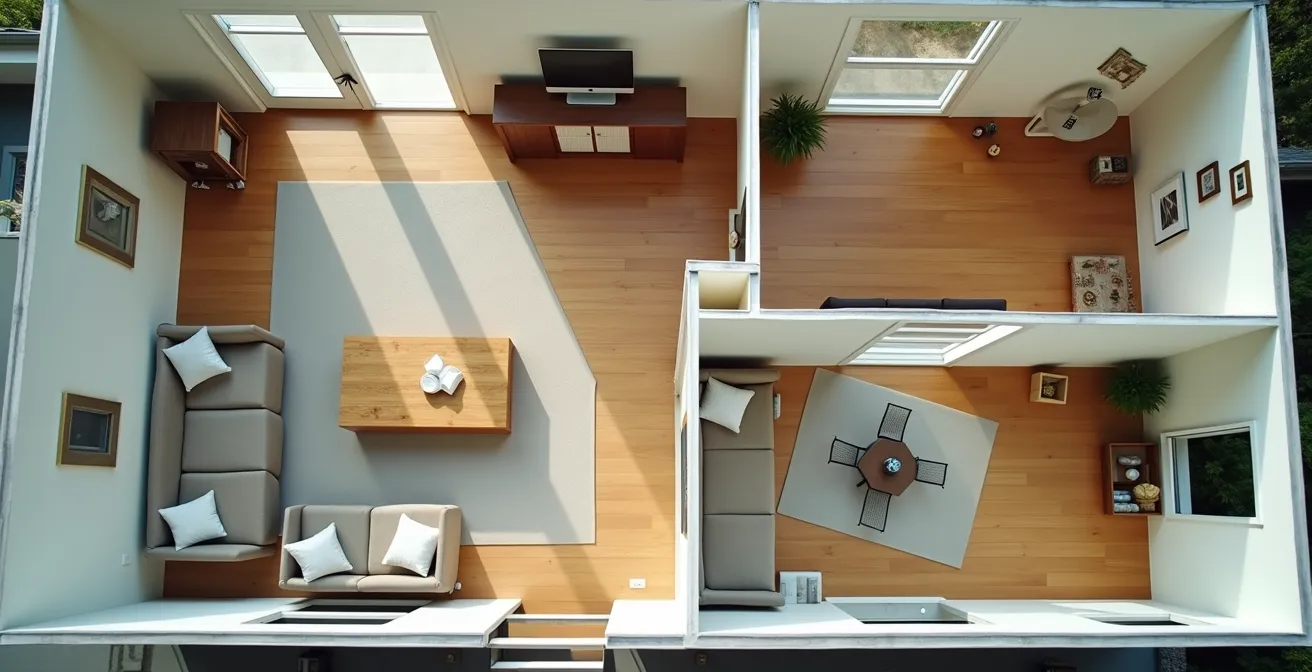
Flooring should always be one of the last items installed to protect it from damage. A strategic sequence is your best defense against the disruption and hidden costs of rework. Follow this professional sequencing to maintain order:
- Create a ‘sanctuary room’ first – completely finish one bedroom/office as a construction-free zone.
- Sequence by systems not rooms – group plumbing/electrical work to avoid reopening walls.
- Start from the furthest point from the main entrance and move forward.
- Complete all structural changes before cosmetic updates.
- Finish one full bathroom early to maintain functionality.
- Save flooring for last to prevent damage from other work.
Solving Common Layout Mistakes Without Tearing Down Walls
Many homeowners assume that fixing an awkward layout requires the most expensive solution: tearing down walls. This is often where budgets go to die. Structural changes are complex, require permits, and can uncover a host of unforeseen issues like hidden pipes, wiring, or support beams. Before you even consider demolition, you must explore non-structural solutions. This is the essence of value engineering—finding a smarter, more cost-effective way to achieve the desired result. Often, perceived layout problems are actually issues of lighting, flow, or undefined spaces.
The cost difference is immense. Simple, non-structural changes can cost as little as $15-$60 per square foot, whereas major structural work can easily soar to $100-$250 per square foot. Strategic lighting is one of the most powerful tools. By layering ambient (overall), task (focused), and accent (highlighting) light, you can create the illusion of separate “rooms” within a single open space. Similarly, large area rugs are incredibly effective at defining functional zones, such as a living area versus a dining area, without a single wall.
Instead of fighting an awkward layout, sometimes the best solution is to redefine the room’s purpose to fit the space. Don’t be afraid to use non-permanent dividers like bookshelves, screens, or even ceiling-mounted curtains to create flexible separations. These non-structural solutions provide the function you need without the cost and risk of demolition.
- Install strategic lighting layers (ambient, task, accent) to create visual zones.
- Use partial-height partitions or bookshelves as room dividers.
- Deploy large area rugs to define separate functional spaces.
- Add ceiling-mounted curtain tracks for flexible space division.
- Redefine room purposes rather than fighting awkward layouts.
- Use furniture placement to create natural traffic flow patterns.
Optimizing Your Kitchen Layout to Reduce Energy Bills by 15%
A smart renovation looks beyond the initial construction cost and considers the long-term operational expenses of the home. Your kitchen is an energy-consumption hub, and its layout can have a direct and significant impact on your monthly utility bills. Simple, no-cost planning decisions made during the design phase can yield savings for years to come. The most critical principle is separating heat-generating appliances from cooling appliances.
Placing your refrigerator next to your oven or dishwasher forces it to work harder to maintain its internal temperature, wasting electricity every single day. By simply planning the layout to keep them apart, you can reduce the refrigerator’s energy consumption by 10-12% immediately. Another powerful strategy is maximizing natural light. Positioning your primary prep areas near a window not only creates a more pleasant workspace but also reduces the need for artificial lighting during the day. This small change can cut lighting-related energy use significantly.
While upgrading to Energy Star appliances provides the biggest savings, it also comes with the highest upfront cost. The table below outlines several strategies, demonstrating that some of the most effective measures are also the cheapest to implement. This is a clear example of where thoughtful planning provides a better ROI than simply throwing money at expensive technology.
| Strategy | Energy Savings | Implementation Cost | Payback Period |
|---|---|---|---|
| Separate heat-generating from cooling appliances | 10-12% | $0 (planning only) | Immediate |
| Natural light optimization | 15-20% | $500-2000 | 2-3 years |
| Smart plugs for vampire power | 5-8% | $200-500 | 1-2 years |
| Energy Star appliance upgrades | 20-30% | $3000-8000 | 5-7 years |
Sequencing Your Insulation Work: Roof, Walls, or Windows First ?
When it comes to improving your home’s thermal performance, not all upgrades are created equal. Homeowners often mistakenly prioritize window replacement, which is one of the most expensive upgrades with the slowest return on investment. The real enemy of your heating and cooling budget is air leakage and poor attic insulation. In fact, industry data reveals a massive 193.9% ROI for basic insulation upgrades in 2024, making it one of the single best investments you can make in your home. The key, as always, is the sequence.
You must address the “stack effect,” where warm air rises and escapes through the top of your house in the winter, pulling cold air in through the bottom. Therefore, the absolute first priority is always the attic or roof insulation. Before you even think about walls, you need to seal the “lid” of your house. The second priority is sealing air gaps. These are the small cracks around outlets, plumbing pipes, and window frames that collectively act like an open window. Only after you have sealed the top of the house and plugged the leaks should you consider adding insulation to the walls. Windows should be your last resort, considered only after all other insulation and air-sealing measures have been maxed out.
This evidence-based sequence ensures you spend your money where it will have the most impact first, delivering immediate comfort and energy savings.
Your Insulation Priority Checklist: The Right Order of Operations
- Air Leak Audit: Conduct a DIY air leak audit first. Use an incense stick on a windy day near windows, outlets, and pipes to find drafts.
- Attic/Roof First: Prioritize adding or upgrading attic/roof insulation to address the stack effect and stop the biggest source of heat loss.
- Seal Gaps: Methodically seal all small air gaps around electrical outlets, plumbing penetrations, and window/door frames with caulk or foam.
- Walls Second: Add insulation to walls only after the attic is done and major air leaks are sealed for maximum effectiveness.
- Windows Last: Consider thermal curtains or window films first. Replace windows only as a final step due to their high cost and comparatively lower ROI.
Key Takeaways
- Budget control is about process control; a contingency fund is a sign of poor planning.
- The sequence of work is not negotiable. Follow a professional order to avoid costly rework and delays.
- A cheap quote is a red flag. Vague terms and low bids signal future financial pain.
Why Standard Paint Might Be the Source of Your Chronic Headaches ?
When finalizing a renovation budget, paint is often seen as a minor, purely aesthetic expense. This is a dangerous oversight. The “cost” of a material isn’t just its price tag; it’s also its impact on your health. Standard, low-cost paints are often high in Volatile Organic Compounds (VOCs), which are chemicals that turn into gas at room temperature. The “new paint smell” is actually your walls off-gassing these potentially harmful compounds into the air you breathe. For sensitive individuals, this can be a direct cause of chronic headaches, dizziness, and respiratory irritation.
As the U.S. Environmental Protection Agency points out, the danger is real and can be long-lasting. Their experts warn about the risks associated with poor indoor air quality exacerbated by building materials.
VOCs off-gas at room temperature and can cause headaches, respiratory issues, and long-term health problems, making low-VOC alternatives a health investment rather than just an aesthetic choice.
– Environmental Protection Agency, Indoor Air Quality Guidelines
Choosing low-VOC or zero-VOC paint is not an indulgence; it’s a critical decision for creating a healthy living environment. This extends to other materials as well. Cabinetry made with formaldehyde-free MDF, flooring without phthalates, and low-emission adhesives all contribute to better indoor air quality. Documenting these healthy material choices can even become a selling point, as more buyers become aware of the importance of a non-toxic home. The small extra cost for these healthier materials is a negligible price to pay for your family’s well-being.
- Choose paints with less than 50 g/L VOCs for walls.
- Select formaldehyde-free MDF and plywood for cabinetry.
- Install phthalate-free luxury vinyl plank flooring.
- Use low-emission adhesives and sealants throughout.
- Document all healthy material choices for resale value.
- Allow proper ventilation time between coating applications.
Now that you are armed with a contractor’s perspective, it’s time to put it into action. Take control of your project from day one. Use this guide not as a set of rigid rules, but as a framework for asking the right questions, demanding detailed answers, and making informed decisions before a single dollar is spent. The success of your renovation and the health of your budget depend on it.