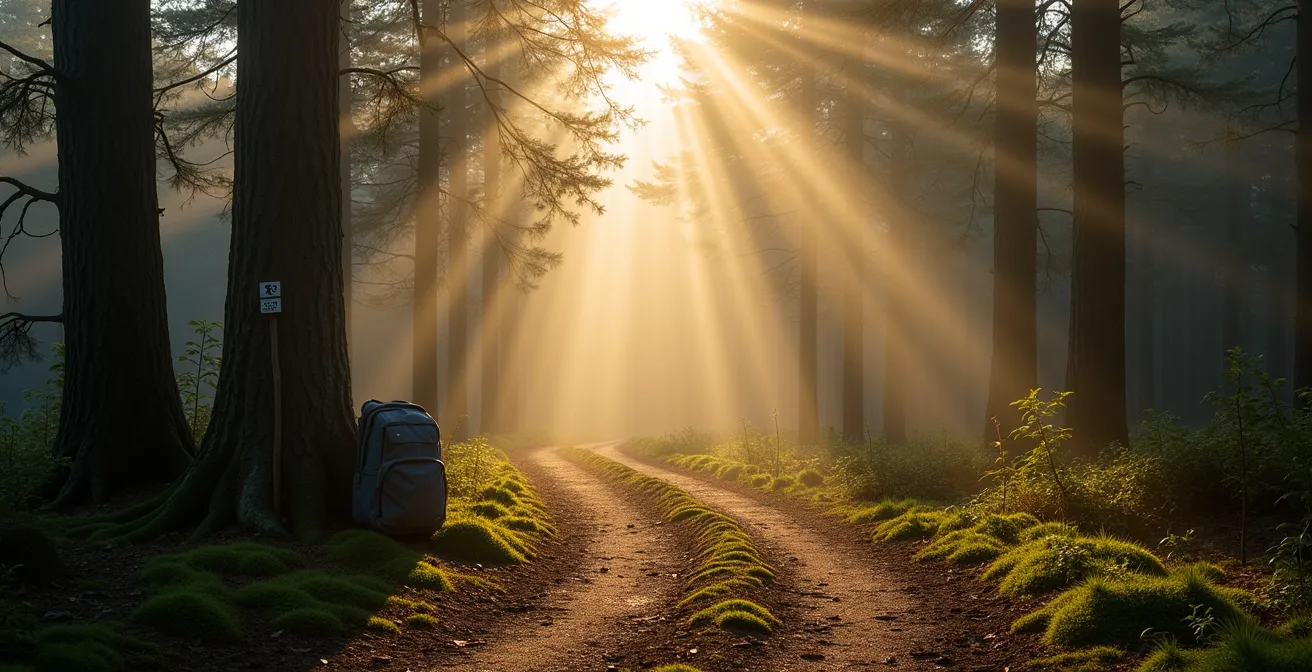
The constant fatigue and poor sleep of urban life are not a personal failing, but a biological response to an environment that has disconnected you from natural cycles.
- Intentional nature excursions, designed as environmental therapy, are the most effective way to recalibrate your internal clock.
- The key is to strategically choose your landscape, manage light exposure, and embrace disconnection to send powerful reset signals to your brain.
Recommendation: Instead of a random weekend getaway, start by planning a single, purposeful day trip focused on maximizing morning sunlight and minimizing artificial stimuli.
The feeling is deeply familiar to most city dwellers: a persistent, low-grade fatigue that coffee can’t touch, a mind that won’t switch off at night, and a sense that you’re operating out of sync with the world. You feel burnt out. In response, we’re told to optimize our sleep hygiene, download meditation apps, or buy blue-light-blocking glasses. These are well-intentioned patches, but they fail to address the root cause: a profound desynchronization of our biology from the natural world.
Our bodies are ancient systems, finely tuned to the rhythmic rise and fall of the sun, the subtle shifts in temperature, and the complex chemistry of the air. Urban environments, with their constant artificial light, noise, and digital demands, send chaotic and conflicting signals to our internal clock, known as the circadian rhythm. This disruption isn’t just about feeling tired; it’s a systemic issue linked to mood disorders, metabolic problems, and a weakened immune system. But what if the solution wasn’t about adding more technology to our lives, but about subtracting it? What if the real key was not just ‘getting outside’, but intentionally using nature as a powerful therapeutic tool to actively recalibrate your body’s core programming?
This guide moves beyond generic advice. It is a framework for planning nature excursions as a form of targeted environmental therapy. We will explore how to choose the right environment for your needs, how to harness light to reset your internal clock, and why true disconnection is the most potent medicine for a modern mind. By the end, you will understand how to transform a simple trip into a profound biological reset, reconnecting your internal rhythms with the grounding cycles of the Earth.
For those who prefer a scientific deep dive, the following video provides a comprehensive look at the mechanisms of sleep, alertness, and the biological clocks that govern them. It’s a perfect complement to the practical, nature-based strategies we’re about to explore.
To help you navigate these concepts, this article is structured to guide you step-by-step through the process of designing your own circadian-resetting excursion. You’ll learn the science behind why it works and gain practical tools to put it into action.
Summary: A Practical Guide to Designing Your Circadian Reset in Nature
- Phytoncides: Why Breathing Forest Air Boosts Your Immune System ?
- Mountain vs Beach: Which Environment Lowers Blood Pressure Faster ?
- The No-Signal Rule: Planning Trips Where Your Phone Won’t Work
- Optimizing Your Pack: How to Carry Less to Enjoy More ?
- Sunrise vs Sunset: When Is the Best Light for Mental Health ?
- Optimizing Your Bedroom for Sensory Deprivation and Deep Rest
- Why Native Plants Require 50% Less Water Than Exotics ?
- How to Choose Hiking Trails That Match Your Fitness Level Realistically ?
Phytoncides: Why Breathing Forest Air Boosts Your Immune System ?
The concept of “forest bathing,” or Shinrin-yoku, is more than a poetic invitation to walk among trees; it’s a scientifically validated form of environmental therapy. When you step into a forest, you are not just entering a quiet space; you are immersing yourself in a complex chemical atmosphere. Trees, particularly conifers, release airborne antimicrobial compounds called phytoncides. These are the natural oils that protect trees from germs and insects, and when we inhale them, they have a remarkable effect on our own biology.
The most profound impact is on our immune system. Inhaling phytoncides has been shown to increase the number and activity of our body’s Natural Killer (NK) cells. These are a type of white blood cell that plays a vital role in fighting off tumors and virus-infected cells. Unlike a fleeting dose of medication, the benefits of this natural immunotherapy are surprisingly long-lasting. In fact, research on forest bathing’s immune effects shows that the increase in NK cell activity can persist for more than seven days after a trip. This means a weekend in the woods is not just a mental break—it’s a tangible boost to your physiological resilience that you carry back with you into your daily life.
Choosing a forest for your excursion is a conscious decision to engage in a form of natural aromatherapy that strengthens your body from the inside out. It’s about recognizing the air itself as a nutrient, rich with compounds that support the very systems depleted by stress and urban living. The simple act of breathing deeply among the trees becomes an active investment in your long-term health.
Mountain vs Beach: Which Environment Lowers Blood Pressure Faster ?
While any natural environment offers benefits, not all are created equal when it comes to their effect on our biology. The choice between a mountain forest and a coastal beach is more than a matter of preference; it’s a strategic decision in designing your circadian reset. Each landscape offers a unique set of zeitgebers—external cues that entrain our internal clocks—from the quality of light to the composition of the air.
A key difference lies in the concentration of negative ions, which are oxygen atoms with an extra electron, generated by crashing water, and linked to improved mood and alertness. The mist from a mountain waterfall and the spray from ocean waves are both incredibly rich sources of these ions, but they interact with our system differently based on the surrounding environment.

The primary distinction between these environments is the light and soundscape. The open expanse of a beach provides intense, blue-rich morning light, ideal for a strong cortisol awakening response. In contrast, the filtered light of a forest canopy is dimmer and better suited for the relaxation phase of the afternoon. The rhythmic crash of waves can entrain alpha brainwaves associated with a relaxed, meditative state, while the complex, non-repeating sounds of a forest promote a state of “soft fascination” that restores directed attention.
The following table, inspired by chronobiological principles, breaks down how these two powerful environments influence our rhythms. It helps illustrate that the question isn’t which is “better,” but which is better for a specific therapeutic goal at a specific time of day.
| Factor | Mountain Environment | Beach Environment |
|---|---|---|
| Light Spectrum | Filtered, dimmer light through trees | Intense blue-rich light from open sky |
| Best Time for Circadian Reset | Afternoon relaxation phase | Morning cortisol awakening |
| Soundscape Effect | Promotes ‘soft fascination’ state | Entrains alpha brainwaves |
| Negative Ion Concentration | High near waterfalls | High from sea spray |
The No-Signal Rule: Planning Trips Where Your Phone Won’t Work
Circadian rhythm asynchrony is one common cause of insomnia.
– Banner Peak Health Physicians, How to Reset Your Circadian Rhythm Guide
This asynchrony is fueled by one of the most powerful and disruptive forces in modern life: the smartphone. Its screen emits potent blue light that signals “daytime” to your brain, and its constant notifications create a state of hyper-vigilance, preventing the nervous system from truly resting. The most effective way to reset your rhythm is not just to practice digital discipline, but to remove the choice entirely. Planning an excursion to a location with no cellular service is a non-negotiable rule for a true biological reset.
This isn’t about punishment; it’s about liberation. When your phone has no signal, the compulsive urge to check it gradually fades. Your attention, no longer fractured into a thousand digital shards, can finally settle on the world around you. This forced disconnection creates a state of sensory cleansing, allowing your brain’s attentional systems to recover from the chronic overload of urban life. The anxiety of “what if” is replaced by the peace of “what is.”
Finding these zones is easier than you think. Many national parks, remote wilderness areas, and even deep river valleys naturally block cell signals. Researching your destination’s connectivity (or lack thereof) should be as crucial as checking the weather. By intentionally choosing a place where your phone becomes a simple camera and clock, you are creating the conditions for your mind to recalibrate. You allow your internal clock to listen to its primary cues—light and darkness—without the constant, confusing chatter of the digital world.
Optimizing Your Pack: How to Carry Less to Enjoy More ?
The principle of “less is more” is central to a restorative nature excursion. A heavy, cluttered pack can introduce physical stress that counteracts the mental benefits you’re seeking. However, optimizing your pack for a circadian reset isn’t just about cutting weight; it’s about reframing your packing list with a single question in mind: “Does this support or disrupt my natural rhythms?” This “Circadian-First” approach shifts the focus from survival gear to restoration gear.
The heaviest and most important investment should be your sleep system. A high-quality sleeping pad that insulates you from the cold ground and an appropriately-rated sleeping bag are not luxuries; they are essential therapeutic tools. Cold is a major stressor that causes cortisol spikes and disrupts sleep, so preventing it is paramount. An eye mask to ensure complete darkness is another lightweight, high-impact item for promoting deep, restorative rest.
The second priority is light management gear. A headlamp with a red-light mode is critical for navigating at night without exposing your eyes to sleep-disrupting blue light. When choosing a tent, consider its opacity—one that can block out early morning light if you need to sleep in, or one that allows you to be woken naturally by the dawn. The goal is to give you conscious control over the most powerful zeitgeber: light. By prioritizing these items, you naturally de-prioritize things that detract from the experience, like multiple electronic devices or heavy cookware that might compromise the weight you can dedicate to your sleep system.
- Priority 1 – Sleep System: Quality sleeping pad, appropriate-rated sleeping bag, blackout eye mask for deep sleep.
- Priority 2 – Light Management Gear: Red-light headlamp for nighttime, tent with opacity control for morning light.
- Priority 3 – Stress Reduction Items: Comfortable footwear, adequate layers to prevent cold stress.
- Non-essential to leave behind: Multiple electronic devices, heavy cookware if it compromises sleep gear weight.
Sunrise vs Sunset: When Is the Best Light for Mental Health ?
Light is the most powerful drug for your brain’s internal clock, the suprachiasmatic nucleus (SCN). However, not all light is equal. The timing, intensity, and angle of light exposure have dramatically different effects on your biology. While a beautiful sunset can be emotionally uplifting, it is morning sunlight that provides the critical signal for resetting your entire 24-hour cycle. Getting sunlight in your eyes within the first hour of waking is the single most effective thing you can do to anchor your circadian rhythm.
The reason is its specific quality and intensity. The low-angle sun of the morning is uniquely rich in the blue-light frequencies that signal the start of the day to specialized photoreceptors in your eyes. This triggers a healthy cortisol pulse that promotes alertness and focus, and it sets a timer for the release of melatonin (the sleep hormone) about 14-16 hours later. According to neuroscience research on morning light exposure, the brightness can be between 10,000 to 50,000 lux, even on a cloudy day—orders of magnitude more powerful than any indoor lighting.

This isn’t just theory; it has been demonstrated in practice. The profound speed at which nature can recalibrate our clocks is remarkable, offering a powerful antidote to the “social jetlag” we accumulate during the workweek.
The Colorado Camping Circadian Reset Study
A landmark University of Colorado study found that just a weekend of camping, with exposure to only natural light, shifted participants’ melatonin rise 1.4 hours earlier. This single weekend achieved 69% of the total circadian shift that was seen after a full week in nature, effectively correcting the typical weekend sleep schedule disruption. This shows that even short, intentional immersions can have a massive and rapid biological impact.
Optimizing Your Bedroom for Sensory Deprivation and Deep Rest
A successful circadian reset doesn’t end when you return home. The goal is to bring the principles of the natural world back with you and transform your bedroom into a “sleep sanctuary” that continues the restorative process. After a period of bio-immersion in nature, your senses are more finely tuned, making them more vulnerable to the disruptive stimuli of a typical home environment. The key is to replicate the core conditions of a night in the wilderness: total darkness, quiet, and a cool temperature.
Your post-excursion mission is to ruthlessly eliminate all sources of light from your bedroom. This goes beyond just curtains. It means covering or removing the tiny standby LEDs on electronics, as even a pinprick of light can be enough to disrupt melatonin production. The goal is to achieve a level of darkness where you cannot see your hand in front of your face. This state of sensory deprivation sends an unambiguous “nighttime” signal to your brain, allowing it to fully commit to the processes of deep sleep and cellular repair.
Similarly, managing your evening light exposure in the hours before bed is crucial for preserving the gains made during your trip. You must avoid overhead blue-rich lights, which mimic midday sun. Instead, use low-wattage lamps with warm, amber-toned bulbs, and place them physically low to the ground to mimic the light of a sunset or campfire. This gradual reduction in light intensity and shift toward the red end of the spectrum is a powerful environmental cue that prepares your body for rest. Applying these principles turns your bedroom from a simple place of rest into an active tool for daily circadian maintenance.
Your Action Plan: Creating a Home Sleep Sanctuary
- Audit for Light Pollution: Go into your bedroom at night and identify every single source of light, no matter how small (power strips, chargers, clocks). Cover them with black electrical tape or unplug them.
- Install Blackout Curtains: Invest in high-quality blackout curtains that completely block outside light from streetlamps or cars. Ensure there are no gaps at the top or sides.
- Implement a “Digital Sunset”: Two hours before your target bedtime, switch all home lighting to warm, dim, low-level lamps. Turn off all screens, especially your phone.
- Control the Temperature: Aim for a cool bedroom temperature, typically between 60-67°F (15-19°C). A drop in core body temperature is a natural signal for sleep.
- Manage Sound: If you live in a noisy area, consider using a white noise machine or earplugs to create a consistent, non-disruptive soundscape.
Key Takeaways
- Resetting your rhythm is an active process of environmental design, not a passive vacation.
- Morning sunlight is the single most powerful tool for anchoring your internal clock and improving alertness.
- The benefits of a nature excursion can be maintained by transforming your bedroom into a sanctuary that mimics natural conditions of darkness and cool temperatures.
Why Native Plants Require 50% Less Water Than Exotics ?
While this question seems rooted in horticulture, it offers a powerful metaphor for our own biology. A native plant thrives in its local soil and climate because it has evolved over millennia to be perfectly adapted to those specific conditions. It requires less intervention—less water, less fertilizer, less effort—because it is in a state of harmony with its environment. An exotic plant, beautiful as it may be, often struggles. It is placed in an environment it was not designed for, requiring constant external support to survive.
Our bodies are no different. We are, in essence, “native” to the rhythms of the natural world. Our biology is designed to function optimally with the rising and setting of the sun, the quiet of darkness, and the clean air of a living ecosystem. The modern urban environment is our “exotic” soil. It’s a landscape we can survive in, but it requires a tremendous amount of effort and artificial support: caffeine to wake us, sleeping pills to rest us, and a constant battle against stress and fatigue. We are constantly watering a plant that is not in its proper soil.
A circadian-resetting excursion is, therefore, an act of replanting yourself in your native soil. It is a temporary return to the environment your body understands intuitively. In this state of bio-immersion, your systems can function with less effort. Sleep comes more easily, stress hormones regulate, and energy levels restore themselves naturally, not because you are forcing them, but because you have finally provided the conditions your body was designed for. The profound sense of well-being you feel is the feeling of a system returning to its intended state of effortless function.
How to Choose Hiking Trails That Match Your Fitness Level Realistically ?
The final element of designing your excursion is choosing the physical activity itself. The goal is not to conquer a mountain, but to use movement as another tool to reinforce your circadian reset. Choosing a trail that is too difficult can introduce excessive physical stress, releasing cortisol and disrupting sleep—the very thing you are trying to fix. Choosing one that is too easy may not provide the physiological benefits of moderate exercise. Realistically matching the trail to your fitness level is key, but you can elevate this choice by also matching it to your chronobiological goals.
Exercise itself is a powerful zeitgeber. Consistent physical activity helps anchor your circadian rhythm and can make it more resilient to disruption. As shown by research into chronobiology, people who exercise regularly can use that routine to shift their internal clock more effectively. By timing your hike correctly, you are layering this benefit on top of the powerful effects of natural light.
You can design your hike’s profile to maximize exposure to the right kind of light at the right time of day. This means moving beyond simply choosing a trail and instead planning a route with the sun’s path in mind. It transforms a simple walk into a dynamic, day-long therapeutic process.
- Morning Phase: Choose east-facing trails or ridges. The goal is to get direct, unobstructed sunrise exposure to trigger your cortisol awakening response and set your clock for the day.
- Midday Phase: Select trails on exposed ridgelines or open meadows. The intense overhead light at this time provides a strong anchor signal to your suprachiasmatic nucleus, reinforcing the “daytime” message.
- Afternoon Phase: Opt for west-facing valleys or trails with significant tree cover. This creates a gradual reduction in light intensity, mimicking the natural transition towards evening.
- Evening Return: Plan your descent to catch the low-angle light of the sunset. This final burst of warm, red-shifted light is another powerful zeitgeber that signals the end of the day.
Now that you understand the principles, the next step is to put them into practice. Start small. Plan a single day trip with the clear intention of watching the sunrise from an open, east-facing place, and staying off your phone until you get home. This simple act is the first step in reclaiming your natural rhythm.