
Recovering your creativity isn’t about brainstorming or starting a new hobby; it’s about systematically destroying the “Efficiency Mindset” burned into you by corporate life.
- Passive consumption (like scrolling Pinterest) is not active creation and won’t reignite your innovative spark.
- Your brain can be retrained for innovation by deliberately embracing “useless” activities that defy optimization.
Recommendation: To truly lower stress and reawaken your imagination, choose a new pastime that can never, under any circumstances, become a side hustle.
Does your world feel like it has shrunk to the size of a spreadsheet? After years of optimizing workflows, hitting KPIs, and justifying every minute of your time, the part of your brain that once dreamed, doodled, and wondered has gone silent. You feel a deep-seated creative burnout, a sense that your imagination has been permanently traded for productivity. You might have even tried the standard advice: take a vacation, start a journal, or curate endless “inspiration” boards, only to find the inner spark remains stubbornly unlit.
The problem is, these solutions treat the symptoms, not the disease. The real culprit isn’t a lack of ideas; it’s the deeply ingrained “Efficiency Mindset” that corporate culture rewards. This mindset demands a return on investment for every action, turning potential hobbies into side hustles and spontaneous thoughts into actionable items. It teaches you that anything not measurable is not valuable, effectively strangling the playful, inefficient, and gloriously pointless process of genuine creation.
But what if the cure for this corporate conditioning wasn’t more productivity, but its radical opposite? This guide is your permission slip to be inefficient. We’re not here to find you a new hobby; we’re here to deprogram your brain. We will explore how to dismantle the myth of being “uncreative,” optimize your life for flow instead of output, and learn why the most “useless” activities are the most powerful tools for your recovery. It’s time to stop curating and start creating, to trade the comfort of the plan for the thrill of the pivot, and to reawaken the artist, innovator, and thinker you left behind in the boardroom.
This article will guide you through a structured process to reclaim your creative self. The following sections outline the key mental shifts and practical steps needed to break free from the productivity trap and unlock your personal expression.
Summary: How to Reawaken Your Creativity After Years of Corporate Burnout
- Why Curating a Pinterest Board Is Not the Same as Creating Art?
- The “I’m Not Creative” Myth: How to Retrain Your Brain for Innovation?
- Optimizing Your Morning Routine to Induce Flow States
- How Visiting a Museum Can Solve Your Business Problem?
- Sharing Your Work: When to Post Online and When to Keep It Private?
- Why 70% of Startups Fail Because They Stick to the Plan?
- Annotating Books: How Writing in Margins Improves Retention by 40%?
- How to Choose a Pastime That Actually Reduces Your Cortisol Levels?
Why Curating a Pinterest Board Is Not the Same as Creating Art?
Let’s be brutally honest. Your perfectly organized Pinterest board, filled with Mid-Century Modern interiors and artisanal pottery, is not a creative act. It’s an administrative one. It’s collecting, sorting, and categorizing—the very skills that made you a successful professional. But it’s passive consumption masquerading as creative engagement. You are admiring the finished product of someone else’s messy, uncertain creative process, while neatly sidestepping the risk and vulnerability of having one yourself. This is the “Efficiency Mindset” at its most insidious: it tricks you into feeling creative without ever having to create.
This feeling of hollow productivity is a hallmark of creative burnout, a condition that is alarmingly common. A 2021 survey revealed the profound impact of professional pressure, finding that 42% of women and 35% of men in corporate roles reported feeling frequently burned out. The passion that once drove you is replaced by detachment. You become an excellent curator of life, but a poor participant in its creation. The first step to recovery is to acknowledge this distinction: curation is about appreciation, but creation is about transformation. It’s the difference between admiring a recipe and actually getting flour on your hands.
To bridge this gap, you must force your brain out of its curatorial comfort zone. Stop collecting and start questioning. Why are you drawn to that image? Deconstruct its composition, its color, its mood. Then, use one tiny element—a color, a texture, a shape—as a prompt for a “Minimum Viable Creation.” A five-minute sketch. A single sentence. A photograph of a shadow in your room. The goal is not a masterpiece; it’s to break the seal and move from observer to actor.
The “I’m Not Creative” Myth: How to Retrain Your Brain for Innovation?
“I’m just not a creative person.” This is the most pervasive and destructive lie sold to us by a culture that equates creativity with prodigal artistic talent. Years in a corporate environment, where logic, order, and spreadsheets are king, reinforce this belief. You weren’t hired to paint; you were hired to perform. This creates a powerful “creative identity lock-in,” where you fundamentally believe that innovation belongs to another tribe of people. This is a fallacy. Creativity is not a mystical gift; it is a cognitive skill, and like any skill, it can be trained—or, in this case, retrained.
This paragraph introduces the concept of brain plasticity. To understand this shift, let’s visualize the brain’s different operating systems. Your corporate life has overdeveloped the Executive Control Network, brilliant for focused, linear tasks. But creativity thrives in the Default Mode Network, which activates during mind-wandering, daydreaming, and unfocused play. The key to retraining your brain is to intentionally create conditions that switch off the executive and turn on the default.
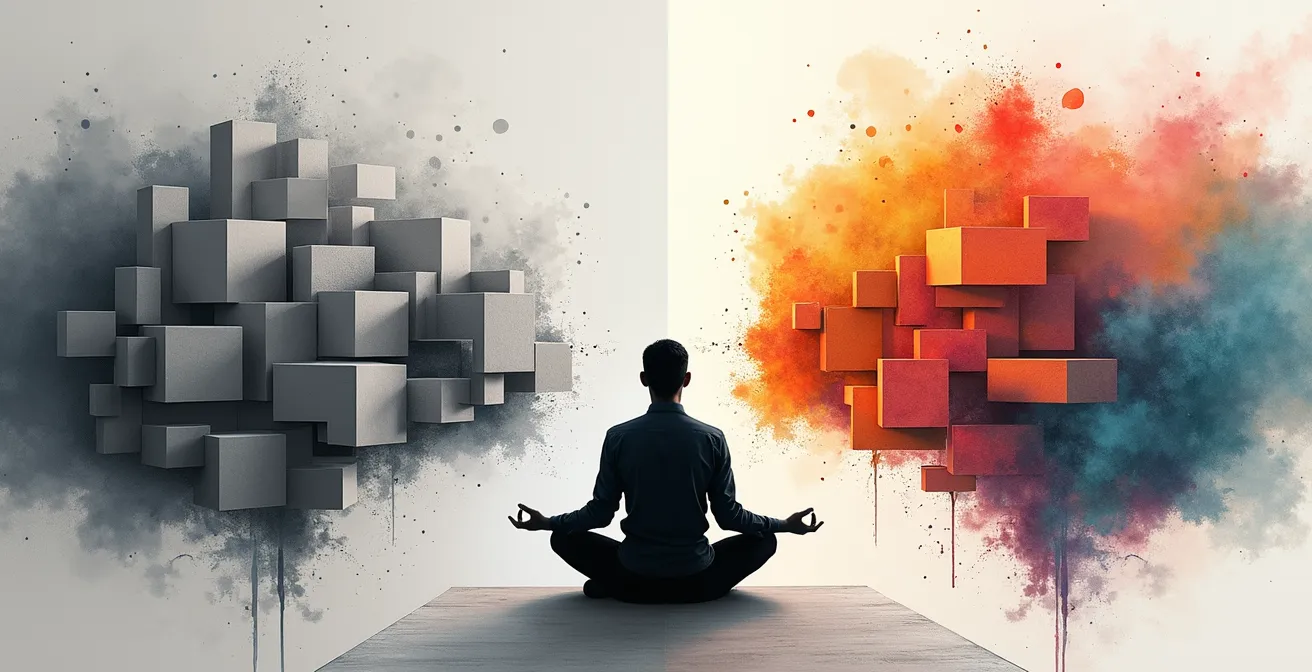
As this visual suggests, the process involves moving from a state of rigid control to one of fluid exploration. A powerful way to do this is to switch from digital to analog tools, as documented by design professional Arron. After years of corporate design, he found that sketching in notebooks and making collages from magazines broke through his identity lock-in. These tactile, low-stakes activities bypassed his inner corporate critic and allowed for experimentation without the pressure of professional standards. It’s not about making “art”; it’s about activating different neural pathways and reminding your brain that it knows how to think outside of a grid.
Optimizing Your Morning Routine to Induce Flow States
If you want to reawaken your creativity, you must stop starting your day by consuming and start it by producing. The first hour of your day is sacred ground, yet for most professionals, it’s a frantic rush of checking emails, scrolling newsfeeds, and absorbing the world’s anxieties. This immediately throws your brain into reactive, executive mode. To induce a state of flow, you need to build a moat around your morning, protecting it from external inputs. This is where you practice “Intentional Inefficiency.”
The cornerstone of this practice is what author Julia Cameron calls “Morning Pages.” As she explains, it’s a simple, non-negotiable act. Upon waking, before your phone or coffee, you write three pages of longhand, stream-of-consciousness drivel. Cameron states they are not meant to be “art” or even “writing.” They are a tool for catching your thoughts before you can judge them.
Morning Pages serve as a kind of ‘brain drain’ that allows you to release the worries, fears, and distractions standing between you and your day.
– Julia Cameron, NPR Life Kit Interview on The Artist’s Way
This is not journaling for insight; it’s a mental squeegee clearing the slate. The goal is to get the anxious, administrative, and self-critical voice out of your head and onto the page, leaving a clear space for more novel thoughts to emerge. The “Anti-Optimization Morning Framework” builds on this principle, creating a buffer between you and the world’s demands. It’s a framework built on choice and sensation, not obligation:
- First-Hour Input Fasting: Absolutely no emails, news, or social media for the first 60 minutes you are awake.
- Morning Pages: The mandatory three pages of “brain drain” writing.
- Somatic Exercises: 5 minutes of simple movement—stretching, shaking, mindful breathing—to connect with your body.
- Creative “Appetizers”: A 5-minute, no-pressure creative act, like a quick sketch, writing a single poetic sentence, or mindfully listening to one song without multitasking.
How Visiting a Museum Can Solve Your Business Problem?
For a mind conditioned by corporate efficiency, a trip to the art museum can feel like a frivolous waste of time. There are no clear objectives, no measurable outcomes, no deliverables. And that is precisely why it is one of the most powerful tools for solving your most complex business problems. This is the practice of “Creative Cross-Training,” where you train your brain in one domain (art observation) to build muscles that are directly applicable to another (strategic thinking).
When you look at a Cubist painting, you’re forced to hold multiple, contradictory perspectives in your mind at once—a skill identical to multi-stakeholder analysis in a complex project. When you sit with a piece of minimalist art, you’re learning to identify and appreciate the power of reduction to essentials—the very definition of a strong core value proposition. The museum is a gymnasium for your strategic mind, disguised as a leisure activity. Content creator Henriquez found that visiting museums was critical to overcoming her own burnout. She practiced what she called “aesthetic friction”—spending time with art she didn’t initially like or understand. This trained her brain to embrace ambiguity, a crucial skill for navigating the uncertainty of business innovation.
This table illustrates how different artistic philosophies can be directly mapped onto strategic business frameworks, as detailed in a comparative analysis by Creative Boom.
| Art Movement | Strategic Approach | Business Application |
|---|---|---|
| Impressionism | Capture fleeting moments | Agile response to market opportunities |
| Cubism | Multiple perspectives simultaneously | Multi-stakeholder analysis |
| Surrealism | Subconscious insights | Innovation through unconventional thinking |
| Minimalism | Reduction to essentials | Focus on core value proposition |
Your goal at the museum is not to “get it.” It’s to let the work rewire your patterns of seeing. By stepping away from your problem and immersing yourself in a completely different context, you allow your Default Mode Network to make novel connections your focused Executive Control Network could never find.
Sharing Your Work: When to Post Online and When to Keep It Private?
In the age of social media, the impulse to create is immediately followed by the impulse to share. We are conditioned to seek external validation—likes, comments, shares—as proof of our work’s value. For someone recovering from corporate burnout, this is a deadly trap. It outsources your self-worth and reconnects your creative act to a performance metric, dragging you right back into the “Efficiency Mindset.” The most provocative and liberating thing you can do is to practice “Output Abstinence.”
This means creating a sacred, private space for your fledgling creativity to grow, free from the judgment of others and, more importantly, from your own desire for validation. As author K.M. Weiland argues, this period of privacy is not optional; it is a mandatory part of the recovery process.
For the first 3-6 months, all creative work must be kept 100% private. The goal is to detach the act of creation from the need for external validation.
– K.M. Weiland, The Writer’s Road to Creative Burnout Recovery
Your “bad” drawings, clumsy poems, and dissonant melodies are not failures; they are data. They are evidence of you trying. Sharing them prematurely invites feedback that can crush this fragile process. You must rebuild your intrinsic motivation—the joy of the act itself—before you can withstand the unpredictable winds of public opinion. Your early work is for an audience of one: you.
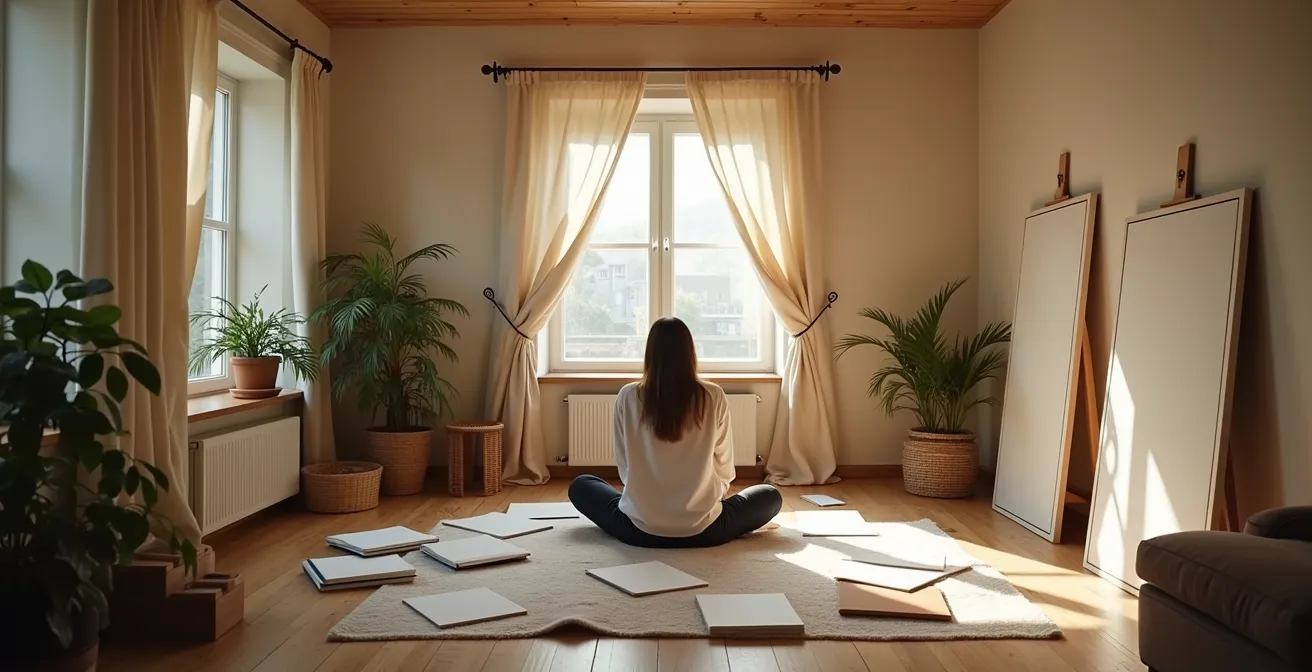
So, when is it time to share? Only when the act of sharing serves a purpose beyond validation. Are you seeking specific feedback from a trusted peer? Are you trying to connect with a community? Have you detached your self-worth from the potential reaction? Before you hit “post,” run your decision through an honest audit.
Your Sharing Readiness Checklist: A Quick Audit
- Self-Worth Check: Is my sense of accomplishment tied to the reaction this will get?
- Intention Definition: What is my specific goal for sharing (e.g., connection, feedback, or just validation)?
- Process vs. Product: Does this piece represent my experimental process or a finished idea I am ready to stand by?
- Boundary Setting: Have I created a plan to only check responses at scheduled times, not reactively?
- Audience of One: Have I maintained a separate, private creative practice alongside any public sharing?
Why 70% of Startups Fail Because They Stick to the Plan?
In the corporate world, the plan is sacrosanct. Deviating from the quarterly forecast or the project roadmap is a sign of failure. In the world of innovation and creativity, however, sticking to the plan is often the fastest path to irrelevance. The startup world understands this implicitly: the “pivot”—a fundamental change in strategy when the initial plan isn’t working—is celebrated as a sign of intelligent adaptation. This same logic must be applied to your personal creative recovery.
Your initial plan to “become more creative” might be to learn watercolor painting. You buy the supplies, you watch the tutorials, but after a month, you feel nothing but frustration. The corporate mindset says: “You failed. You are not a painter.” The startup mindset says: “This hypothesis is invalid. Time to pivot.” Maybe the real insight isn’t in painting, but in the paper-making process you discovered along the way. Maybe your true passion lies in mixing pigments, not applying them. Creative burnout is often a failure to pivot.
A case study from the fashion industry perfectly illustrates this. A veteran designer, burned out from the relentless pressure of creating “cutting-edge jeans,” was stuck. His plan was to find the next big trend in denim. On the verge of quitting, he pivoted entirely away from fashion and began a simple meditation practice. During a two-minute breathing exercise, his mind wandered to an image in a magazine, sparking an idea for a completely different kind of garment that became a bestseller. The breakthrough didn’t come from executing the plan better; it came from abandoning it altogether.
Your creative journey is not a linear project plan. It is a series of experiments. The goal is not to execute flawlessly, but to learn, adapt, and be willing to pivot when you discover something more interesting than what you set out to find. Treat your creative efforts as hypotheses to be tested, not as tasks to be completed.
Annotating Books: How Writing in Margins Improves Retention by 40%?
For the intellectually inclined professional, reading can feel like a productive way to engage with new ideas. However, most of us read passively. We consume information like we scroll a feed, letting it wash over us without true engagement. The act of annotating—of physically writing in the margins of a book—transforms this passive consumption into an active dialogue. It’s a low-stakes, intellectual form of creation that forces you to think, question, and connect ideas. It is the antithesis of the corporate brief, which is about absorbing directives, not challenging them.
This isn’t just a quaint habit; it’s a neurologically effective learning strategy. Groundbreaking research by Mueller and Oppenheimer found that taking notes by hand leads to significantly better retention and conceptual understanding compared to typing. The slower, more deliberate physical act of writing engages the brain more deeply. By annotating, you are not just recording an author’s thoughts; you are creating a record of your own thinking in response. You are creating a new, unique layer of data that exists only in your copy of the book.
To make this a truly creative practice, move beyond simple underlining. Turn your annotations into a form of “cross-pollination.” Read books completely unrelated to your field—mycology, ancient history, poetry. Then, annotate with one constant question in mind: “How is this a metaphor for my own challenges?” When you read about the way fungi networks communicate, you might find a new model for team collaboration. When you read about a failed military campaign, you might see the flaws in your current business strategy. This practice of connecting disparate fields is the very engine of innovation. It trains your mind to see patterns and build bridges, which is a far more valuable skill than simply remembering facts.
Key Takeaways
- Creative recovery requires dismantling the “Efficiency Mindset” that demands a return on investment for every action.
- True creative acts are often “inefficient” and “useless” by corporate standards, and that is their power.
- Protecting your creative process by keeping it private and choosing non-monetizable hobbies is essential for rebuilding intrinsic motivation.
How to Choose a Pastime That Actually Reduces Your Cortisol Levels?
We’ve arrived at the final, most critical piece of the puzzle. You’ve deconstructed the myths, built a protective morning routine, and learned to pivot. Now, you must choose a restorative pastime. But beware: the “Efficiency Mindset” will try to hijack this final step. It will whisper, “You’re good at this, you could sell it on Etsy,” or “You should start a blog about this.” The moment a pastime acquires a goal of optimization or monetization, it ceases to be restorative and becomes another job, complete with its own pressures and potential for burnout.
The single most important criterion for a truly restorative hobby is that it must be resolutely non-monetizable. You must choose an activity so personal, so niche, or so intentionally “unproductive” that the thought of turning it into a side hustle is absurd. This could be learning to identify local bird calls, practicing calligraphy, learning a dead language, or simply taking a walk without a destination or a fitness tracker. The goal is the total absence of a goal.
The organization Creative Restoration documents how activities like knitting circles provide profound burnout recovery, not just because of the craft itself, but because of the context. The rhythmic, repetitive movements are inherently calming to the nervous system, but the real magic is the social connection combined with a complete lack of pressure to produce commercially viable work. This allows the nervous system to “co-regulate” and finally exit the fight-or-flight state that chronic stress and burnout induce. It is the perfect antidote to the corporate world’s demand for constant, measurable output.
Choosing a pastime is not about finding what you’re “good at.” It’s about finding what allows you to be present without striving. It’s about engaging your hands, your senses, and your mind in an activity where the only ROI is the process itself. This is the ultimate act of rebellion against the corporate conditioning that stifled you. It is the final, decisive step in reawakening your creativity.
Your journey back to creativity is not a project to be managed but an existence to be reclaimed. The first step is not to create a masterpiece, but to take one small, gloriously inefficient action. Evaluate your day, identify one activity that can be done without a goal, and commit to it as an act of liberation.