
The key to stopping post-work stress eating isn’t willpower, but learning to consciously switch your body from a “fight-or-flight” state to a “rest-and-digest” mode before your first bite.
- Chronic stress keeps cortisol elevated, which hijacks your natural hunger and satiety signals.
- Simple techniques like diaphragmatic breathing can activate your vagus nerve, calming your nervous system and restoring digestive function.
Recommendation: Instead of fighting the urge to eat, perform a 3-minute nervous system “reset” ritual as soon as you get home to address the root physiological cause of the craving.
The door closes behind you, and with it, the relentless demands of the workday. A wave of exhaustion hits, but it’s tangled with a familiar, gnawing tension. Before you’ve even taken off your coat, your mind is already in the kitchen, seeking solace in the pantry. This pattern, using food as a buffer against stress, is an incredibly common experience for professionals. It’s not a failure of discipline; it’s a deeply ingrained physiological response. We are often told to find distractions, remove tempting foods, or simply “be more mindful,” but these strategies often fail because they don’t address the root cause.
The conventional advice treats emotional eating as a purely psychological problem of weak willpower. But what if the solution lies deeper, in the automatic workings of our own nervous system? The impulse to eat when stressed is not just in your head; it’s a biological command triggered by a state of high alert. This guide reframes the problem entirely. We will explore how to stop battling your cravings and instead learn to partner with your body. The true key is not to resist the urge to eat, but to first change the physiological state that creates the urge itself. By understanding how to shift from a “fight-or-flight” mode to a “rest-and-digest” mode, you can fundamentally alter your relationship with food after a long day.
For those who prefer a more condensed, guided experience, this video from Dr. Andrew Huberman explores Non-Sleep Deep Rest (NSDR), a powerful technique that can help regulate the nervous system and is a perfect complement to the strategies discussed in this article.
In this article, we’ll walk through the science and practical steps to regain control. We will break down why your body reacts this way to stress and provide actionable tools to help you create a new, healthier post-work ritual. This is about building a compassionate, science-backed approach to finally find peace at the end of your day.
Summary: The compassionate guide to ending the post-work stress-eating cycle
- Why Eating While Distracted Causes Bloating and Indigestion?
- The 20-Minute Rule: How Slower Chewing Changes Your Satiety Signals
- Optimizing Plate Size to Trick Your Brain into Feeling Full
- Intuitive Eating vs Dieting: Which Leads to Long-Term Stability?
- Hunger or Thirst: How to Decode Your Body’s False Signals?
- When to Eat Your Heaviest Meal to Maximize Sleep Quality?
- How to Activate Your Vagus Nerve to Switch Off Fight-or-Flight Mode?
- How to Cook for Gut Health Without Sacrificing Flavor?
Why Eating While Distracted Causes Bloating and Indigestion?
When you arrive home after a stressful day, your body is still operating in “fight-or-flight” mode (the sympathetic nervous system). This state is designed for survival; it diverts blood flow away from your digestive organs and towards your limbs, readying you to face a perceived threat. As a result, your digestive system essentially goes on pause. Eating a meal in this state is like asking your body to do two opposite things at once. The food sits in your stomach without the necessary enzymes or muscle contractions to be properly broken down, leading directly to uncomfortable bloating, gas, and indigestion.
This isn’t just a feeling; it’s a physiological shutdown. In fact, compelling research shows that stress completely suppresses digestive function by slowing muscular contractions and dramatically decreasing the secretion of digestive acids and enzymes. You could be eating the healthiest meal in the world, but if your nervous system is on high alert, you won’t be able to absorb its nutrients effectively. This creates a vicious cycle: you eat to soothe stress but end up feeling physically worse, which can create even more anxiety.
The first step to breaking this cycle is to create a deliberate transition from your “stress state” to your “digest state” (the parasympathetic nervous system). This isn’t optional; it’s a non-negotiable prerequisite for healthy digestion. It requires consciously signaling to your body that the “threat” is over and it is now safe to rest and digest.
Your Action Plan: 3 Steps to Switch From Stress to Digest Mode
- Recognize the Stress Signal: Before you even open the refrigerator, take a moment. Notice the physical signs of stress: tension in your jaw or shoulders, shallow breathing, or racing thoughts. Acknowledge them without judgment.
- Create a Transition Ritual: This is your buffer between work and food. It could be taking five deep, slow breaths, mindfully washing your hands with warm water, or doing a quick two-minute body scan to release tension.
- Engage Your Senses: Once you sit down to eat, put away all devices. For the first 30 seconds, simply look at your food. Notice its colors, textures, and aromas. This simple act of focused attention is a powerful signal to your brain to activate the “rest-and-digest” response.
By honoring this transition, you are not just preventing bloating; you are fundamentally changing your body’s response to food and laying the groundwork for a more peaceful eating experience.
The 20-Minute Rule: How Slower Chewing Changes Your Satiety Signals
The feeling of fullness isn’t instantaneous. It takes approximately 20 minutes for your digestive system to release satiety hormones (like cholecystokinin and leptin) and for those signals to travel to your brain, registering that you’ve had enough to eat. When you eat quickly while stressed, you can easily consume far more food than your body needs before this crucial feedback loop has a chance to engage. This is a primary driver of post-work overeating. You finish a large meal in ten minutes, only to realize twenty minutes later that you are uncomfortably full.
Slowing down is a direct intervention in this process. It’s not just about “savoring” your food; it’s a biological hack. By deliberately extending the duration of your meal to at least 20 minutes, you give your body the time it needs to naturally regulate your intake. Chewing more thoroughly also pre-digests food, making it easier for your stomach to process, which is especially important when your digestive system is already compromised by stress.
Case Study: The High-Risk Evening Window for Stress Eating
Research from the Johns Hopkins Department of Psychiatry and Behavioral Sciences identified the afternoon and evening as a particularly high-risk period for stress-induced overeating. Their study revealed that the body’s gut hormone responses to food are significantly blunted during this time, especially when under stress. This makes the commute home and the evening meal critical intervention points. Slowing down eating during this window is not just good advice; it’s a targeted strategy to counteract a known physiological vulnerability.
A powerful technique to facilitate this is the “fork down” method. It’s simple but profoundly effective at breaking the pattern of rapid, unconscious eating. The goal is to create an intentional pause between each bite.
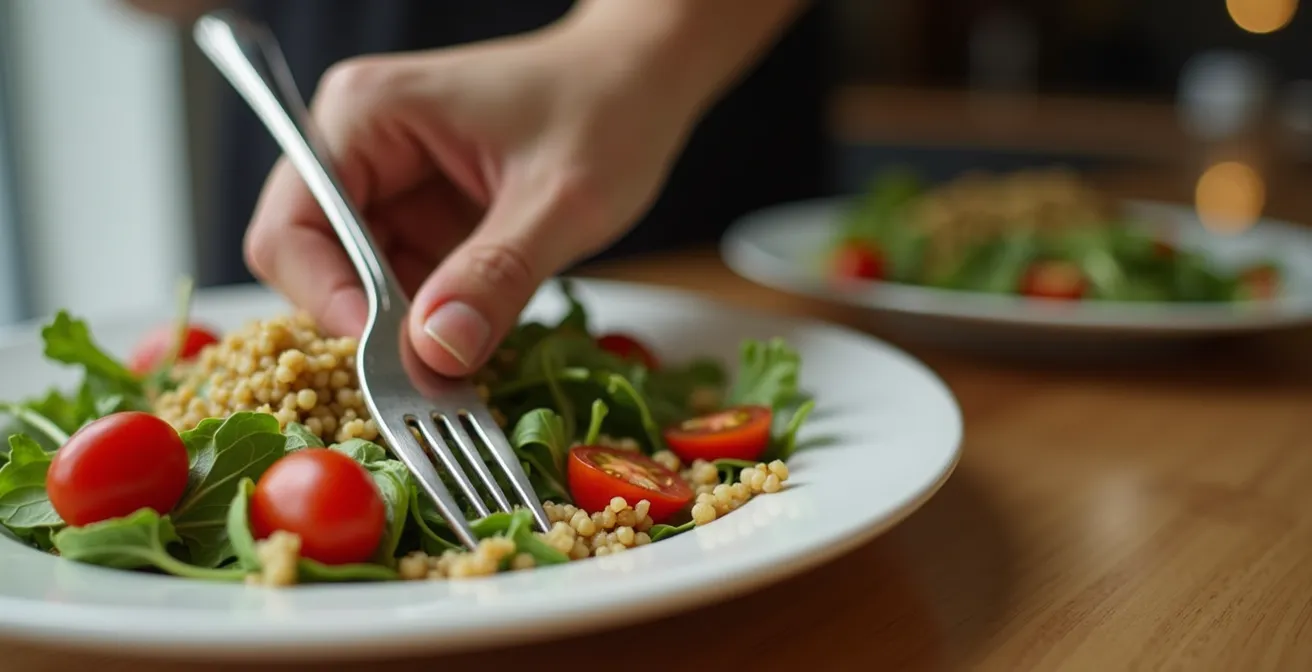
As the image illustrates, the act of physically releasing your utensil forces a moment of mindfulness. After you take a bite, place your fork or spoon down on the table. Chew your food completely, swallow, and take a single conscious breath before picking the utensil up again. This small action mechanically slows your pace, giving your satiety signals the time they need to catch up with your consumption.
This isn’t about restriction. It’s about synchronization—aligning your eating speed with the speed of your body’s internal communication system. You may be surprised to find that you feel satisfied with much less food.
Optimizing Plate Size to Trick Your Brain into Feeling Full
Your eyes play a significant role in determining how much you eat, often overriding your stomach’s signals. This is due to a powerful visual illusion known as the Delboeuf illusion. The same amount of food will look significantly smaller on a large plate than it does on a smaller one. When you come home stressed and hungry, your brain is wired to seek abundance. If you serve your meal on a standard 12-inch dinner plate, your portion may look sparse, prompting you to add more food than you actually need to feel satisfied.
By simply switching to a smaller plate—around 9 inches in diameter—you can “trick” your brain into perceiving the same portion as being more substantial and satisfying. This isn’t about deprivation; it’s about using psychology to your advantage. You are aligning the visual cue of a “full plate” with a more appropriate amount of food, which helps manage consumption without feeling restricted. This simple environmental change can have a dramatic impact on your calorie intake, especially during moments of mindless eating.
This principle extends beyond just plate size. The color contrast between your food and your plate, and even the shape of your glassware, can influence your perception of quantity. These are not gimmicks, but rather evidence-based strategies to create an environment that naturally supports more mindful portion control.
The following table, based on extensive research in visual perception and consumption, breaks down how you can use these environmental cues to your advantage. As this analysis of portion control strategies shows, small changes can lead to significant reductions in consumption.
| Strategy | Visual Effect | Expected Consumption Reduction | Best For |
|---|---|---|---|
| Smaller Plate (9-inch vs 12-inch) | Same portion appears larger | 22% less food consumed | Main meals |
| High Color Contrast | Food appears more substantial | 18% reduction | Pasta, rice dishes |
| Tall Narrow Glasses | Liquid appears more voluminous | 30% less poured | Beverages, smoothies |
| Pre-portioned Containers | Eliminates decision fatigue | 25% better portion control | Snacks, meal prep |
It’s important to remember that the comfort derived from stress eating is fleeting. As Dr. Susan Albers, a leading psychologist in this field, points out, the relief it provides is incredibly short-lived, often replaced by feelings of guilt and physical discomfort. As she states in her work for the Cleveland Clinic:
Research shows that stress eating only makes us feel better for about three minutes.
– Dr. Susan Albers, Cleveland Clinic – Stress Eating: Why It Happens and How To Stop
Intuitive Eating vs Dieting: Which Leads to Long-Term Stability?
For many professionals struggling with stress eating, the default response is to impose a new diet. This approach seems logical: create strict rules about what, when, and how much to eat. However, this often backfires spectacularly. Dieting operates on a principle of restriction, which creates a state of psychological scarcity. When you label foods as “bad” or “off-limits,” you inadvertently increase their allure. After a day of depleting your willpower at work, the resolve to stick to these rigid rules crumbles, leading to what feels like a “rebellion” binge. You’re not just eating because you’re stressed; you’re eating in defiance of the rules that made you feel deprived.
Intuitive eating offers a radical alternative. It’s not a diet but a framework for rebuilding trust between your mind and body. The core principle is to reject the diet mentality entirely. There are no “good” or “bad” foods, only choices that make you feel good and choices that don’t. By giving yourself unconditional permission to eat all foods, you strip them of their power. A cookie is just a cookie, not a forbidden treasure. This removes the psychological charge and the entire restrict-rebel-binge cycle that diets perpetuate.
Case Study: Why Logical Diets Fail Under Emotional Pressure
Analysis from the mental health resource HelpGuide reveals a critical flaw in traditional dieting: it provides logical nutritional advice that only works when you have conscious, rational control over your eating habits. This control center is one of the first things to go offline when strong emotions, like post-work stress, hijack the process. Your brain demands an immediate payoff, and the restrictive rules of a diet only fuel the desire for a rebellious binge. Intuitive eating dismantles this by removing the rules, which in turn removes the motive for rebellion, allowing for a more stable and peaceful relationship with food.
Transitioning to intuitive eating is a gradual process of unlearning years of diet culture. It starts with practicing awareness without judgment. You begin to notice when you’re eating for physical hunger versus emotional reasons. From there, you learn to ask, “What am I really feeling right now? What does this food do for me emotionally?” Sometimes, you’ll still choose to eat the food for comfort, and that’s okay. Other times, you’ll realize what you truly need is a nap, a walk, or a conversation with a friend. Intuitive eating empowers you to make a conscious choice, rather than acting on a compulsive, stress-driven urge. It’s about honoring both pleasure and your long-term well-being.
This shift in mindset is the foundation for long-term stability. It moves you away from a constant battle with food and toward a compassionate partnership with your body, where all its needs—emotional and physical—are heard and respected.
Hunger or Thirst: How to Decode Your Body’s False Signals
The signals for hunger and thirst originate from the same part of the brain (the hypothalamus), and they can be easily confused, especially when stress is involved. After a difficult day, your body is often dehydrated and fatigued. Your brain can misinterpret these signals of exhaustion or thirst as a sudden, urgent need for food, particularly for quick-energy sources like sugar and refined carbohydrates. You feel a craving and assume it’s hunger, but what your body might actually be asking for is water or rest.
Furthermore, stress itself is a master of deception. The primary stress hormone, cortisol, plays a crucial role here. During a stressful event, cortisol (along with adrenaline) mobilizes energy for the fight-or-flight response. Afterwards, its levels should fall. However, the chronic, low-grade stress of a demanding job means this often doesn’t happen. As Harvard Medical School research indicates, if stress doesn’t go away, cortisol may stay elevated, which directly increases appetite and the motivation to eat. This elevated cortisol can override your body’s natural satiety signals, making you feel hungry even if you’ve eaten recently. Your body is stuck in a primitive mode, trying to stock up on energy for a threat that never fully disappears.
Learning to decode these false signals is a critical skill for stopping emotional eating. Before acting on a sudden craving, it’s helpful to pause and play detective. Ask yourself: “When was the last time I drank water?” “Am I feeling tired more than hungry?” A simple and effective method is the 15-minute hydration test. When a strong, specific craving hits after work, drink a large glass (16oz) of water and then wait for 15 minutes. Distract yourself with another task. More often than not, you’ll find the intense “hunger” has subsided, revealing that it was thirst or a fleeting stress response in disguise.
True physical hunger, in contrast, tends to build gradually. It’s less specific about what it wants—many different foods would be appealing—and it’s often accompanied by physical cues like a growling stomach. A stress-induced craving is typically sudden, urgent, and for a very specific type of food (e.g., salty chips, a sugary pastry). Recognizing this difference is empowering.
By learning to question your initial cravings and test them with hydration or a short rest, you can begin to untangle the wires of stress, thirst, and genuine hunger, giving your body what it truly needs.
When to Eat Your Heaviest Meal to Maximize Sleep Quality?
The timing and composition of your evening meal have a profound impact on your ability to get restorative sleep, which is your body’s primary tool for managing stress. Eating a large, heavy meal late at night forces your digestive system to work overtime when it should be winding down. This can raise your body temperature and heart rate, directly interfering with the natural processes that initiate sleep. Furthermore, a full stomach can cause physical discomfort and acid reflux when you lie down, leading to fragmented, poor-quality sleep.
When you’re chronically stressed, your sympathetic nervous system (“fight-or-flight”) is already overactive. This state is antithetical to sleep. The American Psychological Association’s 2021 study on stress in America highlighted this connection, noting that 84% of U.S. adults experienced at least one emotion associated with prolonged stress, which significantly impacts sleep patterns by disrupting the production of melatonin, the sleep hormone. Eating a large meal late in the evening adds fuel to this fire, keeping your body in an activated state and preventing the transition into the deep, restful sleep needed to repair and reset.
For optimal sleep quality and stress management, a widely supported strategy is to make your midday meal the largest of the day and your evening meal the lightest. Aim to finish your dinner at least two to three hours before you go to bed. This gives your body ample time to complete the most demanding phase of digestion before you lie down. A lighter evening meal, focused on easily digestible proteins, cooked vegetables, and healthy fats, provides the nutrients you need without overburdening your system.

As shown in the image, an ideal evening meal is not about restriction but about thoughtful composition. It’s serene and simple. This approach not only supports better sleep but also helps break the cycle of using a large, heavy dinner as an emotional release valve. When you sleep better, your cortisol levels are better regulated the next day, you have more emotional resilience, and you’re less likely to fall into the stress-eating trap to begin with.
This shift can feel challenging at first, but by front-loading your caloric intake earlier in the day, you provide your body with energy when it’s most active and allow it the peaceful rest it desperately needs at night.
How to Activate Your Vagus Nerve to Switch Off Fight-or-Flight Mode?
The most direct way to combat the physiological drive to stress-eat is by consciously activating your vagus nerve. This is the main nerve of your parasympathetic (“rest-and-digest”) nervous system. Think of it as the master switch that can manually override your body’s “fight-or-flight” alarm. Stimulating this nerve sends a powerful signal to your brain and body that you are safe, effectively putting the brakes on the stress response, lowering your heart rate and blood pressure, and bringing your digestive system back online. This is the core practice that underpins all other strategies.
Instead of trying to distract yourself from a craving, you can perform a short ritual as soon as you get home to down-regulate your nervous system. These techniques are simple, free, and can be done in just a few minutes. One of the most effective methods is diaphragmatic breathing, or “belly breathing.” By taking slow, deep breaths that engage your diaphragm, you directly stimulate the vagal fibers that pass through it. Other powerful techniques include humming, singing, or gargling, as the vibrations in your throat also activate the nerve.
Another surprisingly effective method is brief exposure to cold, such as splashing cold water on your face. This triggers a primitive response called the mammalian dive reflex, which instantly slows the heart rate and redirects blood flow—a potent vagal activator. By creating a 3-minute post-work protocol combining these exercises, you can create a powerful buffer between your stressful day and your evening meal, addressing the root cause of the craving before it takes hold.
Case Study: The Optimal Breathing Rate for Vagal Activation
While many breathing exercises work, research examining specific breathing rates has found a sweet spot for maximizing vagal tone. A study highlighted by Oxygen Advantage discovered that a rhythm of 5.5 breaths per minute, with an equal 5-second inhalation and 5-second exhalation, most significantly increased Heart Rate Variability (HRV), a key marker of healthy vagal tone. This shows that the key isn’t just breathing slowly, but finding a coherent rhythm that synchronizes your breath with your nervous system’s natural cadence.
By consistently practicing these techniques, you are not just managing stress in the moment; you are retraining your nervous system over time, building greater resilience and making the compulsive urge to eat for comfort a much less frequent visitor.
Key Takeaways
- Emotional eating is a physiological response to stress, not a moral failing. Your “fight-or-flight” system shuts down digestion and creates cravings.
- You can manually switch to “rest-and-digest” mode by activating your vagus nerve through techniques like deep breathing and cold exposure.
- Slowing down your meal to at least 20 minutes and using smaller plates are practical, science-backed ways to align your eating with your body’s natural satiety signals.
How to Cook for Gut Health Without Sacrificing Flavor?
Embracing a lifestyle that supports your nervous system and digestion doesn’t mean you have to eat bland, boring food. In fact, the opposite is true. Cooking for gut health is about adding flavor and diversity, which directly feeds the beneficial bacteria in your gut microbiome. A healthy gut is crucial for a stable mood and robust stress resilience, thanks to the gut-brain axis, a constant biochemical conversation between your digestive tract and your brain.
As Harvard Health Publishing notes, this connection is central to understanding how we feel. The gut is often called our “second brain” for good reason. Its health directly influences our mental and emotional state.
The gut-brain axis helps explain why researchers are interested in understanding how psychological or social stress might cause digestive problems.
– Harvard Health Publishing, Harvard Medical School – Stress and The Sensitive Gut
To support this vital connection, focus on incorporating a wide variety of plant-based foods, which are rich in fiber and polyphenols—the preferred food for your good gut bacteria. Aim to “eat the rainbow” by including different colored vegetables and fruits in your meals. Flavor doesn’t have to come from excessive salt, sugar, or unhealthy fats. Aromatic herbs like rosemary, thyme, and oregano, along with spices like turmeric, ginger, and cumin, are packed with anti-inflammatory compounds that both delight your palate and calm your system. Fermented foods like yogurt, kimchi, and sauerkraut are also powerhouses, delivering live probiotics directly to your gut.
Think of cooking not as a chore, but as an act of self-regulation. The process itself can be a mindful transition from your workday. The chopping of vegetables, the smell of spices, the focus required to follow a recipe—all of these can be part of your ritual to shift out of a stress state. By preparing meals that are both delicious and nourishing for your gut microbiome, you create a positive feedback loop: you enjoy your food, your gut thrives, your mood stabilizes, and your resilience to stress increases, making you less likely to need food as a coping mechanism in the first place.
Ultimately, this approach integrates all the principles we’ve discussed. It is the long-term, sustainable practice that turns the science of nervous system regulation and mindful consumption into a delicious and enjoyable daily reality. To begin applying these strategies effectively, the next logical step is to assess which techniques will integrate most easily into your specific post-work routine.
Frequently Asked Questions on How to Stop Emotional Eating
Why do I crave sugar specifically when I’m tired after work?
Fatigue triggers cravings for quick energy sources. Your brain mistakes exhaustion for low blood sugar and demands immediate glucose, but what you actually need is rest, not food.
How can I tell if I’m actually hungry or just dehydrated?
True hunger builds gradually and you’re open to various food options. Thirst-disguised-as-hunger comes on suddenly with specific cravings. Try the 15-minute hydration test: drink 16oz of water and wait.
Why does stress make me feel hungry even after eating lunch?
Stress hormones like cortisol can override your body’s natural satiety signals, making you feel hungry even when your stomach is full. This is your body’s primitive response to stock up on energy for perceived threats.