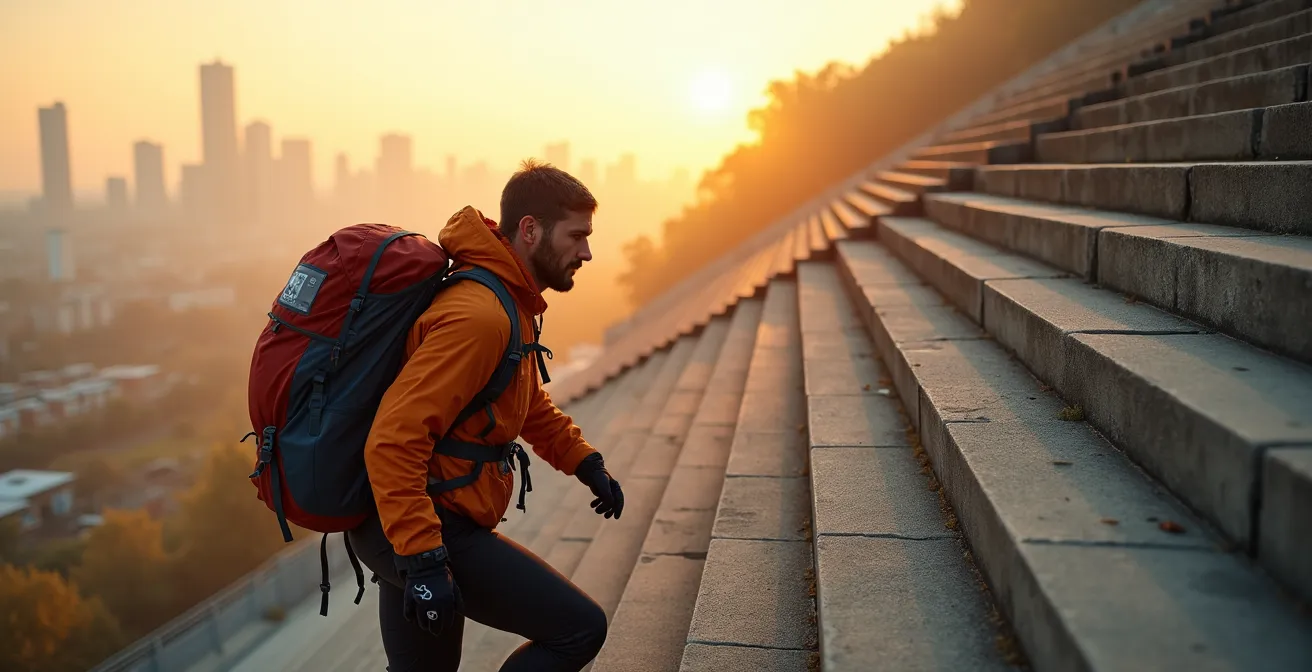
Training for the alpine isn’t about mimicking altitude; it’s about forging a body so metabolically efficient and a mind so disciplined that you can withstand the inevitable physiological breakdown above the treeline.
- Your success hinges on building an aerobic base for fuel efficiency (Zone 2 training), not just a high VO2 max.
- Mastering system integrity—gear, nutrition, and self-awareness—is non-negotiable for survival when things go wrong.
Recommendation: Stop chasing shortcuts and start building a robust survival engine through disciplined, low-intensity endurance and eccentric strength work.
The city skyline is your horizon. The highest point you see is a skyscraper, and the air is thick and heavy. Yet, the high peaks call to you—the jagged silhouettes of the Alps, the Andes, the Cascades. The biggest lie the fitness industry sells to aspiring mountaineers like you is that you can “hack” your way to the summit. You see ads for hypoxic masks, specialized supplements, and weekend warrior training plans. They promise a shortcut from the concrete jungle to the death zone.
This is a dangerous illusion. The mountain doesn’t care about your gear or your gym stats. It is an unforgiving environment that exposes every weakness in your physical and mental preparation. It breaks down the unprepared, systematically and without mercy. True preparation for high altitude, especially when you live at sea level, has nothing to do with gimmicks. It is about building a physiological survival engine—a body so metabolically efficient and a mind so disciplined that it can function under extreme cellular stress.
For those who prefer a visual deep dive into the mindset of pushing limits, the following video on Adam Ondra’s ascent of the world’s hardest route, while not about mountaineering, perfectly captures the essence of discipline and physical mastery required.
This guide will not give you easy answers. It will give you the hard truths. We will dismantle common myths, define the real metrics of readiness, and build a foundational strategy for gear, nutrition, and insurance—the complete system required to not just survive, but to succeed in the high places of the world.
Summary: Training for Alpine Peaks from Sea Level
- Hypoxic Masks vs Stair Climbing: What Actually Mimics Thin Air ?
- Acute Mountain Sickness: How to Recognize the Symptoms Before Edema Sets In ?
- Down vs Synthetic: Which Layer Saves Your Life in a Wet Snowstorm ?
- The Appetite Loss Problem: How to Force Calories Down at 4000 Meters ?
- Optimizing Acclimatization: The “Climb High, Sleep Low” Rule Explained
- Elevation Gain vs Distance: Which Metric Kills Your Knees ?
- Optimizing VO2 Max: The Single Best Predictor of Longevity ?
- How to Prepare for Extreme Sports Travel Without Voiding Your Insurance ?
Hypoxic Masks vs Stair Climbing: What Actually Mimics Thin Air ?
Let’s get this out of the way: those hypoxic training masks are, for mountaineering purposes, mostly useless. They restrict air intake, making it harder to breathe. This trains your respiratory muscles, but it does not simulate the low partial pressure of oxygen that defines high altitude. It’s like trying to learn to swim by tying your hands behind your back. You’re fighting resistance, not adapting to a fundamentally different environment. True adaptation comes from forcing your body to become more efficient with the oxygen it gets, not from simply making it harder to get air.
Stair climbing with a weighted pack is a far superior tool. It builds sport-specific strength and cardiovascular endurance. But to truly touch the edges of hypoxic training at sea level, you need to manipulate your body’s chemistry. This is done through targeted breathing exercises. Research has shown that specific breath-holding techniques can stimulate a 24% EPO release increase, the hormone that triggers red blood cell production. This is a real physiological adaptation.
The discipline is to integrate practices like box breathing or short, controlled breath-holds after exhalation into your daily routine. This isn’t about causing dizziness; it’s about introducing small, manageable doses of cellular stress that signal your body to adapt. Combine this with relentless hours on the stair machine or hiking stadium steps. You aren’t just training your lungs; you are re-engineering your entire oxygen transport system from the ground up.
Acute Mountain Sickness: How to Recognize the Symptoms Before Edema Sets In ?
At altitude, your body begins to break down. This is not a possibility; it is a certainty. Your job is not to prevent it entirely, but to manage it and recognize the red flags before it becomes a life-threatening crisis like High-Altitude Pulmonary or Cerebral Edema (HAPE/HACE). The mountain is a brutal environment where it is estimated that you lose about 1% of your exercise capacity for every 100 meters you ascend above 1,500m. This physical degradation is accompanied by a host of symptoms. The key to survival is honest self-assessment.
A slight headache, fatigue, and waking up frequently at night are normal. Your body is screaming at you that it’s in a hostile environment. But you must learn to distinguish this normal discomfort from the warning signs of a catastrophic failure. A crushing headache that doesn’t respond to painkillers, a wet cough, or losing your balance (ataxia) are not signs of toughness. They are signals of edema—fluid filling your lungs or brain. Pushing through these is suicide.
Every mountaineer must have an unwavering understanding of these differences. The following table is not just information; it is a life-or-death decision matrix. Study it. Memorize it. Be brutally honest with yourself and your team when you identify a red flag. The mountain will be there next year. Your life is non-negotiable.
| Normal Altitude Response | Red Flag – Immediate Descent Required |
|---|---|
| Waking up frequently at night | Severe lethargy and inability to get out of sleeping bag |
| Slight headache relieved by ibuprofen | Crushing, persistent headache unresponsive to medication |
| Mild shortness of breath on exertion | Difficulty breathing at rest or gurgling sounds in chest |
| Reduced appetite | Persistent nausea with vomiting |
| Fatigue during activity | Loss of balance (ataxia) or confusion |
Down vs Synthetic: Which Layer Saves Your Life in a Wet Snowstorm ?
Your clothing is not fashion; it is a life-support system. When you are thousands of meters up, a failure in your layering system can be as fatal as a fall. The classic debate is down versus synthetic insulation. Down offers incredible warmth for its weight and is highly compressible. In dry, cold conditions, it is unmatched. But introduce moisture—from a wet snowstorm, from sweat inside your jacket—and down becomes a liability. It clumps together, loses its loft, and its insulating properties plummet. Your body is then forced to burn precious calories to stay warm, accelerating exhaustion and hypothermia.
Synthetic insulation, while slightly heavier and less compressible, is your lifeline in wet conditions. It retains a significant portion of its insulating ability even when damp. In a classic Cascades wet snowstorm or during a grueling multi-day effort where drying gear is impossible, a synthetic puffy jacket is not just a piece of gear; it’s your survival margin. The choice is not about which is “better” in the abstract, but which provides the most robust defense against the worst-case scenario. For serious mountaineering where conditions are unpredictable, system integrity demands synthetic insulation for your critical outer layers.
This image demonstrates the importance of a well-structured layering system, designed to manage moisture and temperature across a range of conditions. It is a system, and every component must function perfectly.

Ultimately, the choice of a single jacket is less important than your holistic approach. This includes waterproof gloves, proper base layers to wick sweat, and a sacred, always-dry set of sleeping layers. Your entire clothing system must work in concert to manage moisture and heat, protecting the engine you’ve worked so hard to build.
The Appetite Loss Problem: How to Force Calories Down at 4000 Meters ?
As you ascend, your body wages war on itself. One of the first casualties is your appetite. The physiological stress of hypoxia—at Mt. Kilimanjaro’s summit, for instance, oxygen pressure is just 49% of that at sea level—triggers nausea and suppresses hunger signals. This is not a minor inconvenience. It is a critical problem that can end your expedition. A mountaineer who isn’t eating is a mountaineer who is running out of fuel. Your body will begin to cannibalize muscle for energy, your cognitive function will decline, and your ability to stay warm will evaporate. You must treat eating as a mandatory task, like tying your boots.
The solution is not to simply pack more of your favorite snacks. At altitude, your palate is deadened. Sweet things become cloying, and complex flavors are lost. You need to outsmart your own biology with a “Palate Rescue Kit” designed for this specific failure mode. Your goal is to deliver calories in a way that bypasses your brain’s refusal to eat. This means relying on strong, simple, and primal flavors.
Think salty, sour, and spicy. Instant miso soup packets provide a savory, sodium-rich broth that can cut through nausea. Sour gummy candies can shock your taste buds back to life. Single-serving hot sauce packets can make bland food palatable. Most importantly, you must have a plan for liquid calories. A custom drink mix with tasteless carbohydrates like maltodextrin and dextrose, combined with electrolyte powder, allows you to hydrate and fuel simultaneously, even when the thought of solid food is repulsive. Forcing down calories when your body is screaming “no” is a discipline, and you must train for it.
Optimizing Acclimatization: The “Climb High, Sleep Low” Rule Explained
You cannot cheat acclimatization. It is the single most important factor for success and survival at high altitude. Your body needs time to make long-term physiological adaptations—producing more red blood cells, increasing capillary density, and improving oxygen uptake. The mantra that governs this process on the mountain is “climb high, sleep low.” This principle is the practical application of controlled stress and recovery.
The methodology is simple in theory, but demanding in practice. During the day, you push your body by ascending to a new, higher altitude. You spend a few hours there, exposing your system to increased hypoxic stress. This exposure acts as the signal, telling your body it needs to adapt. Then, crucially, you descend to a lower altitude to sleep. The recovery phase at a lower elevation allows your body to rest more effectively and begin the work of adaptation—repairing tissue and building new red blood cells—without the overwhelming stress of sleeping in a profoundly hypoxic environment. This is the core of building a true survival engine. As one study on simulated altitude showed, the gains from this principle are not temporary; they are real physiological changes that last.
Case Study: The Live-High, Train-Low Principle
While mountaineers practice “climb high, sleep low,” endurance athletes use a related principle: “live high, train low.” A study using simulated altitude exposure for 18 days while athletes continued to train at lower elevations showed significant performance gains that were still evident 15 days later. This validates the core concept: measured exposure to hypoxia, combined with proper recovery and maintaining workout intensity, is the key to unlocking physiological adaptations.
This rhythm of stress and recovery, repeated over days and weeks, is what builds a truly acclimatized mountaineer. It allows you to progressively and safely push higher, giving your body a fighting chance to keep up with the demands of the ever-thinning air.
Elevation Gain vs Distance: Which Metric Kills Your Knees ?
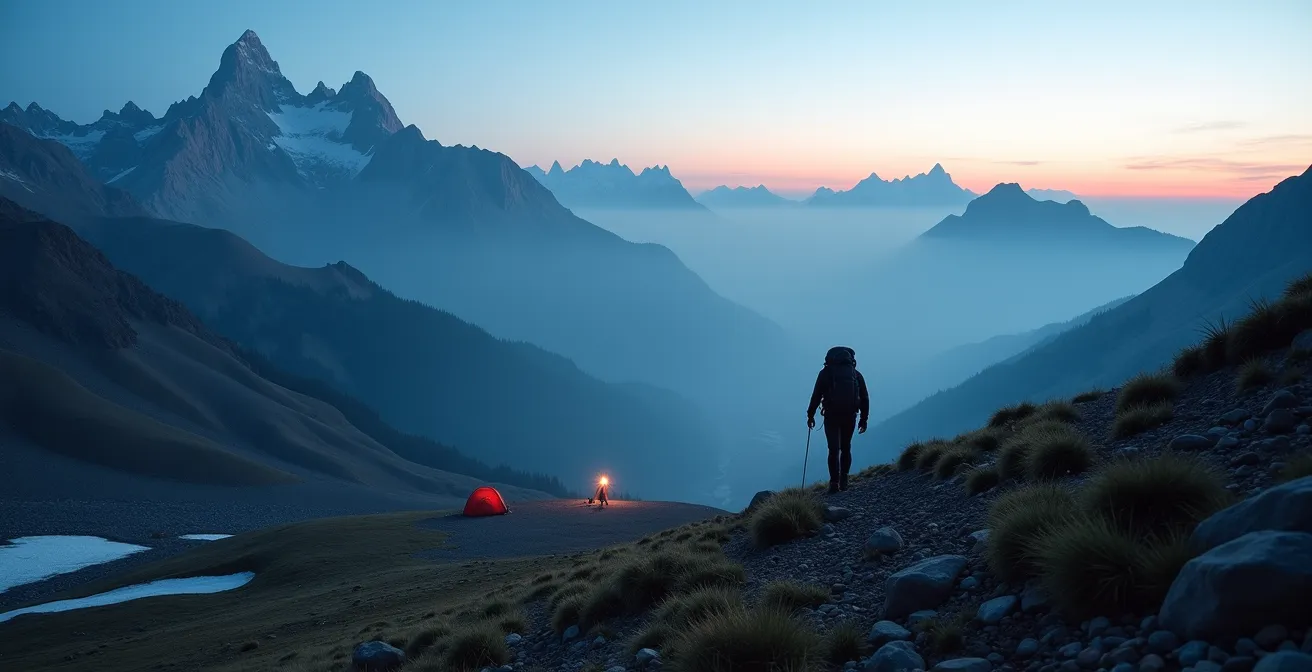
For the sea-level athlete, training for the mountains presents a paradox: how do you prepare for thousands of feet of vertical gain when your world is flat? Many make the mistake of focusing on distance, logging endless miles on flat roads. While this builds cardiovascular health, it does nothing to prepare your joints and stabilizer muscles for the brutal, eccentric loading of a long descent. Distance doesn’t kill your knees; uncontrolled elevation gain does. Specifically, the descent.
Every step downhill is an eccentric contraction: your quadriceps are firing while lengthening to absorb the impact. This is what causes debilitating muscle soreness and, over time, chronic knee injuries. You must train this specific motion. Find the tallest building, the biggest stadium, or the steepest hill you can access. Load a pack with 30-50 pounds and do laps. The ascent builds your engine; the descent builds your armor. Your goal is to make this eccentric load so familiar to your musculoskeletal system that it becomes routine.
This isn’t about speed. It’s about control and volume. Use trekking poles to distribute the load. Focus on a deliberate, heel-to-toe foot placement. As REI’s experts succinctly put it, the strategy is clear. In an article on mountaineering training, they state:
The key to saving your knees is building eccentric strength
– REI Expert Advice, How to Train for Mountaineering
Forget your marathon personal bests. The relevant metric for a mountaineer is how many thousands of feet of loaded vertical you can ascend and, more importantly, descend in a single session without your form breaking down. This is the work that separates tourists from mountaineers.
Optimizing VO2 Max: The Single Best Predictor of Longevity ?
In the world of flat-land endurance sports, VO2 max is king. It’s a measure of the maximum amount of oxygen your body can utilize during intense exercise. A high VO2 max is impressive, and it’s certainly a marker of good cardiovascular health. But on a high-altitude peak, it is not the most important metric. In fact, an over-reliance on high-intensity interval training to boost VO2 max can be counterproductive for a mountaineer. Initially, your VO2 max drops considerably by around 7% for every 1000m of elevation gain, so your top-end power is severely compromised anyway.
Mountaineering is not a sprint; it’s an ultra-endurance event performed at low intensity for 8, 10, or 12 hours a day. Success in this realm is dictated by metabolic efficiency: your body’s ability to burn fat for fuel at low heart rates, sparing precious glycogen stores for when you truly need them. The key to building this efficiency is Zone 2 training—long, slow, disciplined hours spent keeping your heart rate just at your aerobic threshold.
Case Study: The Uphill Athlete Philosophy
The training methodology pioneered by Uphill Athlete argues forcefully that mountaineers and other mountain athletes achieve better results by focusing the vast majority of their training time at or below their aerobic threshold (the top of Zone 2). This approach prioritizes building a massive aerobic base. In an environment where every movement is difficult and oxygen is scarce, the athlete with the most efficient fuel system—the one who can operate for hours on their fat stores—will outperform the athlete with a higher top speed but poor endurance.
This is the unglamorous work. It means resisting the urge to push into the red zone. It’s hours on a treadmill at a steep incline, hours on a stair-climber, or long hikes with a weighted pack, all while keeping your heart rate frustratingly low. You are not training to be fast; you are training to be unbreakable. You are building a diesel engine, not a drag racer. This is the single most important training adaptation for a sea-level athlete aiming for the peaks.
Key Takeaways
- True altitude readiness is built on metabolic efficiency (Zone 2 training), not just a high VO2 max.
- Your gear is a life-support system; synthetic insulation is non-negotiable for unpredictable, wet conditions.
- You must have a disciplined nutrition strategy to force down calories, especially liquids, when appetite fails.
How to Prepare for Extreme Sports Travel Without Voiding Your Insurance ?
You can have the strongest legs and the most efficient aerobic engine in the world, but if your logistical safety net fails, your expedition is over. In the high mountains, that safety net is your insurance. Showing up with a standard travel insurance policy is naive and dangerous. Most basic policies explicitly exclude activities like mountaineering over a certain altitude, leaving you completely exposed if you need a rescue or medical evacuation.
Understanding the “Trinity of Alpine Insurance” is not optional; it is a critical component of your planning. These are three distinct types of coverage that work together. Standard travel insurance covers trip cancellation or delays. Rescue insurance covers the cost of getting you from the point of injury to a medical facility—think a helicopter evacuation from a high camp. Finally, medical evacuation insurance covers transport from that local clinic back to a hospital in your home country. You often need all three from specialized providers.
The following table breaks down what each type of coverage handles. Failure to secure the right combination can result in a six-figure bill for a single rescue operation.
| Coverage Type | What It Covers | What It Doesn’t Cover |
|---|---|---|
| Travel Insurance | Trip cancellation, interruption, delays | Rescue operations or medical evacuation |
| Rescue Insurance | Helicopter/rescue costs from injury point | Medical treatment or repatriation home |
| Medical Evacuation | Transport from local clinic to home hospital | Initial rescue or ongoing medical care |
Beyond the policy itself, your preparation must include a robust digital dossier. In a crisis, you won’t have time to search for policy numbers or emergency contacts. This information must be immediately accessible.
Your Emergency Digital Dossier Checklist
- Store a photo of your passport in a secure, cloud-accessible folder.
- Save your full insurance policy document (all three types) offline on your phone.
- Include the 24/7 emergency contact number for your insurer and rescue service.
- Add your rescue service membership number (e.g., Global Rescue).
- Document all personal medications and known allergies clearly.
Your preparation is a complete system. Your physical conditioning, your gear, your nutrition, and your logistical planning are all interconnected. A failure in one domain will cascade and jeopardize the entire enterprise. Approach your training with the discipline the mountain demands, and you will earn your place among the peaks.
Frequently Asked Questions on How to Train for Alpine Peaks While Living at Sea Level ?
Should I wear my insulation layer while actively climbing?
No, use ‘active insulation’ like Polartec Alpha while moving to prevent sweat buildup. Save your big puffy for stops and camp.
What’s more important than jacket choice in cold conditions?
A complete system approach including waterproof gloves, vapor barrier liner socks, and a sacred dry sleeping layer set.
How does wet down create a survival crisis?
Wet down loses loft, forcing your body to burn precious calories for heat generation, leading to rapid energy depletion and exhaustion.