In summary:
- The biggest frustration at historic sites isn’t just the crowds, but the superficial experience they create.
- The solution is to shift your mindset from a ‘tourist’ to a ‘temporary custodian,’ focusing on strategic timing, narrative control, and meaningful support.
- Mastering the “golden hour” before closing, choosing your guide type wisely, and exploring alternative sites are key tactics.
- Your visit becomes a contribution, not just a transaction, by understanding how your ticket or donation supports restoration.
There’s a universally shared moment of disappointment familiar to any culture lover: you arrive at a hallowed monument, a place that has lived in your imagination for years, only to find it obscured by a sea of smartphones and echoing with the chatter of a thousand conversations. The fight for a clean photo, the endless queues, and the sense of being rushed through a space that demands quiet contemplation can drain all the magic from the experience. We are told the standard advice: go in the off-season, book tickets online, arrive early. While practical, these tips only scratch the surface of the problem.
These common tactics treat the symptom—the crowds—but not the underlying disease: a shallow, consumerist approach to cultural heritage. They don’t help you connect with the soul of a place, understand its stories, or feel the weight of its history. But what if the true strategy wasn’t just about avoiding people, but about fundamentally changing your relationship with the site itself? What if you could recast your role from a passive tourist to an active, engaged participant—a temporary custodian of its legacy?
This guide moves beyond the generic hacks. It offers an insider’s framework for forging a profound, personal connection with the world’s most treasured places. We will explore how to strategically manipulate time, control the narrative of your visit, and ensure your presence is a positive force for preservation. It’s a methodology for turning a crowded, frustrating visit into a memorable and meaningful pilgrimage.
This article provides a complete strategic framework for your next cultural journey. Discover insider tactics, from choosing the right time to visit to ensuring your financial support has a real impact, all organized in the table of contents below.
Summary: How to Visit Historic Monuments for a Deeper Experience
- The “Golden Hour” Ticket: Why Visiting Museums at Closing Time is Better?
- Audio Guide vs Private Guide: Is the Extra Cost Worth the Insight?
- The Alternative List: Visiting Lesser-Known Monuments for a Better Experience
- Tripods and Flash: What Are the Rules in Sacred Spaces?
- Ticket Price vs Donation: How to Ensure Your Visit Helps Restoration?
- The Economic Impact of Supporting Local Art Studios vs Chain Workshops
- Audiobooks vs Physical Books: Do They Stimulate the Brain Differently?
- How to Distinguish Genuine Eco-Tourism from Greenwashing Marketing?
The “Golden Hour” Ticket: Why Visiting Museums at Closing Time is Better?
The most common advice for avoiding crowds is to arrive at opening time. While this can work, it creates a frantic race against the clock as more visitors pour in behind you. The truly strategic move is to target the end of the day. Most tourists, especially families or large tour groups, begin to depart an hour or two before closing, creating a precious window of tranquility. This “golden hour” isn’t just about emptiness; it’s about the quality of the experience. Major institutions like the Metropolitan Museum of Art have seen visitor numbers rebound significantly, with attendance data showing over 5.5 million visitors in a year, making timing strategies more critical than ever.

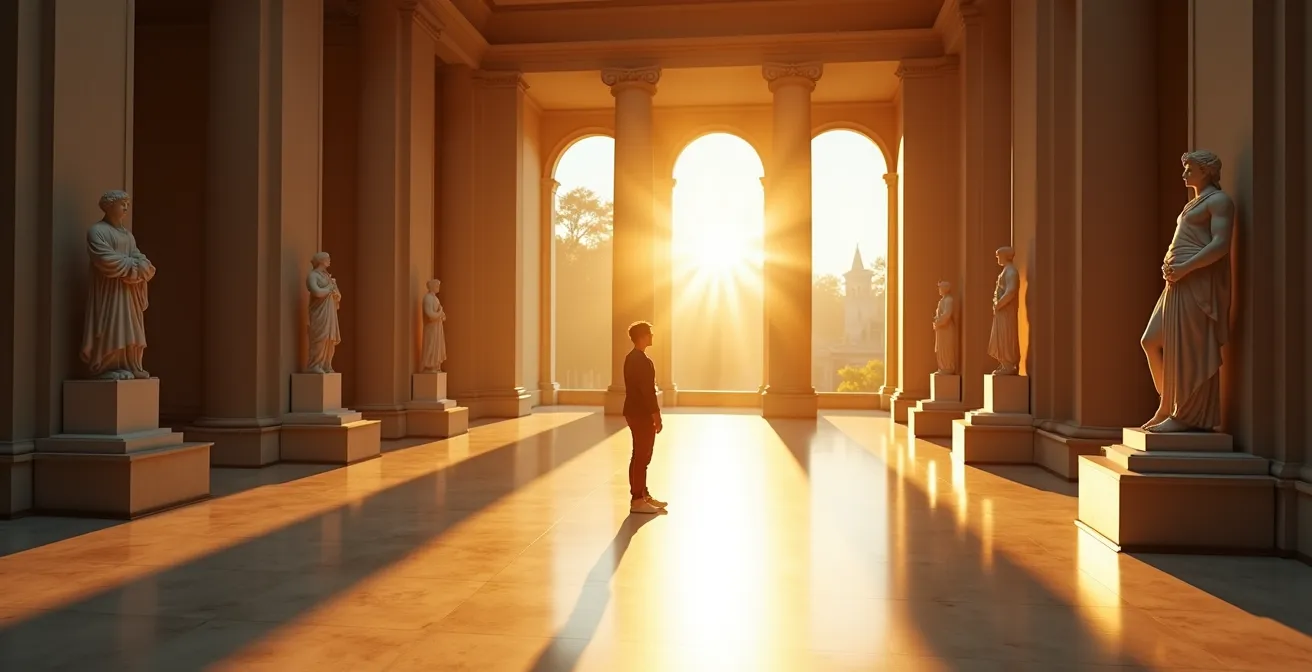
As the sun sets, the low-angle light often streams through windows, revealing textures on sculptures and details in paintings that are washed out by harsh midday or artificial lighting. The atmosphere shifts from a bustling hall to a contemplative sanctuary. Furthermore, staff are often more relaxed and approachable for a quick question. To optimize this, start your visit at the furthest point of the museum and work your way back towards the entrance. While everyone else is making a final dash for the exit, you’ll be enjoying the most popular galleries in relative peace. For certain sites like the Louvre, this strategy is enhanced by late-night openings, offering a completely different, more intimate ambiance.
Audio Guide vs Private Guide: Is the Extra Cost Worth the Insight?
Once you’ve secured your peaceful visiting slot, the next strategic choice involves “narrative pacing”—how you choose to receive the story of the site. This decision often comes down to a choice between a standard audio guide and a private guide. The real calculus isn’t just about cost; it’s about your “experiential ROI.” An audio guide offers flexibility and is often very well-produced. Studies at the Smithsonian American Art Museum found that visitors using audio tours learned and retained more information, reporting a more positive experience overall. They allow you to move at your own pace, linger where you wish, and skip what doesn’t interest you.
However, for complex, sprawling sites like the Roman Forum or Pompeii, a private guide can be transformative. Where an audio guide presents a series of disconnected facts, a great guide weaves them into a compelling, coherent narrative. They can answer your specific questions, tailor the tour to your interests (from military history to daily life), and point out subtle details you would otherwise miss. The key is to match the tool to the task. For a visual-heavy art museum, an audio guide may be perfect. For a narrative-heavy archaeological site, the investment in a private guide often pays for itself in depth and understanding.
This comparative table breaks down the key decision factors, based on an analysis of visitor needs and museum offerings from institutions like the Met. The data clarifies that the choice is not about one being “better,” but which is best for the specific experience you seek.
| Criteria | Audio Guide | Private Guide |
|---|---|---|
| Cost | $7-20 per device | $50-200+ per hour |
| Flexibility | Self-paced, skip sections freely | Fixed schedule, group pace |
| Depth for Complex Sites | Limited narrative connection | Excellent for sites like Roman Forum |
| Language Options | Up to 9 languages typically | Limited by guide availability |
| Personalization | Standard content for all | Tailored to group interests |
| Best For | Art museums, visual-focused sites | Archaeological sites, narrative-heavy locations |
The Alternative List: Visiting Lesser-Known Monuments for a Better Experience
The most effective way to avoid crowds is to sidestep the main event entirely. Overtourism has rendered some “A-list” sites almost unbearable, but for every overrun landmark, there is often a spectacular, lesser-known alternative that offers a more authentic and profound experience. This isn’t about “settling for second best”; it’s about finding a place that delivers the same essence—be it architectural style, historical era, or artistic genius—without the suffocating crowds. This search for cultural resonance over brand-name recognition is the hallmark of a savvy culture lover.
The strategic visitor knows how to build an “alternative list.” Instead of the Louvre, consider the Musée Jacquemart-André, a stunning private mansion-turned-museum. Before tackling Notre-Dame (once it reopens), visit the Basilica of Saint-Denis, the birthplace of Gothic architecture and the burial place of French kings. These sites are not just “quieter”; they often provide a purer, more focused dose of history and art.
Case Study: The Versailles Alternative
Instead of battling the legendary crowds at the Palace of Versailles, travel expert Jennifer Virgilio points visitors towards Château de Chantilly. It’s home to Europe’s largest horse stables and the Condé Museum, which holds the second-largest collection of antique paintings in France after the Louvre. With recently restored apartments and far fewer visitors, it offers the same sense of aristocratic grandeur and artistic wealth in a much more serene and accessible setting.
Tripods and Flash: What Are the Rules in Sacred Spaces?
As a temporary custodian, your presence in a historic site, especially a sacred one, should be one of respect. This extends to how you document your visit. The desire to capture the beauty of a cathedral or temple is natural, but it must be balanced with the primary function of the space: contemplation and worship. The general rule is simple: your photography should never disrupt the atmosphere or the experience of others. This is why almost all sacred spaces and museums ban the use of flash and tripods.
Flash photography causes cumulative damage to delicate pigments in paintings and textiles, and its sudden burst of light is jarring in a quiet environment. Tripods, monopods, and selfie sticks are considered trip hazards and create obstructions in often-crowded spaces. The rules are not arbitrary; they are in place to preserve both the artifacts and the site’s intended ambiance. Many places allow entry during worship services, but strictly prohibit tourist activities like photography. The best approach is to assume photography is a privilege, not a right, and to always check the specific rules at the entrance.
The Museum Photography Ethics Guide offers a powerful reminder for those seeking a deeper connection:
The deepest memories are often forged when our senses are fully engaged with the present moment, not mediated through a screen.
– Museum Photography Ethics Guide, Professional Photography in Sacred Spaces
Ticket Price vs Donation: How to Ensure Your Visit Helps Restoration?
Your financial contribution is one of the most direct ways you can act as a temporary custodian. However, not all spending has the same impact. Understanding the difference between a ticket price and a targeted donation is key to providing meaningful “structural support.” A standard entry ticket primarily covers a museum’s massive operational costs: staffing, security, and climate control. While essential, it may not directly fund the painstaking work of art restoration or archaeological preservation. With many museums experiencing an average of 71% of pre-pandemic attendance levels, every dollar of support is critical.
To ensure your money directly aids preservation, look for specific donation boxes marked for restoration projects. Better yet, consider joining a “Friends of…” membership program. The annual fee provides a stable, predictable source of funding that institutions rely on for long-term planning. These programs often come with perks like members-only hours, which ties back into the strategy of avoiding crowds. When you’re at the gift shop, purchasing a scholarly book published by the museum press provides more direct support to their academic mission than buying a mass-produced souvenir. It’s about making conscious choices to channel your funds where they can have the most significant and lasting impact on the heritage you’ve come to admire.
Action Plan: Maximize Your Support’s Impact
- Investigate Funding: Check the museum’s website under “About Us” or “Support” to understand if it’s a non-profit and how it’s funded.
- Join a Membership Program: Look for “Friends Of…” or “Patron” programs for sustained funding and often receive access to exclusive, less-crowded visiting hours.
- Donate Directly: Use donation boxes specifically earmarked for restoration or ask if you can contribute to a particular project.
- Shop Smart: Purchase scholarly books or unique items from the museum’s own press or shop, as proceeds are more likely to be reinvested.
- Dine In: Using on-site cafés and restaurants helps support the museum’s operational budget, freeing up other funds for conservation efforts.
The Economic Impact of Supporting Local Art Studios vs Chain Workshops
The principle of “structural support” extends beyond the walls of the museum. The cultural ecosystem of a historic area includes the living artists and artisans who carry on its traditions. When seeking a memento of your visit, the choice between a mass-produced souvenir from a chain workshop and a unique piece from a local art studio has profound economic and cultural consequences. Supporting a local artist means your money is far more likely to stay within the community, fostering a creative economy that makes the area vibrant and authentic.
Chain workshops often rely on imported goods or standardized designs that dilute the region’s unique cultural identity. In contrast, local studios are hubs of innovation and preservation, where traditional techniques are passed down and reinterpreted. By purchasing directly from an artist, you are not just buying an object; you are validating their craft, funding their ability to continue working, and helping to preserve the intangible heritage of the place. This direct engagement, often involving a conversation with the creator, adds another layer of meaning to your journey and makes your souvenir a genuine piece of the story, not just a branded trinket. It’s a powerful vote for cultural authenticity over commercial homogenization.
Audiobooks vs Physical Books: Do They Stimulate the Brain Differently?
The concept of “narrative pacing” we discussed with guides also applies to how we prepare for and reflect on our visits. Before traveling to a site, do you read a historical account or listen to an audiobook? While both formats can convey the same information, emerging research suggests they engage the brain differently. Reading a physical book is a more active process. Your eyes move across the page, your brain decodes symbols into words, and you control the pace entirely. This can lead to a deeper encoding of spatial and factual details, creating a stronger mental map of events and places.
Listening to an audiobook, on the other hand, is closer to the ancient tradition of oral storytelling. It’s a more passive but also a more emotive experience. The narrator’s tone, pacing, and inflection can bring a story to life in a way that silent reading cannot, potentially fostering a stronger emotional connection to the characters and events. Neither is inherently superior; they are simply different cognitive tools. For a complex historical analysis, a physical book might be better for retention. For a sweeping historical novel to set the mood before visiting a castle, an audiobook could be more immersive. The strategic traveler understands this difference and chooses the format that best serves their goal, whether it’s deep analytical learning or broad emotional immersion.
Key Takeaways
- Shift your mindset from a ‘tourist’ to a ‘temporary custodian’ to unlock a more meaningful experience.
- Master strategic timing by visiting during the “golden hour” before closing, not just at opening time.
- Choose your narrative tool (audio vs. private guide) based on the site’s complexity and your desired “experiential ROI.”
- Seek out lesser-known alternative sites to find ‘cultural resonance’ without the crowds of A-list landmarks.
- Ensure your financial contribution has a direct impact by supporting specific restoration funds and local artists.
How to Distinguish Genuine Eco-Tourism from Greenwashing Marketing?
The ultimate expression of the “temporary custodian” mindset is ensuring your visit is not just culturally respectful but also environmentally sustainable. As travelers become more conscious, the term “eco-tourism” is frequently used, but often as a marketing tactic—a practice known as “greenwashing.” A hotel that simply asks you to reuse your towels is not a bastion of sustainability; it’s practicing basic cost-saving. Genuine eco-tourism is a much deeper commitment to positive impact.
To distinguish the real from the fake, you must look for evidence of a holistic approach. Does the tour operator or lodge employ local people in meaningful, well-paid roles, not just as low-wage service staff? Do they contribute actively to local conservation projects, not just with money but with action? Are they transparent about their energy and water consumption, waste management, and supply chain? True eco-tourism is about systemic responsibility, not superficial gestures. It involves protecting natural habitats, supporting community well-being, and educating visitors. Look for recognized certifications (like those from the Global Sustainable Tourism Council), but also use your critical judgment. Ask questions. A genuinely sustainable operation will be proud to give you detailed answers.
By adopting this strategic mindset on your next journey, you move beyond being a mere spectator. You become an active participant in the ongoing story of our world’s heritage, ensuring its magic is preserved for generations to come.
Frequently Asked Questions About Visiting Historic Sites
Can I take photos during worship times?
Most sacred spaces allow entry during worship but prohibit tourist activities. You can typically join in prayer for free but should not visit tombs, take photos, or engage in other tourist behaviors to maintain a respectful atmosphere.
What equipment is typically forbidden in museums and sacred spaces?
To preserve the contemplative atmosphere and protect the artifacts, tripods, monopods, selfie sticks, and flash photography are almost universally prohibited. Professional-grade equipment may also require special permits.
How can I capture good photos in low light without a flash?
To get sharp, respectful photos, brace your camera against a wall or pillar for stability. Use a “fast” prime lens with a wide aperture (like f/1.8 or f/2.8) to let in more light. Shooting in RAW format also provides more flexibility to recover details from shadows during post-production.