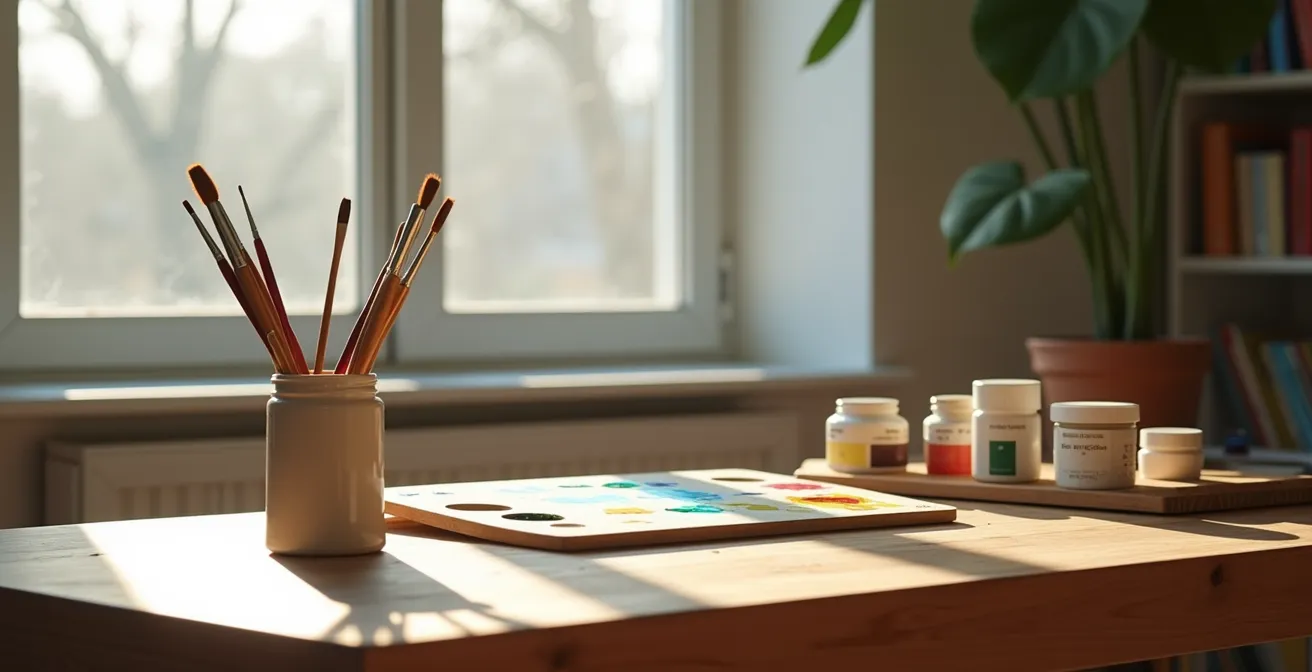
The right paint for a small apartment isn’t just oil or acrylic; it’s a complete system of technical choices managing space, safety, and light.
- Viable oil painting in confined spaces hinges on modern, solvent-free techniques and targeted air purification, not just an open window.
- Surface selection is paramount for storage; canvas paper and boards offer a vastly more efficient spatial economy than traditional stretched canvases.
Recommendation: Before investing in any medium, audit your space for ventilation capacity and assess your lighting’s Color Rendering Index (CRI)—aim for 95+ to ensure color accuracy.
The desire to paint within the four walls of a small apartment often crashes against a wall of practical constraints: fumes, mess, and the simple lack of space. For many aspiring artists, the conversation begins and ends with a seemingly simple choice: oils or acrylics? The common advice is to default to acrylics, praising them as the “safer,” “cleaner,” and “easier” option for home use. Oils are frequently relegated to the realm of dedicated, well-ventilated studios, a luxury most apartment dwellers don’t have.
This binary thinking, however, oversimplifies the reality of a modern art practice. It ignores the significant advancements in materials and techniques that have reshaped what’s possible in a confined environment. The belief that one medium is inherently “better” for a small space is a platitude that can limit your artistic growth. A successful and safe home studio isn’t about a single choice, but about a holistic system of technical management.
But what if the key wasn’t simply choosing a medium, but mastering the ecosystem around it? The truth is, both oil and acrylic paints can be managed effectively in a tiny studio, provided you make informed micro-decisions. The critical factors are not just the paints themselves, but the pigments you choose, the surfaces you work on, the quality of your light, and your ventilation strategy.
This guide moves beyond the basic “oil versus acrylic” debate. We will dissect the technical challenges you face as an apartment artist and provide practical, system-based solutions. We will explore how to achieve vibrant colors, make smart budget decisions on surfaces, ensure your painting environment is safe, and even why the lightbulb in your lamp could be sabotaging your work.
To help you navigate these critical decisions, this article breaks down the essential technical considerations for building a functional small-space studio. The following sections provide a clear roadmap, from pigment purity to long-term durability, ensuring you can make choices based on technical knowledge, not just popular opinion.
Summary: A Guide to Choosing Your Medium in a Small Studio
- Why Your Mixed Colors Look Muddy Instead of Vibrant?
- Canvas vs Paper: Where Should Beginners Spend Their Budget?
- The Ventilation Requirement: Is Oil Painting Safe in a Bedroom?
- Copying Masters vs Intuitive Painting: Which Path Accelerates Growth?
- Optimizing Varnish Application to Protect Paintings from UV Damage
- The Durability Myth: Does Natural Paint Peel Faster Than Acrylic?
- LED Color Rendering Index: Why Your Art Looks Dull at Night?
- Why Local Artistic Workshops Are the Best Way to Beat Adult Loneliness?
Why Your Mixed Colors Look Muddy Instead of Vibrant?
The frustration of mixing a brilliant crimson and a deep blue only to get a lifeless, muddy brown is a universal painter’s problem, but it’s amplified in a small studio. The issue is rarely the medium—oil or acrylic—but rather a lack of pigment purity and disciplined mixing technique. When you add too many different pigments into a mix, you are inadvertently re-introducing the three primary colors (red, yellow, blue), which combine to create neutral grays and browns. Mud is the predictable outcome of color chaos.
To maintain vibrancy, the first rule is to limit your palette. Many professional artists work with a restricted set of colors, often just a warm and cool version of each primary, plus white. This forces you to understand how your specific pigments interact. Furthermore, prioritize paints made with a single pigment whenever possible. Cheaper, “student-grade” paints often use multiple pigments (hues) to approximate a more expensive color, pre-contaminating your mixes from the start. The tube’s label will list the pigment code (e.g., PB29 for Ultramarine Blue), a key indicator of its purity.
Case Study: Small Studio Palette Management
An artist working in a compact 10×13 foot studio consistently struggled with inaccurate color assessment, leading to muddy results. The solution was remarkably simple yet effective: they placed a neutral gray photo sheet under their glass palette. This neutral background, created by painting acrylic on a roller to match a photo-gray swatch, provided a consistent, non-distracting surface for color judgment. This change allowed for accurate mixing despite the close quarters, proving that environmental control is as crucial as pigment choice for achieving clean color.
In a tight workspace, your mixing area itself can become a source of contamination. A small palette gets dirty quickly. Instead of trying to “fix” a mix that has gone muddy, be ruthless. Scrape it off and start again. Working on a neutral gray palette, rather than traditional wood or white plastic, also helps you judge value and hue more accurately, as the gray doesn’t visually distort the colors around it.
Canvas vs Paper: Where Should Beginners Spend Their Budget?
For an artist in a small apartment, the choice of surface goes far beyond texture and absorbency; it’s a critical decision of spatial economy. A stack of 50 finished paintings on stretched canvas can easily consume an entire closet, while 50 paintings on paper might fit in a single portfolio. For beginners who need to produce a high volume of work to improve, this storage reality is paramount. The budget shouldn’t just be allocated to the initial cost, but to the long-term storage footprint.
Stretched canvas is the archetypal surface, offering a satisfying “bounce” and a professional feel. However, it is the most expensive and spatially inefficient option. Canvas boards offer a compromise: they are rigid, less prone to damage than paper, and stack more compactly than stretched canvases. Yet, for pure practice and studies, nothing beats the efficiency of canvas paper. Sold in pads, it offers a canvas-like texture at a fraction of the cost and takes up minimal space.
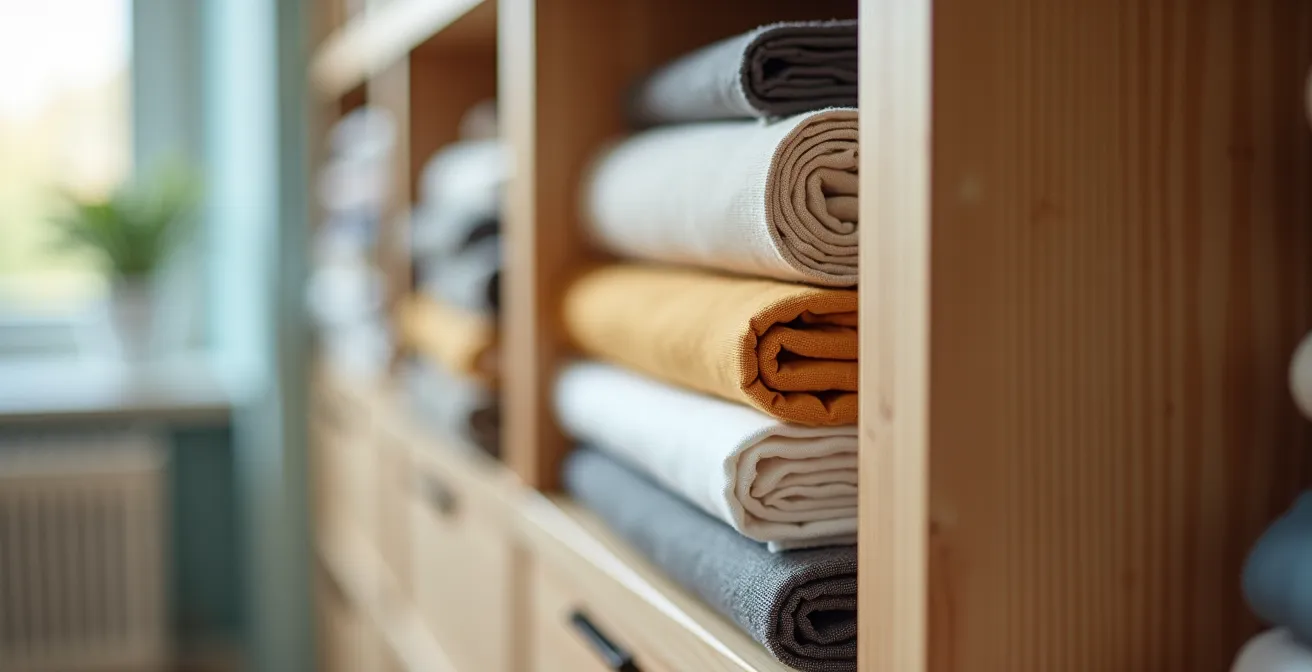
The table below breaks down the practical implications. As you can see, the difference in storage depth is not trivial. For the same number of pieces, stretched canvas requires over four times the storage depth of canvas boards and more than 25 times that of paper. This makes a compelling technical case for using paper for the bulk of your practice work, reserving more expensive and bulky surfaces for finished pieces you intend to display or sell.
This approach allows a beginner to experiment freely without worrying about “wasting” an expensive canvas or running out of room. You can produce dozens of color studies, composition sketches, and technique drills on paper, identify the most successful ones, and then execute a final version on a high-quality canvas board or stretched canvas.
| Surface Type | Initial Cost | Storage Space (50 pieces) | Best For |
|---|---|---|---|
| Canvas Paper Pad | $15-30 | 2 inches stack height | Practice & studies |
| Stretched Canvas | $150-300 | 50+ inches depth | Finished works |
| Canvas Boards | $75-150 | 12 inches stack | Hybrid solution |
The Ventilation Requirement: Is Oil Painting Safe in a Bedroom?
This is the most pressing question for apartment artists, and the answer is nuanced. The primary danger in oil painting comes not from the paint itself, but from the volatile organic compounds (VOCs) released by solvents like turpentine or mineral spirits used for thinning paint and cleaning brushes. Using traditional solvents in an unventilated bedroom is unequivocally unsafe. However, modern oil painting offers numerous pathways for systemic mitigation of this risk, making it entirely possible to work safely without them.
The first and most effective strategy is to adopt a solvent-free practice. You can thin oil paints with mediums like linseed oil, walnut oil, or safflower oil. For cleanup, a jar of safflower oil can be used to rinse brushes during a painting session, followed by a final wash with soap and water (like Master’s Brush Cleaner). This eliminates the main source of harmful fumes at the root. If you must use paints that require some ventilation, professional safety guidelines recommend a minimum of 72 hours before sleeping in a room with fresh oil-based paint, highlighting the need for a separate, contained drying area.
An artist in a 1-bedroom Texas apartment successfully paints with oils using “two fans going + a large air purifier set on medium” while using “no solvents – only baby oil, walnut oil and master’s brush cleaner for final cleanup” with W&N artist grade non-toxic paints, then moves paintings to an off-site storage unit for drying.
– WetCanvas Forum User, WetCanvas
If you do use low-odor solvents or mediums with some volatility, “opening a window” is insufficient. True ventilation requires creating airflow—an open window on one side and an exhaust fan pushing air out on another. A high-quality air purifier with a carbon filter designed to capture VOCs is also a crucial investment, not a luxury. It acts as a safety net, actively scrubbing the air of residual fumes. Ultimately, painting in the same room you sleep in requires a disciplined, multi-layered approach to safety.
Your 5-Point Home Studio Safety Audit
- Fume & Mess Sources: List every chemical you use—paints, mediums, varnishes, brush cleaners. Identify each one’s potential for fumes and spills.
- Material Inventory: Gather your supplies. Read the labels to identify any products containing VOCs or requiring specific ventilation. Separate them from non-toxic materials.
- Ventilation Assessment: Confront your space’s reality. Do you have cross-breeze potential (two windows)? Can you install a window exhaust fan? Is your only option an air purifier?
- Airflow Pathing: Map out how air moves in your room. An open window with no exhaust just lets fumes linger. A fan pointing out is better. A fan pointing in another window is best. Identify your primary airflow path.
- Mitigation Plan: Create a non-negotiable action list. Examples: “Switch to walnut oil for thinning,” “Purchase an air purifier with a carbon filter,” or “Designate the bathroom with its exhaust fan as the varnishing station.”
Copying Masters vs Intuitive Painting: Which Path Accelerates Growth?
The debate between methodical study and spontaneous creation is old, but for the beginner in a small studio, the answer is clear: a structured approach built on master studies provides the fastest, most efficient path to technical skill. Intuitive painting is often romanticized, but without a foundation in composition, value structure, and color theory, it can lead to frustration and a portfolio of directionless experiments. Copying the work of masters is not about plagiarism; it’s a time-honored apprenticeship.
When you do a master study, you are reverse-engineering a successful painting. You are forced to answer critical questions: How did the artist create such a convincing sense of light? What limited palette did they use to achieve color harmony? How did they arrange shapes to guide the viewer’s eye? This analytical process builds a deep, practical vocabulary that you can later apply to your own intuitive, original work. It’s like a musician learning scales before they can improvise a solo.
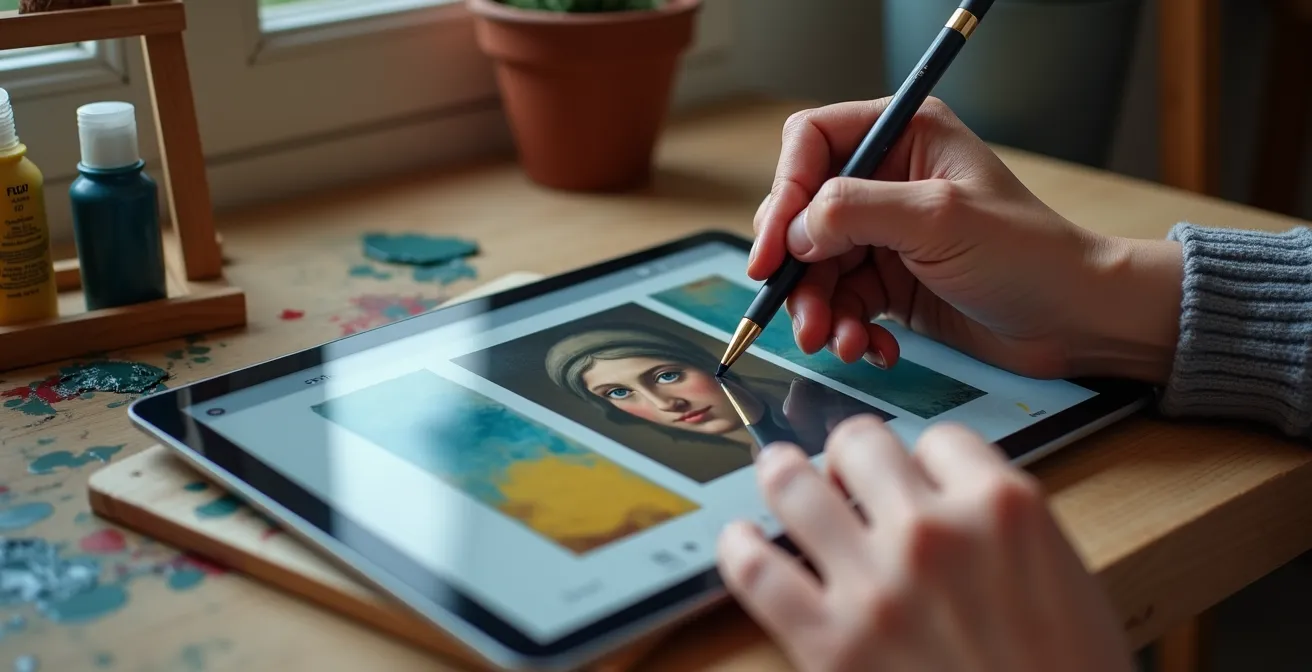
In a small apartment, this practice has a distinct modern advantage. Instead of bringing dusty art books or expensive prints into your limited space, a digital tablet becomes an invaluable tool. You can zoom in on brushstrokes, create color swatches directly from the reference image, and do multiple digital “sketches” to understand the composition before ever touching a physical brush. This digital pre-work saves time, materials, and space, making the process of study more accessible and less messy.
The ideal path is a hybrid one. Dedicate a portion of your practice time to rigorous master studies, focusing on specific technical elements you want to learn. Then, apply those lessons to your own personal, intuitive projects. This way, your intuition is not working in a vacuum; it is guided and informed by a solid foundation of proven techniques, leading to more rapid and satisfying growth.
Optimizing Varnish Application to Protect Paintings from UV Damage
Varnishing is a critical final step, protecting your painting from dust, grime, and the yellowing effects of UV light. However, it’s also one of the most hazardous processes to undertake in a small apartment due to the potent fumes from traditional spray and solvent-based varnishes. For the apartment artist, the goal is to achieve a protective, even coat while implementing a strict fume containment strategy. Failure to do so can make your living space unsafe for hours or even days.
The first line of defense is material selection. Choose a modern, low-odor varnish. For oils, products like Gamvar are popular because they use a mild solvent (Gamsol) and can be applied when the painting is touch-dry, rather than waiting the traditional 6-12 months. For acrylics, water-based polymer varnishes are the clear choice, as they have minimal odor and clean up with water. Avoid aerosol spray cans at all costs; they atomize particles into the air, making containment nearly impossible in a small space.
Your application technique should prioritize control. Always apply varnish with a soft, wide brush in thin, even coats. Two thin coats are far superior to one thick, drippy one. To manage fumes, create a makeshift “varnishing box” out of a large cardboard box placed on its side. This simple enclosure helps contain the initial burst of fumes. Position this box near a window with an exhaust fan or in a bathroom with the vent fan running continuously. Apply the varnish quickly and then move the piece to a more ventilated area to dry, such as a secured balcony, a shared hallway (if permitted and safe), or back in the box with the fan running.
Timing is also a strategic tool. Varnish on a day with low humidity and pleasant weather, allowing you to have windows fully open for maximum airflow without compromising your indoor climate. By combining the right material, a contained application process, and strategic timing, you can safely complete this essential final stage of your painting process.
Apartment-Friendly Varnishing Protocol
- Choose Low-Odor Options: Select Gamvar for oils or a water-based polymer varnish for acrylics to minimize initial fume load.
- Create a Containment Box: Use a large cardboard box to create a three-sided enclosure that contains aerosolized particles and initial fumes.
- Leverage Exhaust Fans: Position your work near a bathroom or kitchen with an exhaust fan running continuously during and after application.
- Apply Thin Coats & Time It Right: Varnish during optimal weather to allow for maximum window ventilation without disrupting your home environment.
- Isolate for Drying: Move freshly varnished pieces to the most ventilated, isolated area available (balcony, stairwell, or dedicated drying box) for the initial, most potent drying phase.
The Durability Myth: Does Natural Paint Peel Faster Than Acrylic?
A common concern among beginners is the long-term durability of their work, which sometimes leads to the misconception that “natural” paints like oils are less stable than synthetic acrylics. The idea that oil paint might peel or crack faster is a myth born from a misunderstanding of how these materials age. The reality is that both mediums are exceptionally durable when applied correctly, but they fail for different reasons and on different timescales.
Acrylic paint is a suspension of pigment in a polymer emulsion. When the water evaporates, the polymer particles fuse into a stable, flexible, and permanent plastic film. Its primary vulnerability is not peeling, but its thermoplastic nature; in very high heat it can become soft and tacky, and in extreme cold, it can become brittle. However, under normal indoor conditions, a properly applied acrylic film is incredibly resilient and does not become more fragile with age.
Oil paint, on the other hand, dries through a chemical process called oxidation. The oil (typically linseed) reacts with oxygen in the air to slowly polymerize and harden into a tough, durable film known as linoxyn. This process never truly stops. Over many decades and centuries, this continued oxidation can cause the paint film to become increasingly brittle, which can lead to cracking if the support (like a canvas) expands and contracts. The famous “fat over lean” rule (applying more flexible, oil-rich layers over less flexible, leaner layers) is a core principle designed to mitigate this long-term stress.
So, does natural paint peel faster? No. In fact, peeling is more often associated with improper application of acrylics on a greasy or unprepared surface. The cracking seen in Old Master oil paintings is a process that occurs over centuries, not a flaw that will appear on your painting in your lifetime. For the apartment artist, the choice should be based on working properties and safety, not on a misinformed fear of long-term durability. Both mediums, when used with proper technique, will outlast their creator.
LED Color Rendering Index: Why Your Art Looks Dull at Night?
You spend hours mixing the perfect, vibrant color, only to find that under your apartment’s evening light, it looks dull and lifeless. The culprit is almost certainly the light fidelity of your bulbs. Natural daylight contains the full spectrum of visible light, allowing us to see colors accurately. Most artificial light sources, especially cheap LEDs, are deficient in parts of the spectrum, which prevents them from rendering colors properly. This isn’t a subjective feeling; it’s a measurable technical issue defined by the Color Rendering Index (CRI).
CRI is a scale from 0 to 100 that measures a light source’s ability to reveal the colors of objects faithfully in comparison to a natural light source. A low CRI light, common in standard household bulbs, might be deficient in rendering deep reds or subtle blues, making those colors appear muted or shifted. For an artist’s studio, where color accuracy is non-negotiable, a high CRI is not a luxury—it is a technical requirement. As a rule of thumb, professional artists recommend a CRI of 95 or higher for accurate color assessment.
When shopping for bulbs for your studio lamp or overhead fixture, look for “High CRI” or “95+ CRI” on the packaging. You should also pay attention to the color temperature, measured in Kelvin (K). A bulb around 5000K is considered to be a neutral, daylight-balanced white light, which is ideal for a painting environment. Bulbs with a lower Kelvin rating (2700K-3000K) produce a “warm” yellow light that will distort your color perception, while very high Kelvin bulbs (6500K+) produce a “cool” blueish light.
Investing in a single, high-quality, high-CRI, 5000K bulb for the lamp you work under can make a more significant difference to your color mixing than upgrading your paints. It ensures that the colors you mix at night will look correct in the daylight, eliminating frustrating surprises and allowing you to work with confidence at any hour. In a small studio, controlling your light is as important as controlling your palette.
Key Takeaways
- A safe oil painting practice in an apartment is achievable through solvent-free techniques and targeted air purification, rendering the medium a viable option.
- The choice of surface—paper, board, or canvas—is a critical decision for spatial economy, with paper offering the most efficient storage for practice work.
- Light quality is a non-negotiable technical requirement; a bulb with a Color Rendering Index (CRI) of 95+ is essential for accurate color mixing.
Why Local Artistic Workshops Are the Best Way to Beat Adult Loneliness?
While this guide focuses on the technical setup of a home studio, it’s crucial to acknowledge the limitations of a solitary practice, especially for those living alone. The act of creating can be isolating, and the practical challenges of fumes and mess may prove insurmountable in some living situations. In this context, local artistic workshops emerge as a powerful solution, addressing not only technical constraints but also the profound human need for community and connection.
Workshops provide a “third space” outside of home and work—a dedicated environment built for art. Here, ventilation is handled professionally, space is ample, and specialized equipment is available. This removes the entire burden of risk mitigation from your shoulders. It allows you to experiment freely with materials you’d never dare use in your bedroom, such as traditional oil solvents or large-scale canvases, without any of the associated anxiety or setup.
Case Study: The Workshop as a Studio Solution
For artists in confined spaces, workshops offer an ideal testing ground. As one art school notes, acrylics are a great alternative to oils in a small space because they require only water and have a very low odor. However, a workshop environment allows a beginner to try both mediums side-by-side. This direct, hands-on comparison in a safe, controlled setting is the most effective way to understand the true differences in feel and workflow before committing to the expense and logistics of a home setup.
More importantly, workshops combat the loneliness that can accompany a solo hobby. They foster a sense of shared purpose and camaraderie. You are surrounded by peers who are navigating the same struggles and celebrating the same small victories. The informal feedback from an instructor and fellow students can be invaluable, accelerating your learning in a way that watching online tutorials cannot. This blend of structured learning, social interaction, and access to a proper facility makes workshops an indispensable resource for the urban artist.
For aspiring painters grappling with the constraints of apartment living, exploring a local workshop is often the most practical and enriching next step. It provides a safe, equipped space to experiment without compromise and connects you with a community to share the journey.