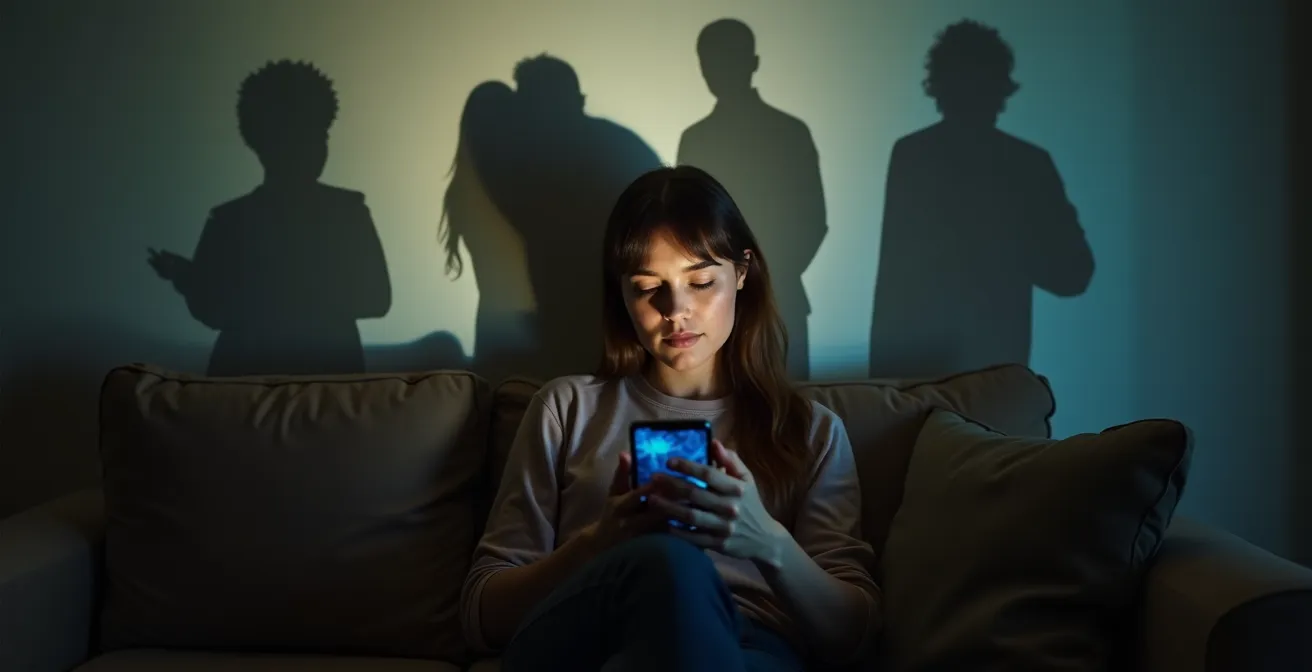
The influence celebrities have on your choices isn’t an accident; it’s the primary product of a sophisticated, industrial-scale system designed to manufacture your consent and direct your behavior.
- Streaming platforms like Netflix and HBO are not just content libraries; they are competing “influence ecosystems” engineered to create specific types of stars and cultural trends.
- Tools like “calculated authenticity” build a false sense of trust, making you more susceptible to both marketing and misinformation.
Recommendation: Shift from being a passive media consumer to a conscious curator by actively analyzing the ‘why’ behind what you watch, not just the ‘what’.
You decide to watch a new series, try a new style, or even form an opinion on a social issue. You believe the choice is yours, a reflection of your unique taste. But what if that feeling of autonomy is an illusion? For years, the conversation around celebrity culture has been remarkably shallow, focusing on the idea that celebrities are simply “role models” or that their main impact is driving consumerism. We are told to “be critical” of the media we consume, as if a simple act of willpower could shield us from its effects.
This perspective misses the point entirely. The truth is far more structural and insidious. Celebrity influence is not a side effect of entertainment; it is the core product. You are not just watching content; you are interfacing with a multi-billion dollar influence-manufacturing system. This apparatus, encompassing everything from streaming algorithms to award show campaigns, is deliberately engineered to shape your desires, thoughts, and daily decisions. It’s a factory, and your attention is the raw material.
The key to regaining control is not to simply turn it all off, but to understand the machinery. This requires a new kind of media literacy—one that moves beyond spotting “unrealistic beauty standards” and starts deconstructing the very infrastructure of influence. This analysis will equip you with the framework to do just that. We will dissect the systems, expose the psychological tools, and provide a clear path to transforming you from a passive consumer into an empowered media critic.
This guide breaks down the mechanisms of the entertainment world’s influence. By understanding how these systems operate, you can begin to make more conscious and deliberate choices about the media you consume and the impact it has on your life.
Summary: Deconstructing the Modern Influence Machine
- How to Spot Fake Entertainment News Before Sharing It ?
- Netflix vs Disney+ vs HBO: Which Subscription Is Worth Keeping in 2024 ?
- The Hidden Cost of Binge-Watching on Your Sleep and Productivity
- When to Watch the Oscars vs The Emmys for Cultural Relevance
- Optimizing Your Watchlist: Curating Quality Over Quantity
- Corporate vs Human Tone: Which Voice Builds More Trust Online ?
- Why Curating a Pinterest Board Is Not the Same as Creating Art ?
- How to Choose a Pastime That Actually Reduces Your Cortisol Levels ?
How to Spot Fake Entertainment News Before Sharing It ?
Fake entertainment news is not just sloppy journalism; it’s a finely tuned weapon that exploits a fundamental vulnerability in our media consumption. We are wired to seek authenticity, and the influence-manufacturing system has trained us to find it in celebrity narratives. As noted in the Journal of Media and Communication Studies, the rise of social media allows a direct-to-consumer form of fame that bypasses traditional media gatekeepers, creating a powerful illusion of unfiltered access and trust. This perceived authenticity makes us highly susceptible to manipulation.
When a story triggers a strong, immediate emotional reaction—rage at an injustice, glee at a downfall—it’s a significant red flag. This is the primary tool of disinformation. These narratives are often built around a “kernel of truth”: a small, verifiable fact buried within a mountain of fabrication, which gives the entire story a veneer of plausibility. For instance, a real photo from a 2018 event might be used to “prove” a fabricated 2024 scandal. Your job as a critic is to isolate that kernel and see what has been constructed around it.
Furthermore, the rise of generative AI introduces new threats. Unnatural pauses in a video, strange background inconsistencies, or a slightly “off” vocal tone can be tell-tale AI artifacts. But the ultimate question is always: *Cui bono?* Who benefits financially or politically from this story spreading like wildfire? Tracing the potential money trail or ideological motive is the most powerful tool you have. Before you share, you must move from passive recipient to active investigator.
Netflix vs Disney+ vs HBO: Which Subscription Is Worth Keeping in 2024 ?
Choosing a streaming service is no longer about comparing content libraries. It’s about selecting which influence ecosystem you want to inhabit. Each platform is a distinct, self-contained influence-manufacturing system, engineered to produce a specific type of celebrity and generate a particular cultural impact. Your subscription is a vote for a worldview, a style, and a set of values that will be algorithmically fed back to you.
Netflix, with its reality and docuseries star system, functions as an incubator for flash-in-the-pan TikTok trends. It creates personalities whose fame is intense but often fleeting, designed for maximum immediate engagement within a binge-watching culture. Disney+ operates on a different model, leveraging its vast franchises to create “multiverse-locked” actors whose influence is tied directly to long-term brand loyalty and family co-viewing. HBO, by contrast, focuses on prestige, auteur-driven talent, cultivating stars who fuel high-level cultural debates and become fixtures of “event television” discussions.
Understanding these ecosystems is the first step toward conscious consumption. As an analysis of platform ecosystems shows, the structure of the platform dictates the nature of the influence. The question is not “Which has better shows?” but “Which system’s cultural output do I want to marinate my subconscious in?”
| Platform | Celebrity Creation Engine | Cultural Impact | Audience Engagement |
|---|---|---|---|
| Netflix | Reality/docuseries star system | Flash-in-the-pan TikTok trends | Binge-watching culture |
| Disney+ | Franchise-locked multiverse actors | Long-term brand loyalty | Family co-viewing |
| HBO | Prestige/auteur-driven talent | High-level cultural debate | Event television discussions |
The Hidden Cost of Binge-Watching on Your Sleep and Productivity
The common critique of binge-watching—that blue light from screens disrupts sleep—is dangerously superficial. It ignores the far more significant cognitive cost. Binge-watching is not passive relaxation; it is an active, often stressful, engagement with the influence-manufacturing system. Your brain is not just processing a story; it is tracking complex character arcs, absorbing social cues, and managing the parasocial relationships the system is designed to foster. This is cognitive labor, and it has a direct impact on your mental resources.
Each episode you consume strengthens the neural pathways associated with these manufactured worlds and personalities. This makes it harder for your brain to disconnect, leading to what is known as “sleep procrastination,” where you delay sleep not because you aren’t tired, but because your mind is still caught in the loop of the content’s emotional and narrative stakes. The result is a demonstrable decline in both sleep quality and next-day productivity, as your cognitive bandwidth has already been partially exhausted.
The system is designed for this. The very structure of modern streaming, with its autoplay features and cliffhanger endings, is engineered to override your natural fatigue signals. As media scholar Mingyi Hou points out, this constant visibility is a new path to fame.
Social media visibility may be considered as an alternative way to fame as it bypasses the gatekeeper role played by the entertainment and mass media industries.
– Mingyi Hou, Journal of Media and Communication Studies
By binge-watching, you are not just a viewer; you are an active participant in this fame-creation cycle, providing the engagement data that fuels the entire machine. This participation comes at a hidden cost to your mental energy and focus.
When to Watch the Oscars vs The Emmys for Cultural Relevance
To treat award shows like the Oscars and the Emmys as mere celebrations of artistic merit is to fundamentally misunderstand their function. These events are not reflections of culture; they are powerful Cultural Relevance Signals broadcast by the industry to tell audiences what to value. They are the climax of multi-million dollar “For Your Consideration” campaigns designed to manufacture consensus and dictate the canon.
The key difference between them lies in the type of signal they send. The Oscars function as Hollywood’s attempt to define its own artistic legacy, elevating films it deems historically important. It is a top-down declaration of what constitutes “cinema.” The Emmys, in contrast, are more responsive to the immediate zeitgeist, reflecting television consumption habits and rewarding the shows that dominate current cultural conversations. Watching the Oscars tells you what the industry wants you to remember; watching the Emmys tells you what the industry knows you are already watching.
Case Study: The Meta-Narrative of Award Shows
A deep analysis of recent award ceremonies reveals that their primary role is industrial self-regulation. The perceived inevitability around certain winners is not a result of overwhelming artistic superiority but the direct outcome of relentless marketing. This process demonstrates how “cultural consensus” is often a manufactured product, shaped more by advertising budgets than by merit alone, solidifying the industry’s power to define its own importance.
However, this top-down signaling is being challenged. While the industry focuses on anointing its chosen few, a different kind of cultural influence is bubbling up from platforms like YouTube. Indeed, research on cultural influence shows that 70% of YouTube subscribers say that creators on the platform are the ones who truly change and shape culture. This highlights a growing disconnect between what the industry deems relevant and what audiences actually find influential.
Optimizing Your Watchlist: Curating Quality Over Quantity
Your watchlist is a battlefield for your attention. On one side are the platform algorithms, pushing trending content designed for mass consumption and immediate engagement. This is algorithmic curation. On the other is your opportunity to take control and build a media experience that enriches, rather than just occupies, your time. This is conscious curation. The goal is to shift from a passive diet of “empty calorie” hype to a balanced, nutrient-dense media consumption plan.

To do this requires a strategic framework. First, apply the ’72-Hour Hype Delay’—wait three days before adding a trending show to your list to distinguish genuine interest from manufactured urgency. Second, build a pyramid model for your viewing: the base should be a limited amount of trending content, the middle should consist of established classics and acclaimed series, and the apex should be reserved for ‘nutrient-dense’ documentaries or films from directors and critics you personally trust. This moves you away from relying on platform algorithms and toward second-order signals from trusted human sources.
Finally, conduct a regular “watchlist autopsy.” Once a month, analyze the last 20 things you watched. How many were genuine discoveries versus algorithmic suggestions? How many had a lasting impact? This data provides a clear picture of who is really in control of your watchlist—you, or the system?
Your 5-Step Audit to Reclaim Your Watchlist
- Points of contact: List all platforms and sources where you get show recommendations (e.g., Netflix algorithm, TikTok trends, critic reviews, friends).
- Collecte: Inventory your last 20 watched items. Tag each as ‘algorithmic push,’ ‘hype-driven,’ or ‘genuine interest.’
- Cohérence: Confront your watchlist against your stated personal values or interests. Does it reflect who you want to be, or just what’s popular?
- Mémorabilité/émotion: For each item, rate its lasting impact on a 1-5 scale. Separate the ’empty calorie’ content from the ‘nutrient-dense’ experiences.
- Plan d’intégration: Create a new “watchlist rule” (e.g., ‘For every trending show, add one classic film’) and purge at least three low-impact shows from your queue.
Corporate vs Human Tone: Which Voice Builds More Trust Online ?
The currency of the modern influence economy is trust, and it is most effectively generated not through polished corporate messaging, but through a performance of humanity. This strategy, which can be termed “calculated authenticity,” is the primary tool used by influencers and modern celebrities to build the parasocial bonds that drive consumer behavior. A carefully crafted “human” tone, complete with perceived flaws and moments of vulnerability, is far more effective at building loyalty than a multi-million dollar advertising campaign.
The psychological mechanism is clear. Research published in Current Psychology confirms this distinction is not just perceived, but deeply felt by audiences.
Recipients tend to identify more with, feel more similar to, and trust influencers more compared to celebrities.
– Schouten, Janssen, & Verspaget, Current Psychology Journal
This explains why the line between “celebrity” and “influencer” has blurred. Traditional stars are now adopting influencer tactics to cultivate a more relatable persona. They understand that in the digital age, the perception of a human connection, however manufactured, is more valuable than the mystique of untouchable stardom. This is not genuine authenticity; it’s a highly strategic performance of it.
Case Study: The Rock vs. Fortune 500: Trust Capital Analysis
Analysis reveals that a single Instagram post from Dwayne “The Rock” Johnson can generate more consumer trust than an entire Fortune 500 marketing campaign. His strategy of “calculated authenticity”—mixing no-makeup gym selfies with motivational content and product endorsements—creates powerful parasocial bonds. This demonstrates how a perceived human connection, meticulously curated, can outweigh massive corporate budgets in building brand value and consumer loyalty. It’s a masterclass in weaponizing the human tone for commercial gain.
Why Curating a Pinterest Board Is Not the Same as Creating Art ?
In the influence-manufacturing system, even our creative impulses are channeled into acts of consumption. Curating a Pinterest board, meticulously arranging images that reflect a desired aesthetic, feels like a creative act. It is not. It is an act of sophisticated consumption, a participation in and reinforcement of existing trends, often dictated by the very celebrity culture you are cataloging. You are not creating; you are organizing. You are not an artist; you are an unpaid brand manager for an aesthetic.
Curation is passive. It involves selecting from a pre-existing pool of content, guided by algorithms designed to show you more of what you already like. It reinforces taste bubbles and narrows your creative horizons. True creation, in contrast, is an act of active rebellion. It is the generation of something new, something that subverts, questions, or deliberately rejects the dominant aesthetic. It is about expressing an internal vision, not reflecting an external trend.
To break free from the cycle of algorithmic curation, one must move from collecting to making. The following exercise is designed to facilitate that shift, forcing a conscious rejection of the curated aesthetic in favor of genuine creative agency.
- Step 1: Analyze your Pinterest board to identify the dominant celebrity or trend aesthetic.
- Step 2: List the core visual elements that define this aesthetic (e.g., minimalist color palettes, specific compositions, recurring themes).
- Step 3: Create an original piece—a photo, a drawing, a paragraph—that deliberately subverts each of those identified elements.
- Step 4: Share this “anti-aesthetic” creation, even if only with yourself, to reclaim your creative agency from the grip of algorithmic curation.
Key Takeaways
- Celebrity influence is not a natural phenomenon but the output of an industrial “influence-manufacturing system”.
- The most powerful tool of this system is “calculated authenticity,” a strategic performance of relatability designed to build trust and drive behavior.
- The only effective defense is “conscious curation”: actively choosing your media diet rather than passively accepting algorithmic recommendations.
How to Choose a Pastime That Actually Reduces Your Cortisol Levels ?
In an era of perpetual connection to the influence-manufacturing system, even our leisure time has become a source of stress. Many modern “hobbies” are simply extensions of the same performance-based, comparison-driven culture. If your pastime can be photographed for social media, involves a clear “win” state, or encourages you to compare your performance to others, it likely contains hidden achievement metrics that elevate, rather than reduce, your cortisol levels.
The antidote is to seek out pastimes rooted in active, present-moment engagement rather than passive consumption or digital performance. True leisure is about process, not outcome. Activities that involve manual dexterity or induce a “flow state”—such as pottery, gardening, hiking, or playing a musical instrument—anchor you physically and mentally in the present. This is in direct contrast to consuming celebrity culture, which is a form of cognitive labor that keeps your mind occupied with external narratives and social hierarchies.
A powerful framework for selecting a truly restorative hobby is the “Sensory Anchor” principle. Choose activities that strongly engage one of the five physical senses. The smell of baking bread, the feeling of soil in your hands while gardening, the sound of a well-played chord—these sensory inputs create a powerful anchor to the present moment. They effectively shut down the mental drift toward the digital noise of celebrity drama and algorithmic trends, allowing your nervous system to genuinely recover. The goal is to find an activity so engrossing in its physical reality that there is simply no cognitive space left for the manufactured world of media.
By deconstructing the systems of influence and consciously choosing how you engage with media and spend your free time, you shift from being a target of the culture industry to being the architect of your own attention. The next logical step is to begin auditing the media you already consume and identifying which pastimes serve the system and which ones serve you.
Frequently asked questions about Media Consumption and Stress
What distinguishes active from passive leisure in terms of cortisol reduction?
Active leisure involves manual dexterity or flow states (pottery, hiking) that anchor you in the present moment, while passive consumption of celebrity culture creates cognitive labor that elevates stress hormones.
How do I identify if my hobby has hidden achievement metrics?
If your pastime can be photographed for social media, has a clear ‘win’ state, or involves comparing yourself to others’ performance, it likely contains stress-inducing achievement metrics.
What is the ‘Sensory Anchor’ principle for choosing hobbies?
Select activities that strongly engage one of the five physical senses (baking’s smell, gardening’s touch) to create a powerful present-moment anchor that prevents mental drift to digital celebrity culture.