
The real reason a sports team keeps you consistent isn’t just motivation; it’s the powerful psychological cost of letting others down.
- Unlike a personal trainer you can cancel, missing a team practice impacts an entire group, creating a strong social contract.
- Your identity shifts from “someone exercising” to “a teammate,” making participation a part of who you are.
- The structure of a game provides purpose-driven interaction, eliminating social awkwardness and building genuine bonds.
Recommendation: Instead of searching for more willpower, find a local recreational league. The accountability is already built into the system.
For anyone who has ever paid for a gym membership they barely used or repeatedly cancelled on a personal trainer, the struggle for workout consistency is deeply familiar. We’re often told the solution is more discipline, better goals, or finding a “fun” activity. We hire personal trainers hoping that a one-on-one appointment will be the financial and personal commitment we need to finally show up. But what if this entire approach misses the most powerful human driver of all?
The common wisdom focuses on individual motivation, but as social creatures, our most profound commitments are not to ourselves, but to others. This is where the dynamic of a team sport fundamentally outshines the solo-exercise model. It’s not just about having fun or being social in a general sense. It’s about leveraging a sophisticated, built-in system of social accountability that makes participation the path of least resistance. It engineers an environment where showing up is no longer a battle of willpower, but a natural response to group obligation.
This article explores the specific psychological mechanisms that make joining a team a superior strategy for long-term physical consistency. We will deconstruct the “no-show” guilt that keeps you coming back, analyze how to choose the right sport, and uncover the surprising professional and social benefits that a personal trainer can’t offer. We’ll show you how to integrate this commitment into a busy life and why the structure of a team is the ultimate hack for building lasting health habits.
To fully understand this dynamic, we’ll break down the key elements that transform exercise from a chore into a shared mission. This guide will walk you through the psychological advantages, practical considerations, and life-changing benefits of trading the lonely treadmill for a team jersey.
Summary: The Team Advantage: More Than Just a Workout
- The “No-Show” Guilt: How Team Dependability Drives Attendance ?
- Soccer vs Volleyball: Which Sport Lowers Risk of Injury for Over-30s ?
- Learning a New Sport at 40:Why Training Like an Athlete Improves Your Corporate Performance ?
- The Locker Room Effect: Networking Opportunities in Amateur Leagues
- Optimizing League Schedules: How to Balance Matches with Family Life ?
- How to Talk to Strangers at Community Events Without Being Awkward ?
- Why 20 Minutes Daily Beats 2 Hours Weekly for Long-Term Health ?
- How to Improve Cardiovascular Health Without Running Marathons ?
The “No-Show” Guilt: How Team Dependability Drives Attendance ?
The core difference between a personal trainer and a team lies in the scale of social obligation. Cancelling on a trainer is a simple, one-to-one transaction. You might lose money and feel a pang of personal guilt, but the only person you’ve truly let down is yourself. This is a fragile contract. Now, consider missing a team practice or a game. You aren’t just one person; you’re a forward, a defender, or a crucial part of a relay. Your absence has a cascading effect on 10 or 15 other people who are counting on you. This is what we call engineered accountability.
This feeling isn’t just vague pressure; it’s a combination of powerful psychological mechanisms. First is the social contract pressure. By joining a team, you implicitly agree to contribute. Failing to do so violates this contract, creating a much higher psychological cost than breaking a promise to yourself. Second is the identity transformation. You are no longer just “someone trying to get fit”; you become “a soccer player” or “a member of the volleyball team.” This identity shift makes attendance an affirmation of who you are. Finally, there is reciprocal accountability. Your teammates depend on you to fill a position, and you depend on them. This creates a powerful bond of mutual reliance that solo training can never replicate.
This structure is far more compelling than the isolated motivation of a gym session. While team sports often benefit from formal coaching to refine strategy, the most powerful coaching comes from the team itself. The group dynamic becomes a self-regulating system that drives attendance and effort far more effectively than any external instructor could. It’s the simple, unspoken truth: you show up because your team needs you.
Soccer vs Volleyball: Which Sport Lowers Risk of Injury for Over-30s ?
For many adults considering a return to sports, the fear of injury is a significant barrier. The high-impact sprints of a soccer match or the sharp pivots of basketball can seem daunting, especially for those over 30 whose bodies may not recover as quickly. However, the world of team sports is vast, and choosing the right one is key to a sustainable and safe fitness journey. The goal is to find an activity that provides the cardiovascular and social benefits without the excessive strain on joints.
When comparing popular sports like soccer and volleyball, the difference in impact becomes clear. Soccer involves constant running, sudden changes in direction, and potential for contact, which places significant stress on the knees, ankles, and hips. While fantastic for cardio, it carries a higher risk of sprains and strains. In contrast, volleyball, especially when played on an indoor court or sand, is a significantly lower-impact sport. The movements are more controlled and vertical, focusing on explosive power over short distances rather than sustained running.
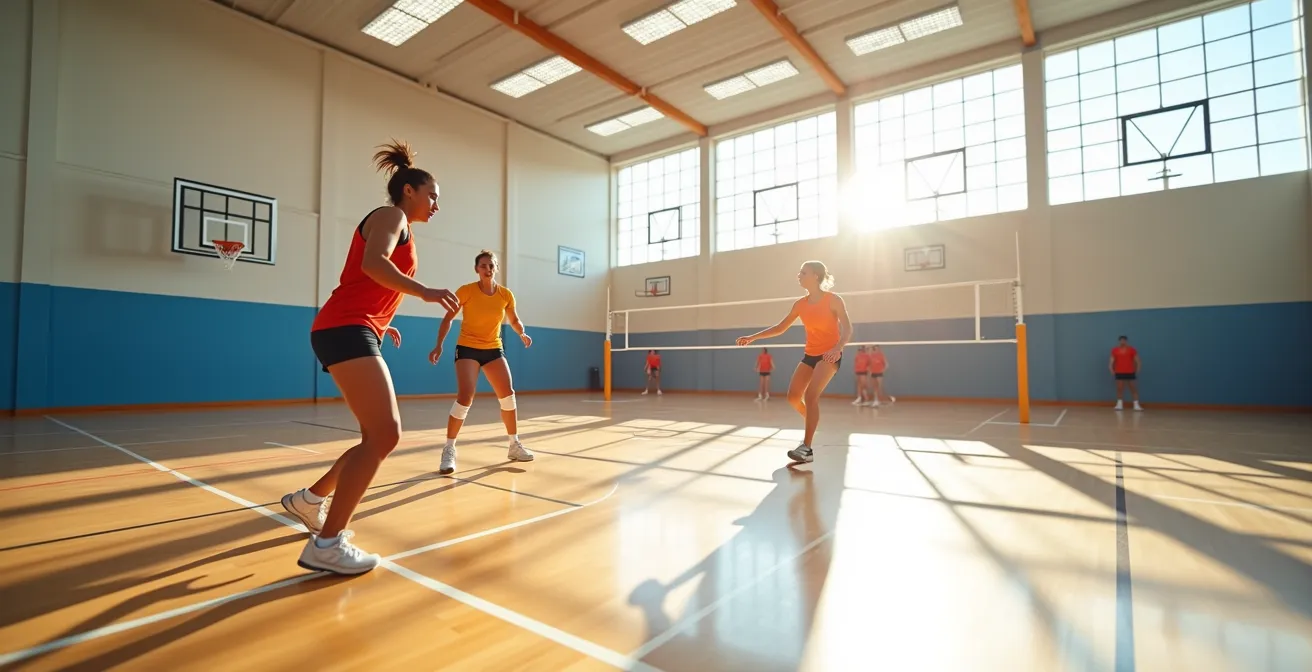
As the image above illustrates, proper technique in sports like volleyball emphasizes controlled landings and coordinated team movement, reducing the chaotic, unpredictable forces that often lead to injury. This makes it an excellent choice for adults who want the intensity and camaraderie of a team sport while minimizing wear and tear on their bodies. Other great low-impact options include swimming relays, doubles tennis, or even ultimate frisbee, which, despite its running, involves less direct physical contact than sports like soccer or basketball. The key is to match the sport’s physical demands to your body’s current condition and long-term health goals.
Learning a New Sport at 40:Why Training Like an Athlete Improves Your Corporate Performance ?
Embracing a team sport after 40 is more than just a way to get fit; it’s a powerful tool for professional development. The skills honed on the field or court are directly transferable to the corporate world, but there’s a crucial distinction. Simply exercising with a personal trainer focuses on physical metrics like reps and weight. Training as part of a team, however, involves a holistic approach that builds mental fortitude and strategic thinking, much like the work of a professional Strength & Conditioning (S&C) coach.
As the Carter & George Performance Institute notes, a true athletic coach’s role extends far beyond physical fitness. It’s a comprehensive discipline that cultivates crucial executive functions:
A strength and conditioning coach’s specific approach includes agility, speed, power, endurance, flexibility, and factors like mental toughness and recovery strategies.
– Carter & George Performance Institute, The Benefits of a Strength & Conditioning Coach
This multi-faceted approach forces you to think like an athlete—analyzing opponents, adapting strategy in real-time, and managing your energy for peak performance. You learn to make decisions under pressure, communicate effectively with teammates from diverse backgrounds, and develop a resilience that is invaluable in a competitive business environment. A personal trainer helps you get stronger; a team forces you to get smarter.
Case Study: Athletic Training’s Impact on Professional Skills
A comparison of athletes working with S&C coaches versus those with personal trainers revealed a significant difference in skill development. The S&C group, immersed in a holistic training environment, showed marked improvements in strategic thinking and resilience. Their training, which included mental toughness, nutrition, and recovery protocols, directly translated to better decision-making under pressure and a greater ability to adapt to changing competitive landscapes—skills essential for corporate leadership.
The Locker Room Effect: Networking Opportunities in Amateur Leagues
While the fitness benefits of team sports are obvious, one of the most powerful and often overlooked advantages is the “Locker Room Effect”: the unparalleled opportunity for genuine professional networking. Traditional networking events can feel forced and transactional. In contrast, the shared struggle and triumph of a sports team creates a foundation of trust and camaraderie that breaks down professional hierarchies and fosters authentic relationships.
On the field, a CEO and an entry-level analyst are just two teammates working toward a common goal. This dynamic levels the playing field, allowing for conversations and mentorship opportunities that would rarely occur in an office setting. Research on amateur sports leagues confirms this, showing that a significant number of participants build meaningful professional connections. In fact, one study found that 68% of participants report forming meaningful professional connections through their teams, with these bonds being three times stronger than those formed at traditional networking events.
This isn’t accidental; it’s the result of a shared experience that builds trust organically. The high-fives after a great play and the collaborative strategy sessions during a time-out create a sense of unity that transcends job titles. For those looking to expand their professional circle, joining a team is one of the most effective and enjoyable strategies available.
Your Action Plan: Maximizing Professional Networking in an Amateur League
- Join co-ed leagues: This ensures a wider diversity of industries and professional backgrounds on your team.
- Volunteer for organizational roles: Taking on a role like team captain or treasurer increases your visibility and interaction with all team members.
- Attend post-game gatherings: This is where informal conversations naturally happen and professional discussions can arise organically.
- Share your expertise when relevant: Offer your professional skills if they can help the team, such as creating a budget spreadsheet or designing a team logo.
- Establish on-field rapport first: Build trust through gameplay and teamwork before exchanging contact information or discussing business.
Optimizing League Schedules: How to Balance Matches with Family Life ?
For many adults, the biggest hurdle to joining a team isn’t motivation or fear of injury—it’s time. Juggling work, family, and personal commitments can feel like a sport in itself, and adding league games and practices to the mix can seem impossible. However, with the right strategy and by choosing the right kind of league, it’s entirely possible to reap the benefits of team sports without sacrificing family life. The key is to move from a mindset of “finding time” to one of “integrating the activity.”
The first step is to honestly assess your current life stage and find a league whose commitment level matches. Not all leagues demand multiple nights a week. Many recreational or “beer leagues” play once a week on a consistent night, making it easy to schedule around. Corporate leagues often play on weekdays after work, which might be perfect for singles but conflict with family dinner for parents. The goal is to find a predictable schedule that your family can plan around, rather than a chaotic one that adds stress.
Furthermore, many leagues are incredibly family-friendly. Look for venues with playgrounds, encourage your family to come and spectate, and involve your children as unofficial “team mascots” or water carriers. This reframes game day from “time away from the family” to a fun family outing. The following table from an analysis by the American Sport and Fitness Association provides a helpful guide.
| League Type | Time Commitment | Family Integration | Best For |
|---|---|---|---|
| Recreational/Beer League | 1x/week, 1.5 hours | High – family spectators welcome | Parents with young kids |
| Competitive Amateur | 2x/week + games | Moderate – scheduled around family | Empty nesters, flexible schedule |
| Masters/Senior League | Flexible, daytime options | High – age-appropriate for whole family | Retirees, remote workers |
| Corporate League | After work, weekdays | Low – conflicts with family dinner | Singles, couples without kids |
How to Talk to Strangers at Community Events Without Being Awkward ?
For many of us, the idea of walking into a community event and striking up a conversation with a stranger is terrifying. The fear of awkward silences or saying the wrong thing can be paralyzing. This is another area where team sports provide a brilliant, built-in solution. The structure of a game completely bypasses the need for conventional “small talk” by providing an immediate, shared purpose. You don’t need to think of a clever opening line when you can just yell “I’m open!” or “Great pass!”
This is what we call purpose-driven interaction. Communication is born out of a tangible, collective goal: winning the game. This instantly removes the pressure of personal conversation. A study of adult recreational league participants found that this environment is remarkably effective at fostering connections, with 89% of participants making at least one close friend in their first season. Trust is built faster through non-verbal cues and in-game collaboration than through verbal interaction alone.
Social psychology researcher Dr. Sarah Mitchell explains this phenomenon perfectly, highlighting how the game itself becomes the ultimate icebreaker.
A shared, tangible goal on the field completely bypasses the need for awkward small talk and creates instant, purpose-driven interaction.
– Dr. Sarah Mitchell, Social Psychology in Sports Settings
Within just a few practice sessions, participants report feeling socially integrated. The shared objective creates an instant bond and a natural context for communication. The awkwardness dissolves because the focus isn’t on the conversation; it’s on the play. The friendships that follow are a natural byproduct of this shared effort, not the forced outcome of a networking event.
Why 20 Minutes Daily Beats 2 Hours Weekly for Long-Term Health ?
The fitness world often promotes the mantra of “consistency is key,” leading many to believe that a short, daily workout is superior to a longer, less frequent one. The logic seems sound: building a daily habit is easier than mustering the energy for a marathon session once a week. For solo activities like running or going to the gym, this is often true. However, when we introduce the element of a team, this conventional wisdom is turned on its head. The power of social obligation completely changes the adherence equation.
Remarkably, the accountability built into team sports can make a single weekly commitment more “sticky” than a daily solo habit. The psychological cost of letting down a team for a weekly game is far greater than the cost of skipping a daily 20-minute jog that no one else knows about. This is supported by compelling data on athletic participation. A longitudinal study on sports participation revealed that athletes with 2-hour weekly team sports showed 73% better long-term adherence than individuals attempting daily solo exercise.
This doesn’t mean daily activity isn’t valuable. The ideal approach combines both. The weekly team game or practice serves as the motivational anchor—the non-negotiable event that keeps you engaged in the sport. This commitment then inspires smaller, daily “skill work” sessions. You might spend 20 minutes on non-game days practicing drills, not because you have to, but because you want to improve for your team. The weekly game gives the daily practice a clear purpose. Without the team, that 20-minute daily session is just another task on your to-do list, easily skipped and forgotten.
Key takeaways
- Team sports create “engineered accountability,” where the psychological cost of letting down a group is higher than skipping a solo workout.
- Choosing a lower-impact sport like volleyball can provide the social and cardiovascular benefits while minimizing injury risk for adults.
- The networking that occurs organically in team sports builds stronger professional bonds than traditional, formal networking events.
How to Improve Cardiovascular Health Without Running Marathons ?
When people think of improving cardiovascular health, their minds often jump to monotonous, steady-state activities like jogging on a treadmill or spending hours on an elliptical. While effective, these can be incredibly boring, leading to burnout and inconsistency. Team sports offer a far more engaging and, in many cases, more effective alternative for heart health. The secret lies in their natural rhythm, which mimics one of the most proven training protocols: High-Intensity Interval Training (HIIT).
The constant stop-and-start nature of sports like basketball, soccer, or ultimate frisbee—sprinting for a ball, jogging back to position, resting for a moment, then exploding into action again—is the very definition of HIIT. This pattern of intense bursts of effort followed by short recovery periods is incredibly efficient at improving cardiovascular fitness, boosting metabolism, and burning calories. You get a superior workout without ever feeling like you’re “working out” because your focus is on the game, not the clock.

This dynamic gameplay keeps your heart rate fluctuating within an optimal training zone, delivering better results in less time. As the American College of Sports Medicine confirms, this natural interval pattern is a cornerstone of effective fitness.
The natural stop-and-start rhythm of team sports like soccer and basketball provides one of the most effective forms of High-Intensity Interval Training.
– American College of Sports Medicine, Exercise Guidelines for Cardiovascular Health
You’re not just avoiding the monotony of a marathon; you’re engaging in a scientifically superior method of training without even thinking about it. The fun of the game becomes the vehicle for elite-level cardiovascular conditioning.
The evidence is clear: joining a team is not just a different way to exercise, it’s a fundamentally better system for building the consistency most of us lack. It replaces the fragile currency of individual willpower with the powerful, unbreakable bond of a social contract. The next step is not to find a “perfect” workout plan, but to find your team. Explore a local recreational league, join a pickup game in the park, and discover the transformative power of engineered accountability for yourself.