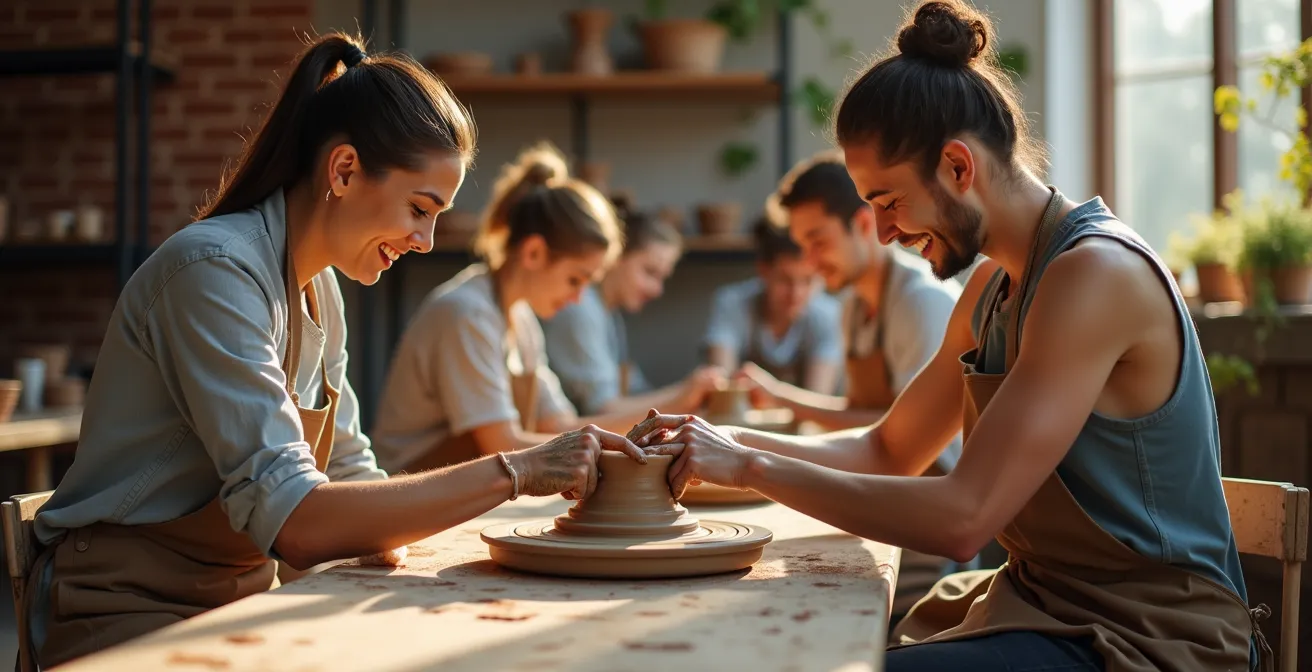
Contrary to popular belief, beating adult loneliness isn’t about forcing small talk at loud social events; it’s about finding a space for quiet, shared creation.
- Art workshops leverage “parallel play,” allowing you to be social without the constant pressure to perform or converse.
- The shared, vulnerable act of learning a new skill (and often failing at it) builds authentic bonds much faster than typical social interactions.
Recommendation: To build a consistent community and truly combat isolation, find a local, recurring weekly class in a hands-on medium like pottery or textiles.
Moving to a new city or transitioning to remote work can feel like an exciting new chapter, but it often comes with an unwelcome guest: loneliness. In an age of endless digital connection, feeling socially isolated is a paradox many of us face. The standard advice—”join a club,” “go to meetups,” “just put yourself out there”—can feel daunting, often placing us in high-pressure social settings that are more awkward than authentic. We’re told to find people with shared interests, but the noisy bar or crowded networking event rarely feels like the right place to forge a genuine bond.
What if the solution wasn’t about trying harder to be sociable, but about finding a better environment for connection to happen naturally? The answer might be hiding in plain sight, in the quiet, focused atmosphere of a local art studio. This isn’t just about picking up a new hobby. It’s about leveraging the unique power of collaborative creativity to build the social and emotional resilience we crave. The structure of an art workshop provides a form of “social scaffolding” that traditional social venues lack, allowing relationships to grow organically from a shared process rather than forced interaction.
This guide explores why these creative spaces are so uniquely effective. We’ll delve into the psychology of learning new skills, compare different workshop formats for building relationships, and provide practical tips for turning a shared creative pursuit into a strong community. It’s time to reframe the fight against loneliness not as a social challenge to be overcome, but as a creative journey to be embraced.
To help you navigate this journey, we’ve structured this article to answer your most pressing questions about using art to build community. You’ll find a clear path from understanding the core principles to taking practical first steps.
Summary: The Definitive Guide to Using Creative Workshops for Social Connection
- The Pottery Wheel: Why Failing at a New Skill Is Good for Your Ego?
- Ceramics vs Textiles: Which Workshop Suits High-Stress Personalities?
- One-Day Intensive vs Weekly Class: Which Format Retains Knowledge Better?
- How to Network at Art Classes Without Being “That Business Guy”?
- The Economic Impact of Supporting Local Art Studios vs Chain Workshops
- How to Talk to Strangers at Community Events Without Being Awkward?
- Board Games vs Video Games: Which Builds Stronger Real-Life Bonds?
- Oil vs Acrylic: Which Medium Suits a Tiny Apartment Studio?
The Pottery Wheel: Why Failing at a New Skill Is Good for Your Ego?
There is perhaps no greater equalizer than a lump of wet clay on a spinning wheel. It doesn’t care about your job title, your social status, or how witty you are. It will collapse, wobble, and refuse to cooperate, and in doing so, it offers a profound gift: the freedom to fail. In a world where we’re expected to project competence, the pottery studio is a sanctuary for imperfection. This shared vulnerability is the bedrock of genuine connection. When your lopsided bowl collapses for the third time, and you look over to see your neighbor laughing as theirs does the same, a bond is formed that no amount of small talk can replicate.
This experience is a practical exercise in developing a growth mindset—the belief that abilities can be developed through dedication and hard work. Instead of seeing failure as a reflection of your inadequacy, you begin to see it as a necessary part of learning. This shift is not just good for your ego; it’s a powerful tool for building resilience. In fact, compelling research published in Frontiers in Psychology demonstrates that individuals with a growth mindset show up to 50% greater resilience when facing setbacks. In a workshop, you’re not just learning to make a pot; you’re learning to be kinder to yourself, a lesson that is much easier to absorb when you’re surrounded by others on the same journey.
The instructor’s role is crucial here. They don’t just teach technique; they cultivate an environment where experimentation is encouraged and failure is normalized. This creates a low-stakes atmosphere where the fear of judgment dissolves, allowing your authentic self to emerge. This is the first and most crucial step in moving from isolation to connection.
Ceramics vs Textiles: Which Workshop Suits High-Stress Personalities?
Once you’ve decided to embrace a creative workshop, the next question is which one to choose. The tactile worlds of ceramics and textiles, for example, offer distinct experiences that can cater to different personality types, especially those dealing with high stress. The choice isn’t just about the final product but about the therapeutic nature of the process itself. One offers grounding, messy engagement, while the other provides rhythmic, orderly structure.
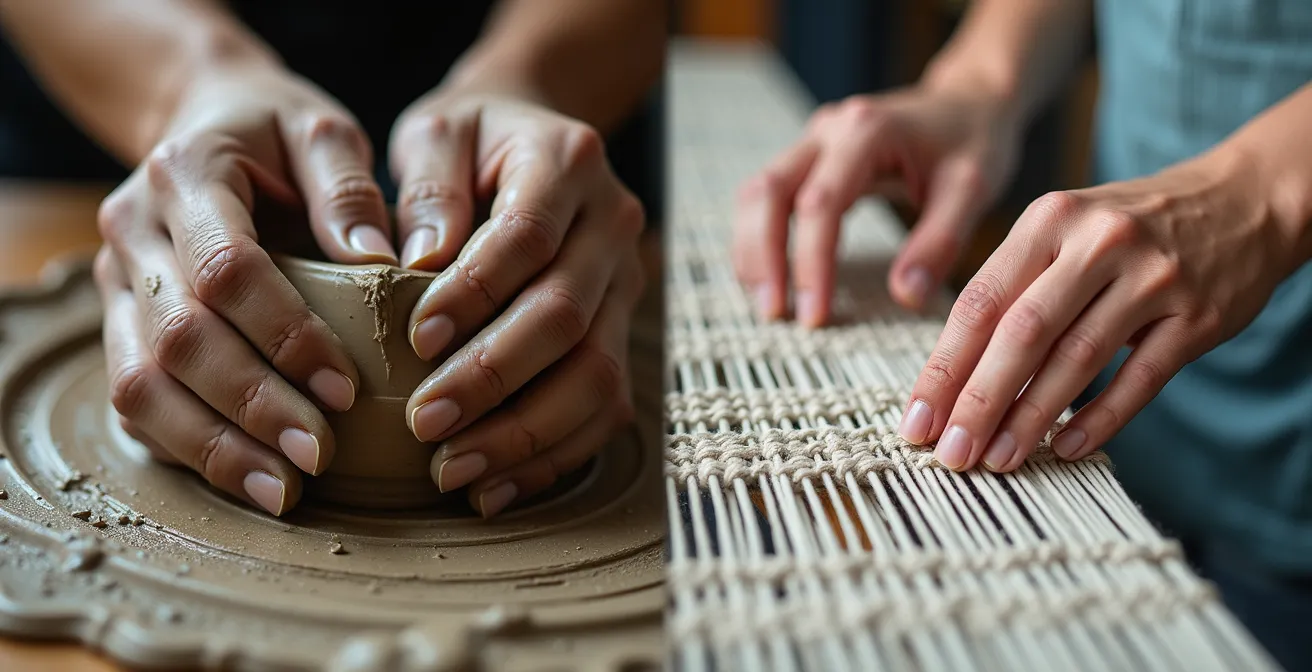
As the image above illustrates, ceramics involves a direct, grounding connection with the earth. The cool, heavy clay requires physical force and presence, making it an excellent outlet for pent-up energy and frustration. It’s a sensory experience that forces you out of your head and into your hands. For those whose stress manifests as restless energy, the physical engagement of kneading, centering, and shaping clay can be incredibly cathartic. However, the true magic of these workshops lies in a concept known as “parallel play.” As Lesley University research on art therapy notes, this is the act of engaging in an activity independently alongside others. A workshop allows for this beautifully; you can be fully absorbed in your own project while still feeling a sense of belonging, creating connection without the pressure of constant interaction. This concept is a cornerstone of why art workshops effectively combat loneliness.
Textile arts, such as weaving or knitting, offer a different kind of solace. These activities are characterized by rhythm and repetition. The steady, predictable motion of passing a shuttle through a loom or looping yarn on needles can have a meditative effect, calming an overactive mind and lowering cortisol levels. For individuals whose stress manifests as anxiety or racing thoughts, the structured, orderly nature of textiles can provide a profound sense of control and calm. The focus is on pattern and precision, creating a quiet space for mindfulness. Ultimately, both paths lead to the same destination: a calmer mind and a stronger sense of community.
One-Day Intensive vs Weekly Class: Which Format Retains Knowledge Better?
Art studios offer a variety of formats, but for the purpose of combating loneliness, the choice between a one-day intensive workshop and a recurring weekly class is critical. The intensive format is great for a taster experience—a fun Saturday afternoon to learn the basics of a new skill. You might leave with a finished (or nearly finished) piece and a sense of accomplishment. From a pure skill-retention perspective, spaced repetition, the principle behind weekly classes, is proven to be more effective for long-term memory. But when the goal is building community, the weekly class is unequivocally superior.
Loneliness is not a problem that can be solved in a single afternoon. It requires the slow, steady cultivation of relationships, and that’s precisely what the weekly format is designed for. Consistency is key. Showing up at the same time and place each week creates a sense of rhythm and reliability. It transforms a group of strangers into a familiar cohort. You begin to recognize faces, learn names, and witness each other’s creative progress. This shared journey, filled with small triumphs and frustrating setbacks, is the fertile ground where friendships grow. A one-day workshop provides a spark; a weekly class nurtures it into a flame.
The recurring nature of a weekly class allows for the development of social rituals that extend beyond the studio walls. It starts with small talk about projects and evolves into deeper conversations. Before you know it, you’re grabbing coffee before class or visiting a gallery together on the weekend. The class becomes a reliable anchor in your social calendar, a “third place” that is neither home nor work, but a vital hub for community and connection. It’s a commitment not just to learning a skill, but to investing in your social well-being.
Your Action Plan: Building Lasting Connections in a Weekly Art Class
- Weeks 1-2: Focus on showing up consistently. The simple act of being present, even when motivation is low, is the first step in establishing yourself as part of the group.
- Weeks 3-4: Begin learning names and sharing basic creative struggles. Commenting on a shared challenge, like “My clay keeps collapsing too,” is a powerful, low-risk icebreaker.
- Weeks 5-6: Form study partnerships or exchange feedback. Ask a classmate for their opinion on your work or offer a specific compliment on theirs.
- Weeks 7-8: Establish social rituals around the class. Suggest grabbing a coffee beforehand or ask if anyone is interested in visiting a local art supply store or gallery.
How to Network at Art Classes Without Being “That Business Guy”?
One of the biggest fears people have when joining a new group is how to connect with others without appearing awkward or having an ulterior motive. The art workshop setting is uniquely designed to solve this problem. Unlike a business networking event where everyone is expected to have an “elevator pitch,” an art class is centered around a shared activity. The art itself becomes the social lubricant, a neutral third party that deflects the pressure of direct conversation.
The golden rule is to focus on the process, not the person. Instead of asking someone what they do for a living—the default, often-dreaded question at social gatherings—ask about their creative process. “How did you get that texture?” or “What made you choose that color palette?” These questions are non-invasive, show genuine interest, and open the door for a conversation rooted in the shared experience. You’re not networking; you’re collaborating in curiosity. This shifts the dynamic from transactional to relational.
Authenticity is your greatest asset. Don’t be afraid to be vulnerable and share your own struggles. Admitting that you’re finding a technique difficult or that you’re unhappy with your progress is not a sign of weakness; it’s an invitation for connection. It signals that you’re human and makes it safe for others to be human too. As Melisa Su, a student involved in a Bowdoin College creative workshop, aptly puts it:
The arts not only give us an outlet to express what words cannot, but also serve as a starting point for a conversation—an opportunity for connection, whether existing momentarily or sparking a new friendship.
– Melisa Su ’24, Bowdoin College Workshop Report
This insight highlights that the artwork is not the end goal, but the beginning of a dialogue. Let the art do the talking first. Compliment a specific choice someone has made, offer help if you see someone struggling with a tool you’ve mastered, or simply work in comfortable silence. In the quiet hum of a studio, connection is built not on what you say, but on what you share.
The Economic Impact of Supporting Local Art Studios vs Chain Workshops
When you sign up for a class at a local art studio, you’re doing more than just investing in a new hobby; you’re investing in the social and economic fabric of your community. While large chain stores or corporate workshops might offer slick marketing and standardized curricula, they can’t replicate the unique ecosystem of a local studio. These spaces are often run by passionate artists who live in the neighborhood, and the money you spend circulates directly back into the local economy, supporting not just the studio owner but also nearby cafes, suppliers, and other small businesses.
A local studio is more than a business; it’s a community hub. It’s a “third place” where people gather, connect, and create. These studios often host free community events, showcase local artists’ work, and provide a safe and welcoming space for people from all walks of life. By choosing to support them, you are actively helping to build a more vibrant, connected, and resilient neighborhood. You are voting with your wallet for a community rich in culture and human connection.

The return on this investment goes beyond economics; it has a measurable impact on public health. Social isolation is a significant health risk, and community-based arts programs are a powerful antidote. While data on workshop participation is specific, the broader trend is clear: engaging with the arts reduces loneliness. For instance, an English longitudinal study of over 3,000 participants showed a 33% reduction in the odds of becoming lonely for those who regularly attended cultural events like concerts or theater. Local studios are the grassroots engine of this cultural engagement. They make art accessible, transforming passive consumers of culture into active creators of it, and in doing so, they weave a stronger, healthier community for everyone.
How to Talk to Strangers at Community Events Without Being Awkward?
The fear of saying the wrong thing—or having nothing to say at all—is a primary driver of social anxiety and avoidance. At a typical party or networking event, the burden is on you to initiate and sustain conversation. An art workshop brilliantly subverts this dynamic by providing a “social object”: the art itself. Your project, your neighbor’s project, the shared tools, the instructor’s demonstration—all become focal points that absorb social pressure and provide endless, low-stakes conversation starters.
The key is to shift from internal anxiety to external observation. Instead of worrying about what to say, simply comment on what you see. Art allows for non-verbal expression to become a bridge to verbal communication. When words are difficult, the act of creation can communicate feelings and experiences, fostering a sense of understanding and connection before a single sentence is exchanged. This process of self-reflection through making can build the confidence needed to engage with others.
To make this practical, focus on open-ended questions related to the shared experience. Avoid questions with simple “yes” or “no” answers. Instead of “Are you enjoying the class?” try “What’s been the most surprising part of this process for you?” This invites a more thoughtful response and shows you’re interested in their experience, not just making polite chatter. Here are a few proven conversation starters that work in almost any workshop setting:
- Start with observational comments: “I notice you’re using a dry brush technique. Does that give you more control?”
- Share your own struggles: “My clay keeps collapsing, is that happening to you too?” (This creates an instant alliance).
- Ask about process, not results: “How did you decide on that color palette? The combination is really effective.”
- Offer specific, genuine compliments: “The texture you created in that section really draws the eye. It’s beautiful.”
Remember, silence is also acceptable. In an art studio, quiet concentration is understood and respected. You don’t need to fill every moment with talk. This shared, comfortable silence is often a deeper form of connection than forced conversation.
Board Games vs Video Games: Which Builds Stronger Real-Life Bonds?
In the search for social connection, many people turn to games. Board game cafes and online multiplayer video games have exploded in popularity as venues for meeting new people. While both are valid ways to socialize, the nature of the connection they foster is fundamentally different from that of an art workshop. Understanding this difference is key to choosing the activity that best suits your goal of building deep, authentic relationships.
Video games often build connections based on shared performance and strategic goals within a virtual world. The bonds can be strong, but they are mediated by screens, headsets, and avatars. Board games bring people into the same physical space, fostering connection through friendly competition or cooperation. The focus is on mastering rules and outwitting opponents. Both are structured, but the vulnerability is typically low and strategic. The main goal is to win the game.
Art workshops introduce a different dimension: personal vulnerability. Unlike a game with clear winners and losers, art is subjective. There is no single “right” way to create, and the process involves expressing something of yourself. This shift from competition to creation fosters a much deeper and more authentic type of bond. The following table breaks down these distinctions:
| Activity Type | Vulnerability Level | Connection Depth | Skill Development |
|---|---|---|---|
| Board Games | Strategic (low) | Competitive/cooperative | Rule mastery |
| Video Games | Performance-based | Virtual/mediated | Technical skills |
| Art Workshops | Personal/authentic (high) | Shared creation | Progressive mastery |
As this comparative analysis highlights, art workshops stand alone in their emphasis on “personal/authentic” vulnerability. When you share a piece of art you’ve made, you are sharing a piece of yourself. When you struggle with a technique alongside others, you are building a bond based on shared humanity, not just shared strategy. This “shared creation” is a powerful catalyst for friendship, turning a simple class into a meaningful communal experience.
Key Takeaways
- Loneliness is best addressed not by forcing social interaction, but by creating an environment where connection can happen organically.
- Art workshops provide “social scaffolding” through the concept of “parallel play,” reducing the pressure to constantly converse.
- The shared vulnerability of learning a new skill and embracing imperfection builds authentic bonds much faster than traditional small talk.
Oil vs Acrylic: Which Medium Suits a Tiny Apartment Studio?
The journey of creative connection doesn’t have to end when you leave the studio. Bringing your new hobby home is a fantastic way to continue practicing and solidify your skills. However, for those living in small apartments or with limited space, the choice of medium is a crucial practical consideration. The romantic image of a sprawling artist’s loft isn’t the reality for most, but that shouldn’t be a barrier. Painting, in particular, is highly adaptable to compact living—if you choose the right materials.
Traditional oil paints are beloved for their rich colors and slow drying time, which allows for beautiful blending. However, they come with a significant drawback for apartment dwellers: they require solvents like turpentine or mineral spirits for thinning and cleanup. These chemicals release volatile organic compounds (VOCs), which require excellent ventilation that most small apartments lack. Without a dedicated, well-ventilated space, working with traditional oils is not recommended. This doesn’t mean oil painting is off-limits; water-mixable oil paints offer a fantastic alternative, providing a similar feel and look without the toxic fumes.
For the ultimate space-saving and low-hassle option, acrylics are the undisputed champion. They are water-based, meaning cleanup is as simple as soap and water. They dry quickly, which can be a challenge for blending but is a huge advantage for storage. You don’t need to leave wet canvases lying around for days; an acrylic painting can often be dry to the touch in under an hour. A small corner of a desk or a portable easel is all you need to set up your painting station. The rapid results and easy cleanup make acrylics perfect for busy schedules and tidy homes. Ultimately, the best medium is the one you’ll actually use, and for many urban creators, the practicality of acrylics makes them the clear winner for a home practice that complements their studio classes. This home practice is vital, as consistent engagement with a creative outlet is a proven method for improving well-being. For example, research on art therapy effectiveness shows that clay-based group art therapy achieved a rapid reduction in loneliness within just six weeks.
Your journey into art and community is a powerful step towards a more connected life. By choosing a local workshop, you’re not just learning a skill; you’re investing in your own well-being and the vitality of your neighborhood. Find a class that sparks your curiosity, embrace the beautiful mess of the creative process, and watch as new friendships begin to bloom.
Frequently Asked Questions on Apartment-Friendly Art
Can I use oil paints in a studio apartment without proper ventilation?
No, traditional oil paints require turpentine or mineral spirits which need good ventilation. Water-mixable oils are a safer alternative for small spaces.
How much space do I need for acrylic painting at home?
A small table or desk corner (2×3 feet) is sufficient for acrylic painting. Acrylics dry quickly and can be stacked, making them ideal for limited space.
What’s the best medium for someone who can only practice once a week?
Acrylics are ideal for intermittent practice as they don’t require special storage of wet paintings and supplies remain usable between sessions.