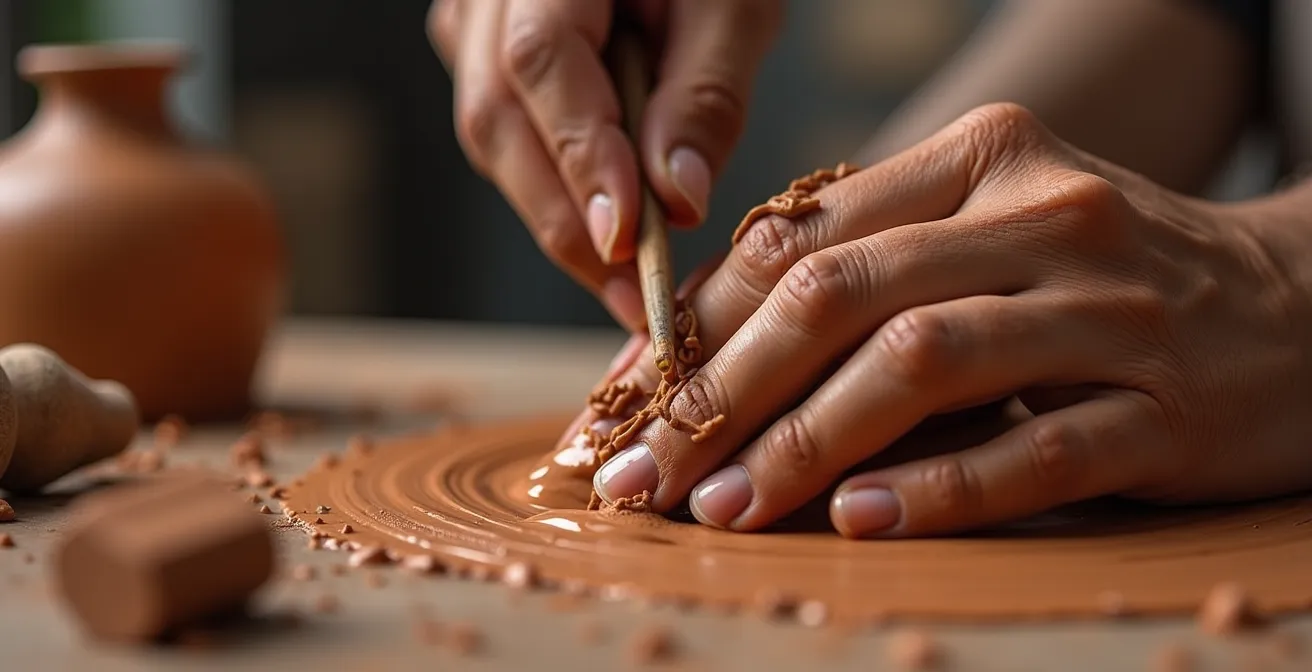
Sculpture is more than a relaxing hobby; it’s a form of sensory recalibration that directly counters the neurological drain of screen-based work.
- Working with materials like clay provides physical, haptic feedback that our digital lives lack, helping to ground an overstimulated mind.
- The three-dimensional nature of sculpture engages proprioceptive systems, rebuilding our sense of body and space that atrophies in front of a screen.
Recommendation: Instead of seeking another passive distraction, choose a tactile practice like sculpting to actively heal your connection between mind and body.
In a world of endless scrolling and glowing rectangles, our hands have forgotten their purpose. We type, we tap, we swipe—our movements confined to a flat, frictionless plane. This constant digital immersion leaves us feeling disembodied, anxious, and fundamentally disconnected from the physical world. It’s a unique form of exhaustion that sleep doesn’t fix, a hallmark of digital burnout. Many seek solace in more screen time: streaming services, video games, or social media, believing distraction is the cure. Others turn to mindfulness apps, attempting to solve a physical problem with a purely mental, and still digital, solution.
But what if the true antidote wasn’t found on another screen or inside our heads? What if it was waiting in the weight of stone or the cool, yielding resistance of clay? This is the principle of sensory recalibration. The problem isn’t just mental fatigue; it’s sensory deprivation. Our brains are starved of the rich, varied, and unpredictable feedback that comes from interacting with the three-dimensional world. Sculpture is not merely a creative outlet; it is a neurological counterpoint to the screen. It forces us to re-engage dormant haptic and proprioceptive systems, pulling us out of our anxious minds and anchoring us firmly in our bodies.
This guide will not teach you to become a master sculptor. Instead, it will walk you through the therapeutic process itself. We will explore how the choice of material, the management of your space, and even the way you handle your tools become acts of healing. By understanding the ‘why’ behind each step—from the patience required for drying clay to the focus needed to sharpen a chisel—you will discover how to use this ancient art form to build a more resilient, grounded, and tangible existence.
To guide you through this journey of reconnection, this article breaks down the essential aspects of starting a sculpting practice with a therapeutic mindset. The following summary outlines the key stages we will explore, from choosing your first material to understanding the deeper principles of form and process.
Summary: Why Sculpture Is the Physical Antidote to Digital Burnout
- Clay vs Stone: Which Material Is Most Forgiving for Beginners?
- Dust Management: How to Sculpt Indoors Without Ruining Your Lungs?
- The Negative Space Concept: Why Your Sculpture Looks Heavy and Clumsy?
- Sharpening Chisels: The Maintenance Skill That Saves Your Wrists
- Timing the Drying Process: Why Rushing Clay Leads to Explosions in the Kiln?
- Why Your Mixed Colors Look Muddy Instead of Vibrant?
- Ceramics vs Textiles: Which Workshop Suits High-Stress Personalities?
- How to Choose a Pastime That Actually Reduces Your Cortisol Levels?
Clay vs Stone: Which Material Is Most Forgiving for Beginners?
When you first approach sculpture as a means of therapy, the material itself is your first partner in the process. The choice between clay and stone is a choice between two different kinds of dialogue. Stone is resistant, demanding, and subtractive; you can only take away. It teaches decisiveness and acceptance. Clay, however, is the ideal starting point for sensory recalibration. It is forgiving, responsive, and additive. If you make a “mistake,” you can add more clay, reshape it, or even start over. This inherent flexibility is a powerful metaphor for personal growth and adaptability, making it perfect for beginners.
The simple act of working with clay provides immediate haptic feedback that is profoundly grounding. Its cool, smooth texture and yielding nature invite touch and manipulation without a specific goal. This process isn’t about making something; it’s about feeling something. For those struggling with anxiety, this tactile engagement is a powerful anchor to the present moment. In fact, focused creative activities are known to have a significant impact on mental well-being, with studies confirming that Anxiety reduction demonstrated in psychiatric unit patients after engaging in clay work sessions. The non-verbal nature of this “material dialogue” allows for expression when words fail.
To begin this journey, you don’t need a plan or an artistic vision. You only need to give yourself permission to connect with the material. The following steps are designed to help you start this conversation with clay, focusing entirely on the therapeutic process rather than the outcome.
Your Action Plan: Beginning a Therapeutic Dialogue with Clay
- Start with Tactile Exploration: Before trying to make anything, simply hold, squeeze, and manipulate the clay. Focus on its temperature, texture, and weight. This act anchors you in the present and reawakens your sense of touch.
- Let the Clay Guide You: Don’t impose a rigid idea. Begin shaping the clay and see where it leads. This process becomes a metaphor for growth, allowing you to knead tensions and reshape difficult experiences non-verbally.
- Practice Mindful Presence: The focus required to work with clay naturally quiets mental chatter. Pay attention to the sensations in your hands and the changing form of the material. This focus improves emotion regulation and reduces anxiety.
- Embrace Adaptability: Clay can be endlessly reshaped. Use this flexibility as a symbol for life’s transformations. Project emotions onto the material and explore different forms to develop new coping mechanisms.
- Consider a Collaborative Setting: If you feel isolated, working with clay in a group setting can be beneficial. The non-verbal nature of sculpting allows for a unique form of shared expression and connection, especially for those who struggle with verbal communication.
Dust Management: How to Sculpt Indoors Without Ruining Your Lungs?
The idea of sculpting indoors, especially with clay or stone, can evoke images of a fine, pervasive dust that settles on every surface and, more worryingly, in your lungs. This practical concern can be a significant barrier, preventing you from creating the very sanctuary you need. However, managing dust is not a complex industrial process; it’s a series of mindful habits that transform your workspace into a safe and therapeutic environment. The key principle is simple: keep it wet. Dry clay is the source of airborne silica dust, so working with moist clay and using wet-sanding techniques are your first lines of defense.
Creating a dedicated “wet zone” is crucial. This involves having a bowl of water for your hands and tools, a spray bottle to gently mist your work as you go, and using damp sponges for cleanup instead of dry brushes. When you wipe down surfaces, use a wet cloth. This approach doesn’t just control dust; it becomes part of the sensory ritual. The act of cleansing your space and tools with water adds another layer of haptic feedback to the experience, reinforcing a sense of care and calm. Proper ventilation, such as an open window or an air purifier with a HEPA filter, provides an extra layer of security and peace of mind.
This image of a serene and organized workspace is not an unachievable ideal. It demonstrates how a few simple tools—water, sponges, and good light—can create a haven for creativity. This is precisely the principle behind initiatives like The Clay Studio’s “Clay as Care” exhibition, which features a communal clay spot to show how safe, indoor clay work can be a powerful tool for community wellness and personal therapy.

As you can see, the focus is on organization and cleanliness, which are themselves therapeutic practices. An apron, easily cleaned floors, and dedicated shelves for drying pieces all contribute to a feeling of control and order. By adopting these simple dust management habits, you’re not just protecting your health; you’re cultivating a space where your mind can feel safe, clear, and free to create.
The Negative Space Concept: Why Your Sculpture Looks Heavy and Clumsy?
As you begin to move beyond simple forms, you may notice your sculptures feel dense, heavy, or “clumsy.” This is a common experience and it rarely has to do with a lack of skill. Often, the cause is a focus solely on the object itself—the positive space—while ignoring the space around and through it. This is where understanding negative space becomes a profound therapeutic tool. Negative space is the empty area that defines the form. Think of the hole in a donut or the space between the rungs of a ladder. It is as crucial to the final piece as the material itself.
When a sculpture feels heavy, it can be a physical manifestation of a “heavy” emotional state—a feeling of being blocked or weighed down. The act of carving away material to create an opening, or shaping clay to define a void, is a powerful metaphor for creating emotional and mental breathing room. It’s a lesson in letting go. By focusing on the negative space, you shift your perspective from merely building an object to crafting a relationship between form and emptiness, presence and absence. This shift engages your brain in a more complex form of proprioceptive engagement, as you start to perceive your work in its full three-dimensional context.
This connection between form and emotion is the very heart of sculpture therapy. It is not about the aesthetic quality of the final object but about the journey of its creation. As one gallery dedicated to the practice explains, the process is a path to liberation. In their guide to the practice, Art4you Gallery notes:
Sculpture therapy releases blocked emotions through the creation in three dimensions of shapes from deep within oneself. The therapist must be sensitive to this form of art, but not necessarily an artist. The important thing is the path that leads to liberation.
– Art4you Gallery, Art Therapy Sculpture Guide
Embracing negative space teaches you that what you remove is just as important as what you add. It invites lightness and dynamism into your work, and by extension, into your state of mind. The next time your piece feels clumsy, don’t add more material. Instead, ask yourself: where can I create an opening? Where can I let the light in?
Sharpening Chisels: The Maintenance Skill That Saves Your Wrists
If your journey takes you toward wood or stone, you’ll encounter a new set of tools, chief among them the chisel. A common frustration for beginners is the feeling of fighting the material, leading to wrist strain and fatigue. The culprit is almost always a dull tool. Sharpening your chisels is not a chore to be rushed through; it is a foundational skill and a meditative practice in itself. A sharp chisel doesn’t brute-force its way through the material; it glides. The energy you exert is transferred efficiently, saving your wrists and transforming a struggle into a fluid, rhythmic conversation with the stone or wood.
The process of sharpening requires focus, patience, and a delicate touch—qualities that are central to the therapeutic experience. Holding the chisel at a precise angle against a sharpening stone, you engage in a repetitive, rhythmic motion. This act becomes a form of active meditation, quieting the mind and anchoring you in the physical task. You are not just maintaining a tool; you are cultivating a state of flow. This focused, repetitive work is a powerful neurological counterpoint to the scattered attention demanded by our digital lives.
The positive mental effects of such hands-on, creative processes are well-documented. Craft-based therapies have been shown to provide significant benefits for individuals dealing with complex trauma and stress. For instance, programs working with military personnel and veterans have found that activities like clay work can offer a non-verbal outlet for processing experiences related to PTSD, depression, and low self-esteem. The focused, tangible nature of the work helps rebuild a sense of agency and self-worth. In a similar vein, studies have shown that art can increase serotonin levels, boost blood flow to pleasure centers in the brain, and foster new, more flexible ways of thinking. Sharpening a tool is a microcosm of this larger therapeutic process—a simple, focused act that brings both the tool and the mind back to a state of keen readiness.
Timing the Drying Process: Why Rushing Clay Leads to Explosions in the Kiln?
In our world of instant gratification, waiting is a lost art. When you’ve poured your energy into a clay sculpture, the temptation to rush it to the kiln to see the final, permanent form is immense. But clay operates on its own timeline, and ignoring it leads to disaster. If a piece is fired while it still contains moisture, the trapped water will turn to steam and violently explode, destroying your work. This isn’t a failure; it’s a lesson from the material itself. Rushing the drying process is a betrayal of the material dialogue you’ve been cultivating.
The drying process is a gradual, multi-stage journey that demands observation and patience. First, the piece becomes “leather hard”—firm enough to handle and add details to, but still cool to the touch. This can take a few days. Next, it must become “bone dry,” a state where all physical moisture has evaporated, which can take a week or more for an average-sized piece. It will feel room temperature and appear lighter in color. Only then is it ready for its first “bisque” firing. This slow, deliberate timeline is a powerful teacher. It forces you to detach from the desire for an immediate result and instead find value in the quiet, unfolding process. It’s an exercise in letting go of control and respecting the natural rhythm of the material.
This journey from pliable clay to finished form mirrors an emotional one, where aggressive or frustrating feelings can slowly transform into calmer, more reflective states. One artist beautifully described this cathartic release:
The creation of the sculpture brought catharsis during emotional strife; wedging and kneading clay helped direct pent-up frustration. When hollowing out and adding details, aggressive emotions shifted to calmer ones. Carefully smoothing the piece brought peace and allowed reflection on why I was upset.
– Artist, Where Creativity Works
The explosion in the kiln is a stark physical metaphor: if you don’t give emotions the time and space to properly process (dry), they can erupt destructively. Learning to time the drying process is learning the art of patience—a crucial skill for navigating both ceramics and life.
Why Your Mixed Colors Look Muddy Instead of Vibrant?
After the initial creation and firing, the next stage in ceramics is glazing—the application of color. This is often where a new kind of frustration emerges. You envision vibrant, jewel-toned surfaces, but your finished piece comes out of the kiln looking murky, flat, or “muddy.” This common problem is rarely about using the wrong colors; it’s about a lack of understanding of how glazes interact. But from a therapeutic perspective, this “muddiness” can be seen as more than just a technical issue. It’s a visual metaphor for a lack of emotional clarity.
When our feelings are jumbled, confused, and unprocessed, they feel “muddy.” The process of achieving vibrant, clear colors in glazing requires knowledge, patience, and intention—the same things required to achieve emotional clarity. Technical issues like applying glazes too thickly, mixing incompatible glaze bases, or not understanding how colors will transform under the intense heat of the kiln all contribute to a muddy result. Learning to glaze is an exercise in foresight and trust. You apply what looks like a dull, chalky liquid and must trust that the fire will transform it into something beautiful and vibrant.
This image of ceramic pieces, with their gradient from dark, muddy tones to bright, clear colors, serves as a powerful symbol for this emotional journey. It represents the transformation from confusion to clarity that the creative process can facilitate.
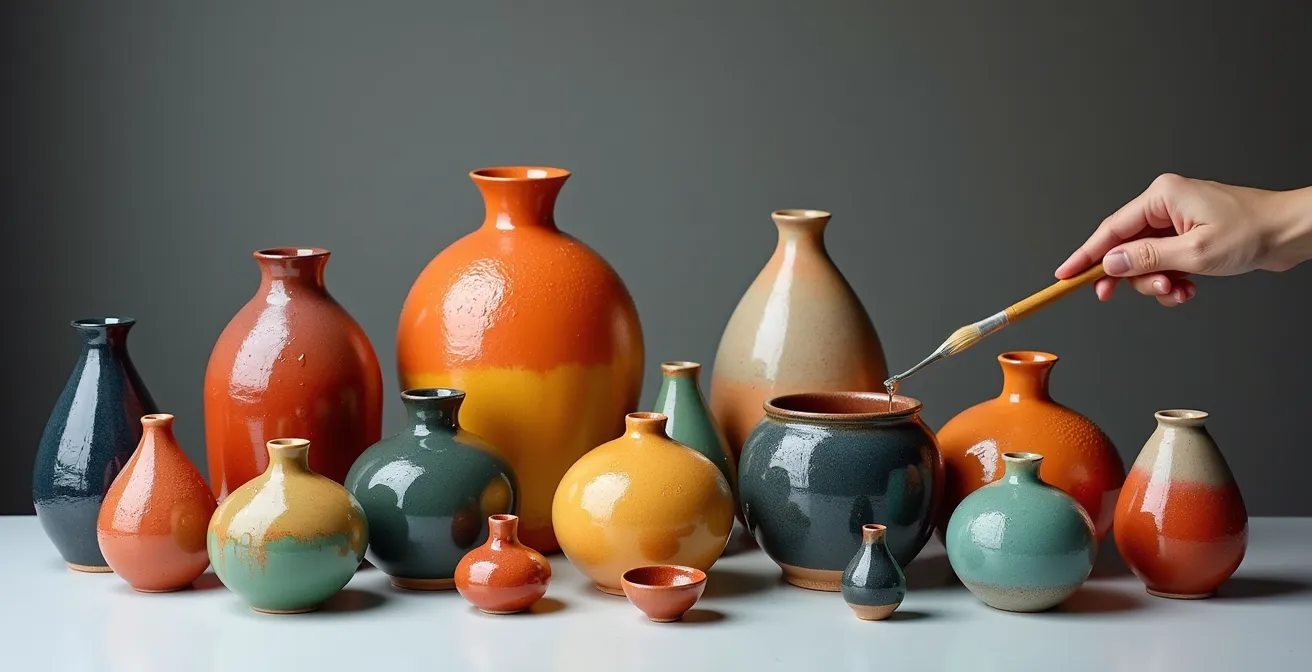
To avoid muddy colors, you must learn the rules: test your glazes, apply thin coats, and keep meticulous notes. This structured, almost scientific approach provides a neurological counterpoint to a chaotic inner world. It offers a clear, cause-and-effect framework where your efforts lead to predictable, beautiful results. By learning to create vibrant colors on the outside of your vessel, you are practicing the very skills of patience, intention, and clarity needed to cultivate vibrancy within.
Ceramics vs Textiles: Which Workshop Suits High-Stress Personalities?
When seeking a tactile hobby to combat digital burnout, many choices present themselves. Two popular options are ceramics and textiles, like weaving or knitting. Both offer hands-on engagement, but they provide very different forms of haptic feedback and are suited to different needs, especially for high-stress personalities. Textiles often involve soft materials and repetitive, rhythmic motions that are inherently soothing and meditative. They are wonderful for calming an anxious mind. Ceramics, however, offers something more primal: a cathartic release. As one therapeutic practice notes:
Molding and manipulating clay provides a cathartic release.
– Balanced Awakening, Clay Therapy: Healing Benefits Beyond Pottery
For someone with pent-up frustration, anxiety, or stress, the act of wedging clay—slamming it onto a surface to remove air bubbles—or the forceful centering of a lump of clay on a potter’s wheel is intensely physical and satisfying. It allows for the safe and constructive expression of aggressive energy. While knitting can soothe, clay work can actively process and release tension. It allows you to be rough and forceful, then gentle and precise, all within the same session. This dynamic range makes it uniquely suited for individuals navigating the volatile emotions that often accompany high-stress states.
The effectiveness of this approach is backed by clinical observation. In a notable study, a registered art therapist in Hong Kong demonstrated how Clay Art Therapy (CAT) significantly improved mood, decision-making abilities, and motivation in adults suffering from depression over a six-week period. The research concluded that even short-term engagement could be a powerful aid in emotional regulation. The tangible, three-dimensional result of a ceramics practice—turning a lump of earth into a functional or beautiful object—also provides a profound sense of accomplishment and agency, directly counteracting the feelings of helplessness that can accompany burnout and depression.
Key Takeaways
- Sculpture is not a passive distraction but an active form of sensory healing that physically counters the effects of screen time.
- The therapeutic value lies in the process, not the product. Engaging with the material’s feedback is more important than creating a masterpiece.
- Patience is a core skill taught by sculpture; respecting the material’s timeline (like clay drying) is a metaphor for healthy emotional processing.
How to Choose a Pastime That Actually Reduces Your Cortisol Levels?
In the quest to unwind, we often choose pastimes that are merely distractions, not true restorative practices. Binge-watching a series or scrolling through social media may occupy the mind, but they don’t address the underlying physiological stress of digital burnout. A truly effective pastime does more than distract; it actively lowers your body’s stress response. The key is to choose an activity that engages your body and senses in a grounding, physical way. This is where sculpture and other hands-on crafts excel, and the science backs this up.
Cortisol is the body’s primary stress hormone. Chronic exposure to it, fueled by the “always-on” nature of digital life, leads to burnout, anxiety, and a host of physical health problems. The most effective way to counteract this is not with more mental input, but with physical, sensory-rich engagement. Activities that involve tactile feedback, rhythmic motion, and focused, low-stakes problem-solving have been shown to be particularly effective. Scientific inquiry into this area has yielded clear results, with reduction of cortisol levels following art making activities demonstrated in formal studies. The act of creating something tangible with your hands shifts your brain out of its anxious, abstract-thinking loops and into a state of present-moment awareness and flow.
So, when choosing a pastime for genuine stress reduction, ask yourself these questions. Does it involve my hands? Does it provide satisfying sensory feedback? Does it require a gentle, focused attention that pulls me away from my worries? Sculpture, with its inherent haptic feedback and proprioceptive engagement, checks all these boxes. It’s a direct, physical prescription for a modern, digital ailment. You are not just making an object; you are actively down-regulating your nervous system and rebuilding your resilience, one handful of clay at a time.
Beginning this journey is the most important step. Don’t wait for the perfect tools or the perfect studio. Start today by finding a piece of clay and allowing yourself to simply feel it in your hands. That is where the healing begins.
Frequently Asked Questions About Sculpture Therapy
Do I need prior sculpting experience to benefit from sculpture therapy?
No prior sculpting experience is required to benefit from sculpture therapy. It is accessible to individuals of all skill levels and backgrounds. The focus is on the therapeutic process and creative expression rather than sculpting expertise.
Can sculpture therapy help with addressing trauma or emotional issues?
Yes, sculpture therapy can be effective in addressing trauma and emotional issues. The tactile and creative nature of sculpting allows individuals to process and express their emotions in a non-verbal way. It can provide a safe and expressive outlet for exploring difficult experiences.
How long is a typical sculpture therapy session?
The duration of a sculpture therapy session can vary but typically lasts around 45 minutes to an hour.