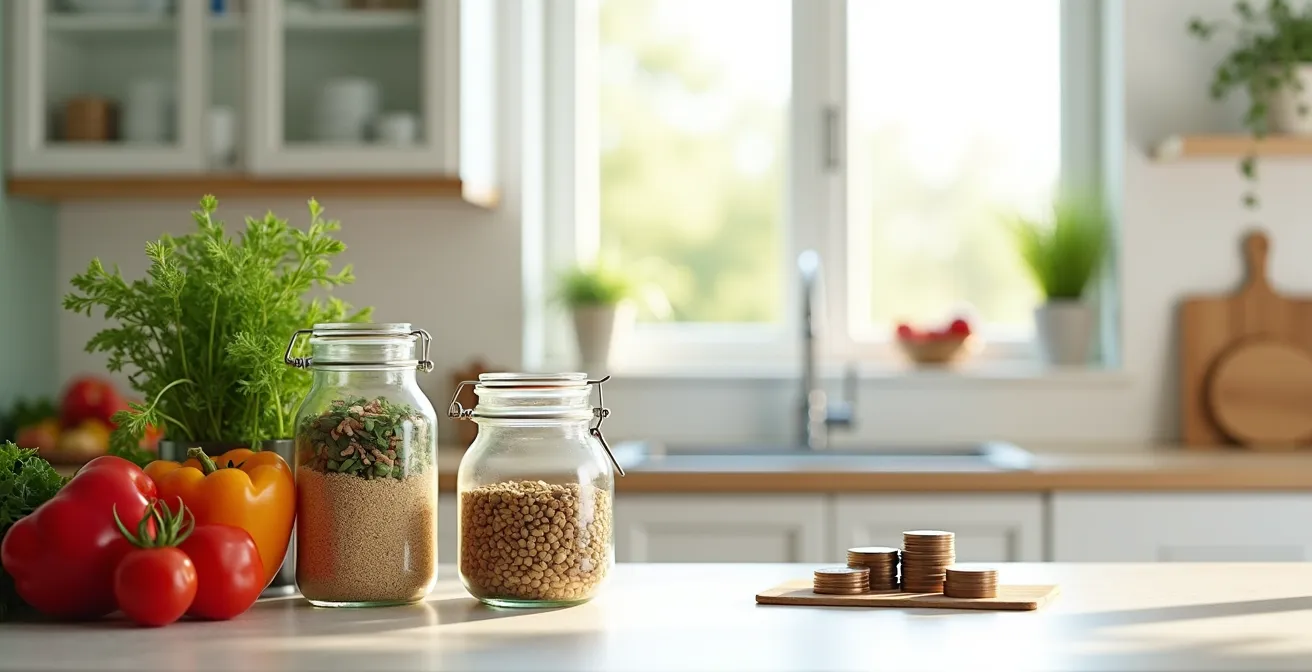
The true cost of food delivery isn’t just the menu price; it’s a financial drain that can be systematically eliminated by investing in core culinary skills.
- Delivery apps add significant markups and fees that silently erode your budget, while your home-cooked meal equivalent costs a fraction of the price.
- Mastering foundational techniques like knife skills and basic sauces makes cooking at home faster and more satisfying than waiting for a delivery driver.
Recommendation: Start by auditing your kitchen for efficiency and mastering one mother sauce. This small investment in “culinary assets” yields immediate returns in both flavor and savings.
For many young professionals, the day ends with a familiar ritual: scrolling through a food delivery app. The appeal is undeniable—convenience at your fingertips after a long day. You tell yourself it’s just for tonight, but “tonight” quickly becomes most nights, and the convenience comes with a hidden, cumulative cost that impacts both your wallet and your well-being. You’ve probably heard the standard advice to “meal prep” or “buy in bulk,” but these tips often fail to address the core reasons you order in: fatigue and a perceived lack of time or skill.
The cycle of expensive takeout and unsatisfying meals feels hard to break. The convenience of delivery apps is designed to be addictive, using psychological triggers to override your rational decision-making. But what if the solution wasn’t about forcing yourself into complicated, time-consuming cooking routines? What if the key to unlocking significant savings and better health wasn’t just about avoiding takeout, but about building a small set of powerful “culinary assets” that make home cooking genuinely faster, cheaper, and more delicious than any delivery?
This guide offers a different perspective. We’re not just going to tell you to cook more; we’re going to show you how a strategic investment in foundational kitchen skills creates an efficiency loop that systematically beats the delivery economy. By understanding the true cost of convenience and mastering a few core techniques, you can transform your kitchen from a place of chore into an engine of financial and personal empowerment. This isn’t about becoming a gourmet chef overnight; it’s about reclaiming control, one simple, delicious, and budget-friendly meal at a time.
text
In this article, we will deconstruct the real cost of food delivery and provide a clear roadmap to building the skills that make home cooking the superior choice. Follow along as we explore the essential techniques and mindset shifts that will put $200 back in your pocket every month.
Summary: A Practical Guide to Saving Money With Home Cooking
- The Delivery Markup: How Much Extra Are You Paying for Convenience ?
- How to Master the 5 Mother Sauces to Elevate Any Dish ?
- Knife Skills vs Gadgets: What Actually Speeds Up Prep Time ?
- The “I’m Too Tired” Solution: 15-Minute Meals That Are Faster Than UberEats
- Hosting a Dinner Party: How to Feed 6 People for the Price of 1 Restaurant Meal ?
- Why Smart Fridges Are Often a Waste of Money for Average Families ?
- Why Do We Feel Compelled to Buy Things We Don’t Need ?
- How to Make Healthy Cuisine Taste Indulgent for Picky Eaters ?
The Delivery Markup: How Much Extra Are You Paying for Convenience ?
The first step in breaking the takeout cycle is to understand its true financial impact. The price you see on the menu is just the beginning. Delivery apps operate on a model of layered fees—service fees, delivery fees, driver tips, and “small order” penalties—that are designed to be just small enough to ignore individually. However, the most significant hidden cost is the markup on the food itself. Restaurants often inflate prices on these platforms to offset the hefty 15-30% commission they are forced to pay, meaning you pay a premium before any other fee is even added.
Just how much extra is this convenience costing you? The numbers are staggering. Analysis shows that some platforms apply massive premiums; for example, one report found that DoorDash charges an average markup of 71.1% compared to direct-from-restaurant prices. That $15 burrito on the app could cost closer to $9 if you bought it directly. When you factor in all the additional fees, a single delivery meal can easily cost double what it would to prepare a similar, fresher version at home.
This isn’t just a cost; it’s a wealth transfer from your pocket to tech companies, all for the illusion of convenience. Recognizing this systematic overpayment is the critical first step. Every time you choose to cook, you are not just saving a few dollars; you are opting out of a system that is engineered to be inefficient for both you and the local restaurants you want to support. This financial awareness transforms home cooking from a chore into a smart economic decision.
How to Master the 5 Mother Sauces to Elevate Any Dish ?
If the high cost of delivery is the problem, building “culinary assets” is the solution. The most powerful of these assets are the five mother sauces of classical cuisine. This isn’t about becoming a French chef; it’s about acquiring a flavor toolkit that can transform simple, inexpensive ingredients into dozens of different restaurant-quality meals. Mastering these sauces means you’ll never have a “boring” meal again and can turn leftover vegetables or a simple piece of chicken into something truly special.
These sauces are the foundation, the operating system for a world of flavor. Instead of buying countless single-use jars of sauce that clutter your fridge, you learn five core techniques that unlock endless creativity. Each sauce serves a different purpose and can be adapted in infinite ways, giving you complete control over flavor and quality.
To truly understand their transformative power, it’s best to visualize the building blocks of flavor you’ll be mastering.

As you can see, each sauce offers a unique color and texture, representing a different flavor profile. Here are the five you should focus on:
- Béchamel: A simple white sauce made from butter, flour, and milk. It’s the key to creamy mac & cheese, lasagnas, and vegetable gratins.
- Velouté: A light, stock-based sauce that’s perfect for elevating leftover chicken, fish, or vegetables into a sophisticated dish.
- Espagnole: A rich brown sauce that gives deep, savory flavor to inexpensive cuts of meat, turning a simple stew into a gourmet experience.
- Hollandaise: A tangy, emulsified sauce made with egg yolk and butter. It makes simple eggs, asparagus, or salmon feel like a five-star brunch.
- Tomato Sauce: The versatile foundation for countless pasta dishes, pizzas, and stews, all made with affordable pantry staples.
Knife Skills vs Gadgets: What Actually Speeds Up Prep Time ?
A common barrier to home cooking is the perceived time it takes to prep ingredients. This leads many to invest in an army of single-use kitchen gadgets—garlic pressers, onion choppers, vegetable spiralizers—that promise to save time. However, these tools often create more work than they save, adding setup, breakdown, and cleaning time to your workflow. The real key to kitchen efficiency isn’t a drawer full of plastic; it’s mastering one tool you already own: a good chef’s knife.
Investing a small amount of time to learn basic knife skills creates an efficiency loop. Proper technique makes you faster, safer, and more precise. This speed and confidence make the entire cooking process more enjoyable and less of a chore. Studies comparing prep times have found that while a food processor might seem faster for dicing an onion, once you include assembly and cleanup, it’s often slower. For instance, a comparison found that a skilled chef can dice an onion in 30 seconds with a knife, versus 2 minutes for a gadget user when cleanup is factored in.
Forget the endless stream of “must-have” gadgets. Your time and money are better invested in a single, quality chef’s knife and the skill to use it. This minimalist approach not only saves you money on unnecessary purchases but also makes your entire cooking process more streamlined and meditative. It’s the ultimate example of how a foundational skill is a more valuable asset than any piece of technology.
Action Plan: Your Kitchen Efficiency Audit
- Prep Station Review: Identify your primary prep space. Is your cutting board, knife, and compost bowl within arm’s reach to minimize movement?
- Tool Inventory: List all single-use gadgets (e.g., avocado slicer, banana hanger). For each, ask: “Does a knife do this job just as well?” Consider donating any that are redundant.
- Workflow Analysis: The next time you cook, notice your movements. Are you walking back and forth to the pantry or trash? Group tasks and ingredients (mise en place) before you start cooking.
- Skill Gap Check: Honestly assess your knife skills. Can you dice an onion, mince garlic, and julienne a carrot confidently? If not, watch a 5-minute tutorial and practice for 15 minutes.
- System Integration: Create a “first in, first out” system in your fridge. Place older ingredients at the front to ensure they get used, reducing waste and last-minute grocery runs.
The “I’m Too Tired” Solution: 15-Minute Meals That Are Faster Than UberEats
The most common justification for ordering delivery is exhaustion. After a draining day, the idea of cooking feels overwhelming. But this is where the convenience of delivery apps is a carefully constructed illusion. When you factor in the time spent browsing menus, agonizing over choices, placing the order, and waiting for the driver, the entire process is surprisingly slow. In fact, data shows it’s often much slower than you think.
The reality is that the average food delivery takes 33 minutes and 24 seconds from order to arrival. In that same timeframe, you can prepare a delicious, healthy, and satisfying meal at home, especially if you adopt a few smart strategies. The key is to cross the “convenience threshold”—the point where your home cooking system becomes genuinely faster and easier than ordering out. This isn’t about complex recipes; it’s about assembly and efficiency.
Having a small arsenal of pre-prepped components ready to go is the ultimate weapon against the “I’m too tired” feeling. It allows you to assemble a meal in minutes, satisfying your hunger instantly without the wait or the cost.
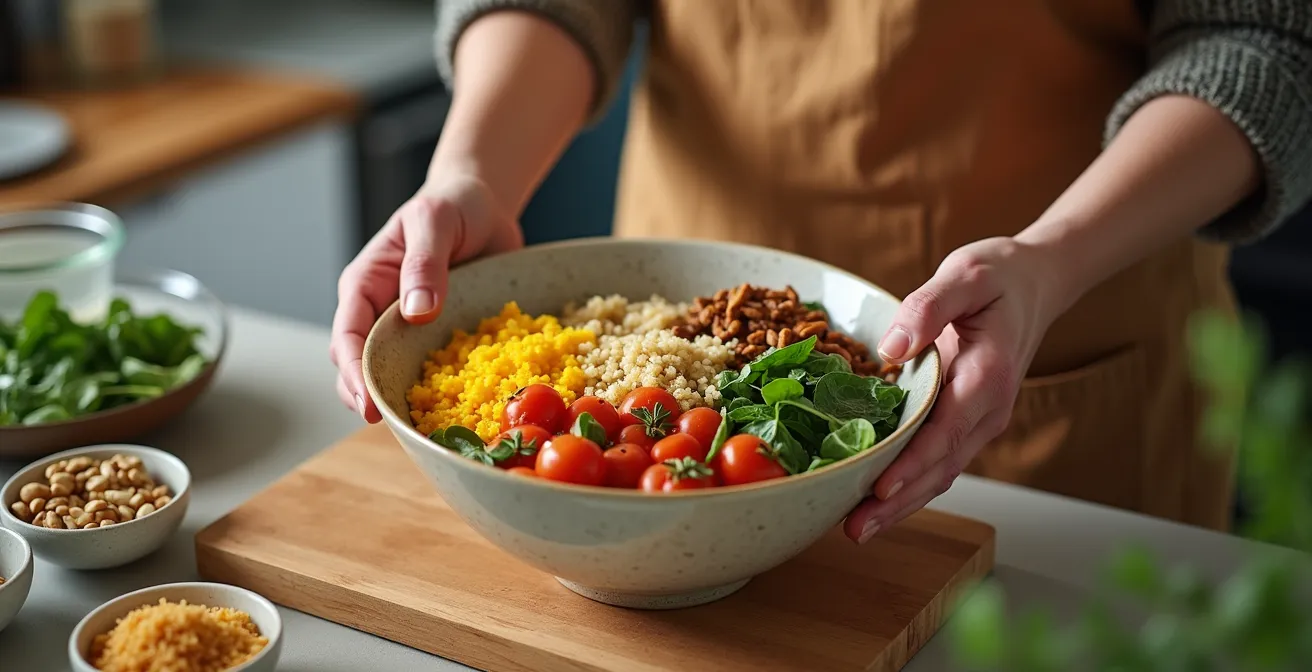
Here are some proven strategies to make 15-minute meals a reality:
- Component Prep: Spend one hour on Sunday prepping 5-6 core components: cook a batch of grains, roast a tray of vegetables, wash and chop greens, make a vinaigrette, and grill some chicken or tofu.
- Pantry Staples: Keep a running list of go-to 15-minute meals you can make with pantry items, like black bean tacos, pasta aglio e olio, or a quick curry with canned coconut milk.
- Double and Freeze: Whenever you cook a freezable meal like chili, soup, or a casserole, double the recipe. Freeze the extra half in individual portions for an instant meal later.
- Smart Shortcuts: Use healthy shortcuts like pre-washed greens, canned beans, and rotisserie chicken to build fast, nutritious grain bowls or salads.
- One-Pot Wonders: Embrace one-pot or sheet-pan recipes that require minimal active time. You can assemble them in 10 minutes and let them cook while you unwind.
Hosting a Dinner Party: How to Feed 6 People for the Price of 1 Restaurant Meal ?
The habit of eating out or ordering in extends beyond individual meals; it often dominates our social lives. The default for catching up with friends is frequently a restaurant, where a single person’s bill for an entrée, a drink, and a tip can easily approach $40 or more. This creates a false dichotomy: either spend a lot of money to be social or stay home and save. Home cooking shatters this myth by demonstrating the incredible economic leverage it provides.
The cost disparity between restaurant dining and home cooking is not linear; it’s exponential. A case analysis shows that the average restaurant meal costing $15 can be recreated at home for about $5 per person. This simple 3x difference becomes monumental when hosting a group. Based on these numbers, a dinner party for six people can be catered for just $30—less than the cost of one person’s meal at a restaurant. This isn’t about being cheap; it’s about being smart and generous.
Imagine hosting five of your friends for an amazing, multi-course meal of homemade pasta, a large salad, and a simple dessert, all for less than what you would have paid for your own single plate at a mid-range bistro. Cooking for others transforms a simple meal into a shared experience. It’s more intimate, more customizable, and allows for deeper connection than shouting over the noise of a crowded restaurant. It repositions your home as a hub of hospitality and warmth, strengthening relationships without breaking the bank. This is the ultimate expression of how culinary skills are a social asset, not just a financial one.
Why Smart Fridges Are Often a Waste of Money for Average Families ?
In the quest for an optimized kitchen, it’s tempting to look for technological silver bullets. The smart fridge, with its promise of automated inventory tracking, recipe suggestions, and app-based shopping lists, seems like the ultimate solution to meal planning and food waste. However, for most people, these expensive appliances are a classic case of over-engineering a problem that has a much simpler, cheaper, and more effective solution. They represent a high-cost gadget approach rather than a low-cost systems approach.
A smart fridge is a solution looking for a problem. The core challenges it aims to solve—knowing what you have, remembering to use it, and planning what to buy—can all be managed with near-zero-cost analog or basic digital tools. The high price tag, potential for costly repairs, and rapid technological obsolescence make it a poor financial investment. A simple, well-maintained system will always outperform a complex, underutilized piece of technology. The key is consistent habit, not expensive hardware.
The following table starkly illustrates the cost-benefit disparity. A system costing less than $20 achieves the same core functions as a multi-thousand-dollar appliance, with greater reliability and longevity. The source of this data is a comparative analysis of kitchen money hacks.
| Feature | Smart Fridge ($3000+) | Simple System ($20) |
|---|---|---|
| Inventory tracking | Automatic sensors | Weekly photo + list |
| Expiry alerts | App notifications | Date labels + weekly check |
| Shopping lists | Auto-generated | Phone notes app |
| Maintenance | Software updates, repairs | Replace marker yearly |
| Lifespan | 5-7 years (tech obsolescence) | Indefinite |
Ultimately, a smart fridge is a passive tool, whereas a simple whiteboard or a notes app is an active one that builds the habits of awareness and planning. These habits are the true assets that lead to long-term savings and reduced food waste, proving that the most effective solutions are often the simplest.
Why Do We Feel Compelled to Buy Things We Don’t Need ?
Understanding the financial drain of takeout is one thing, but understanding *why* we keep doing it, even when we know it’s expensive, is the key to breaking the habit. The compulsion to order food delivery is not just about hunger or a lack of time; it’s deeply rooted in modern consumer psychology. Delivery apps are masterfully designed to exploit our cognitive biases, making the act of ordering feel irresistible.
These platforms tap into our desire for instant gratification, offering a solution to hunger and decision fatigue with just a few taps. The “endless choice” they present triggers a paradox; while it feels like freedom, it can also be overwhelming, leading us to revert to familiar, comforting, and often unhealthy options. Research into consumer behavior has shown that while a majority of users will abandon an order if the fees seem too high, the overall usage of these apps continues to grow. This is because the apps’ convenience messaging and reward systems are engineered to override our rational cost-benefit analysis, creating a behavior pattern similar to other forms of compulsive buying.
This psychological pull is a powerful force. As Technomic Research noted in their 2024 Delivery & Takeout Consumer Trend Report, the habit is becoming more entrenched, not less. They highlight that, “The share of consumers choosing third-party delivery services over direct restaurant delivery is rising, up from 15% in 2020 to 21% in 2024.” We are being conditioned to outsource one of life’s most basic activities. Recognizing this manipulation is the first step toward reclaiming your agency. Every meal cooked at home is a small act of rebellion against a system designed to profit from your impulses.
Key Takeaways
- The true cost of food delivery is a hidden financial tax; convenience comes at a premium of markups and fees that can double the price of your meal.
- Foundational skills like sauce making and proper knife work are “culinary assets” that pay long-term dividends in time, money, and enjoyment, far outweighing any single-use gadget.
- A simple system for meal planning and flavor enhancement consistently beats expensive tech and the temptation of takeout, making home cooking faster and more satisfying.
How to Make Healthy Cuisine Taste Indulgent for Picky Eaters ?
One of the biggest hurdles in sticking with home cooking is the “flavor gap.” Restaurant food is often loaded with salt, fat, and sugar to make it hyper-palatable. When you start cooking at home, especially with a focus on health, your food can sometimes feel bland or unsatisfying in comparison. This is especially true when cooking for picky eaters or for yourself when you’re craving something indulgent. The secret to bridging this gap isn’t to replicate the unhealthiness of restaurant food, but to use flavor engineering to make nutritious ingredients taste incredible.
This involves understanding the core components of taste and learning how to manipulate them. By mastering a few simple techniques, you can amplify the natural flavors of food, create depth and complexity, and make healthy dishes that are genuinely exciting to eat. This is the skill that ensures your home-cooking habit becomes a long-term lifestyle, not a short-lived experiment.
Here are some fundamental flavor-boosting techniques:
- Master the Salt-Fat-Acid-Heat Balance: This is the cornerstone of good cooking. Adding a splash of lemon juice (acid) to roasted vegetables or a pinch of salt to fruit can dramatically brighten and intensify their flavor.
- Use Umami Boosters: Umami is the fifth taste, responsible for savory, deep flavors. Incorporate umami-rich ingredients like miso paste, mushroom powder, soy sauce, or tomato paste to give your dishes a satisfying depth that rivals meat-heavy restaurant meals.
- Toast Your Spices: Before adding them to a dish, toast whole or ground spices in a dry pan for 30-60 seconds until fragrant. This simple step awakens their essential oils and can double their flavor intensity without adding a single calorie.
- Embrace Caramelization: Cooking vegetables (like onions, carrots, or broccoli) at high heat until they are deeply browned brings out their natural sugars, creating a sweet, complex flavor that is far more appealing than simply steaming or boiling them.
- Finish with Fresh Herbs: A sprinkle of fresh parsley, cilantro, or basil at the end of cooking adds a burst of freshness and brightness that can lift an entire dish, providing a sensory experience that processed foods can’t match.
By building these culinary assets, you shift from being a passive consumer to an active creator. You are no longer just fighting the urge to spend money on takeout; you are building a system that delivers better-tasting, healthier, and radically cheaper results. This is how you win the battle for your budget and your well-being, one delicious home-cooked meal at a time.
Start by auditing your own kitchen habits. For one week, track your spending on delivery and groceries. The numbers will provide the clear, undeniable motivation you need to begin building your own culinary assets and reclaim your finances.
Frequently Asked Questions about Why Switching to Home Cooking Saves You $200/Month ?
How can I make vegetables taste better without adding lots of butter?
Roast vegetables at high heat (425°F) to caramelize their natural sugars, then finish with a splash of balsamic vinegar or lemon juice for brightness.
What’s the secret to making healthy grains taste interesting?
Cook grains in vegetable or chicken broth instead of water, add aromatics like garlic or bay leaves while cooking, and finish with fresh herbs.
How do I get kids to eat healthier foods?
Use food ‘rebranding’ – call roasted cauliflower ‘popcorn cauliflower’ or spinach smoothies ‘hulk shakes’. Let them help prepare meals to increase buy-in.