
The ‘fresh’ strawberries you buy in January are a nutritional illusion, having sacrificed their vitamin content for the ability to travel thousands of miles.
- Produce harvested before peak ripeness for long-distance shipping has a significantly lower nutrient profile than its seasonal, local counterpart.
- The environmental cost of out-of-season produce extends beyond carbon emissions to include intensive water usage, soil degradation, and biodiversity loss.
Recommendation: Shift your focus from year-round availability to seasonal alignment. Start by auditing your current shopping habits to identify and replace one out-of-season item with a seasonal alternative this week.
The sight is common in any modern supermarket: a perfect-looking clamshell of bright red strawberries in the middle of winter. For a shopper accustomed to year-round availability, it seems like a miracle of modern logistics. We’ve been taught to associate ‘fresh’ with ‘healthy,’ but this assumption crumbles under scientific scrutiny. That winter strawberry, likely grown thousands of miles away, is a shadow of its seasonal self. It was bred for durability, not nutrition, and picked green to survive a long journey, sacrificing the very phytochemicals and vitamins that develop during the final stages of sun-ripening.
The standard advice to “eat more fruits and vegetables” often overlooks a crucial qualifier: *when* they are grown and *how* they get to your plate. The global food system has engineered a disconnect between our diets and the natural cycles of the earth. This convenience comes at a hidden cost—not only to our health in the form of diminished nutritional integrity, but also to the planet through staggering, often unseen, environmental pressures like water stress and soil depletion. The conversation must move beyond a simple calorie count to a more holistic understanding of food value.
But what if the solution wasn’t about deprivation, but realignment? This article deconstructs the myth of year-round freshness from an agricultural science perspective. We will move beyond the platitude that “seasonal tastes better” to explore the tangible, evidence-based reasons why aligning your diet with the seasons is a powerful strategy for maximizing nutrient intake, reducing your ecological footprint, and even saving money. We will provide the tools to not only understand the problem but to take practical, effective action.
To navigate this topic, we will explore the key pillars of a seasonal eating strategy. This guide breaks down how to identify true local producers, understand the full environmental impact of imported foods, preserve seasonal abundance, and make intelligent choices on a budget. Let’s delve into the science behind a more sensible way of eating.
Summary: Why Imported Strawberries in Winter Are Nutritionally Empty ?
- How to Find True Local Producers vs Resellers at Farmers Markets ?
- The Carbon Footprint of Avocados: Is Your Toast Killing the Planet ?
- Optimizing Fermentation to Keep Summer Vegetables for Winter
- Spring, Summer, Fall, Winter: What Should Actually Be on Your Plate Now ?
- Seasonal vs Greenhouse: Which Is Cheaper for a Family of Four ?
- CSA Boxes vs Supermarkets: Which Offers Better Value in Summer ?
- Optimizing Your Organic Budget: Which 5 Foods Must You Buy Organic ?
- Why Switching to Home Cooking Saves You $200/Month ?
How to Find True Local Producers vs Resellers at Farmers Markets ?
The farmers market seems like the perfect solution to the industrial food system, but not all stalls are created equal. A common issue is the presence of resellers—vendors who simply buy produce from a wholesale market and resell it as “local.” This practice undermines the very benefits you’re seeking: freshness, peak-ripeness harvesting, and a direct connection to the person who grew your food. A reseller’s produce is often subject to the same long-haul journey and premature picking as supermarket goods. Finding a true local producer is the critical first step in reclaiming nutritional integrity.
True farmers have an intimate, season-specific knowledge of their land and crops that resellers lack. They can speak in detail about their cultivation methods, the challenges of the specific growing season, and the unique characteristics of the varieties they offer. As noted by agricultural researchers at Arizona College, farmers producing for a direct market are far more likely to prioritize plant varieties based on nutrition and taste rather than simply yield or transport durability. Engaging them in a knowledgeable conversation is your best tool for verification. Don’t be shy; a passionate farmer will be happy to share their expertise.
To empower your choices, you need a framework for inquiry. The following audit checklist provides a structured way to assess your current habits and then use specific questions to vet vendors effectively, ensuring your food dollars support genuine local agriculture.
Your Action Plan: Auditing Your Kitchen for Seasonality
- Map Your Sources: List all places you buy produce (e.g., specific supermarket, CSA, farmers market). This is your food-sourcing map.
- Inventory and Investigate: Look at the produce in your fridge right now. For each item, check the country of origin sticker. How many food miles are represented?
- Cross-Reference with a Calendar: Compare your inventory against a regional seasonal produce guide. What percentage of your produce is currently out of season for your area?
- Analyze the “Why”: For each out-of-season item, note the reason for purchase (e.g., habit, specific recipe, convenience). This reveals your personal consumption patterns.
- Create a Substitution Plan: Identify your top 3 out-of-season purchases. Research and commit to trying a seasonal, local replacement for each one on your next shopping trip.
The Carbon Footprint of Avocados: Is Your Toast Killing the Planet ?
The avocado has become a global symbol of healthy eating, but its journey to your plate carries a heavy, complex environmental burden. While “food miles” and carbon footprint are often the primary focus, a true scientific assessment reveals a much wider array of impacts. The issue isn’t just the CO2 from transport; it’s a holistic ecological footprint that includes water stress, biodiversity loss, and soil health degradation, especially when produced in monoculture systems far from where they are consumed.

This visualization highlights the two dominant factors: water consumption and transport emissions. However, the impact varies dramatically by origin. For instance, a 2012 study comparing raspberry production demonstrated that water stress was significantly higher in irrigated fields in Spain compared to those in the UK, even with similar greenhouse gas emissions. This illustrates that a narrow focus on carbon can be misleading. A local, seasonal item grown in harmony with its native climate almost always has a lower overall impact than an imported equivalent, even if the carbon numbers appear similar.
To make informed decisions, consumers must look beyond the single metric of carbon. The following table compares a local, seasonal approach with an imported, out-of-season one across several crucial environmental metrics.
| Impact Metric | Local Seasonal | Imported Out-of-Season |
|---|---|---|
| Carbon Footprint | Low (minimal transport) | Variable (ship vs air freight) |
| Water Footprint | Adapted to local rainfall | Often irrigation-intensive |
| Biodiversity Impact | Supports crop diversity | Often monoculture |
| Soil Health | Regenerative practices common | Industrial practices dominant |
Optimizing Fermentation to Keep Summer Vegetables for Winter
One of the most powerful arguments for seasonal eating is the superior nutrient content of produce harvested at its peak. As research shows that seasonal timing affects nutrient density, with one study finding that broccoli grown in the fall and winter contained almost twice the amount of vitamin C as the same vegetable grown in the spring. The challenge, then, is how to preserve this peak nutritional bounty for the leaner months. Fermentation is an ancient, scientifically-backed method for doing just that.
Unlike canning, which uses heat that can degrade sensitive vitamins, lacto-fermentation is a biological process that can actually enhance the nutritional value of food. As beneficial bacteria like *Lactobacillus* convert sugars into lactic acid, they perform several key functions. They create a natural preservative that protects the food from spoilage, they synthesize new vitamins (particularly B vitamins), and they break down anti-nutrients like phytic acid. This process makes the minerals within the vegetables more bioavailable, meaning your body can absorb and utilize them more effectively.
The process is a dynamic microbial succession that unfolds over time. Understanding this timeline allows you to control the outcome for both flavor and nutritional benefit.
- Days 1-3: Lactic acid bacteria begin to multiply rapidly. The pH of the brine drops, creating an acidic environment that inhibits spoilage microbes.
- Days 4-7: This is the period of peak probiotic development. The characteristic tangy flavor begins to emerge as B-vitamin synthesis starts.
- Week 2: Maximum flavor complexity is typically achieved. Enzymes produced by the bacteria have worked to break down anti-nutrients, improving digestibility.
- Weeks 3-4: The fermentation becomes stable. The minerals within the vegetables are now significantly more bioavailable for absorption.
- Month 2+: The vegetables enter the long-term storage phase. At this point, they should be kept at a consistent, cool temperature to maintain their texture and probiotic quality.
Spring, Summer, Fall, Winter: What Should Actually Be on Your Plate Now ?
Aligning your diet with the seasons requires a mental shift from a mindset of “what do I want?” to “what is available now?” This approach not only guarantees better flavor and nutrition but also fosters a deeper connection to your local food system and environment. Each season offers a distinct palette of flavors, textures, and nutrients that are naturally suited to the time of year. A winter diet rich in dense, starchy root vegetables provides the slow-burning energy needed for colder months, while the light, water-rich fruits of summer offer hydration and quick energy.
Building your meals around a seasonal calendar is the most practical way to implement this philosophy. While specifics vary by climate, the general categories of produce remain consistent across temperate regions. This cyclical pattern introduces natural variety into your diet, preventing the monotony of eating the same ten vegetables year-round and exposing you to a wider range of phytochemicals and micronutrients. The image below provides a visual representation of this annual culinary cycle, grouping produce by the season of its peak harvest.
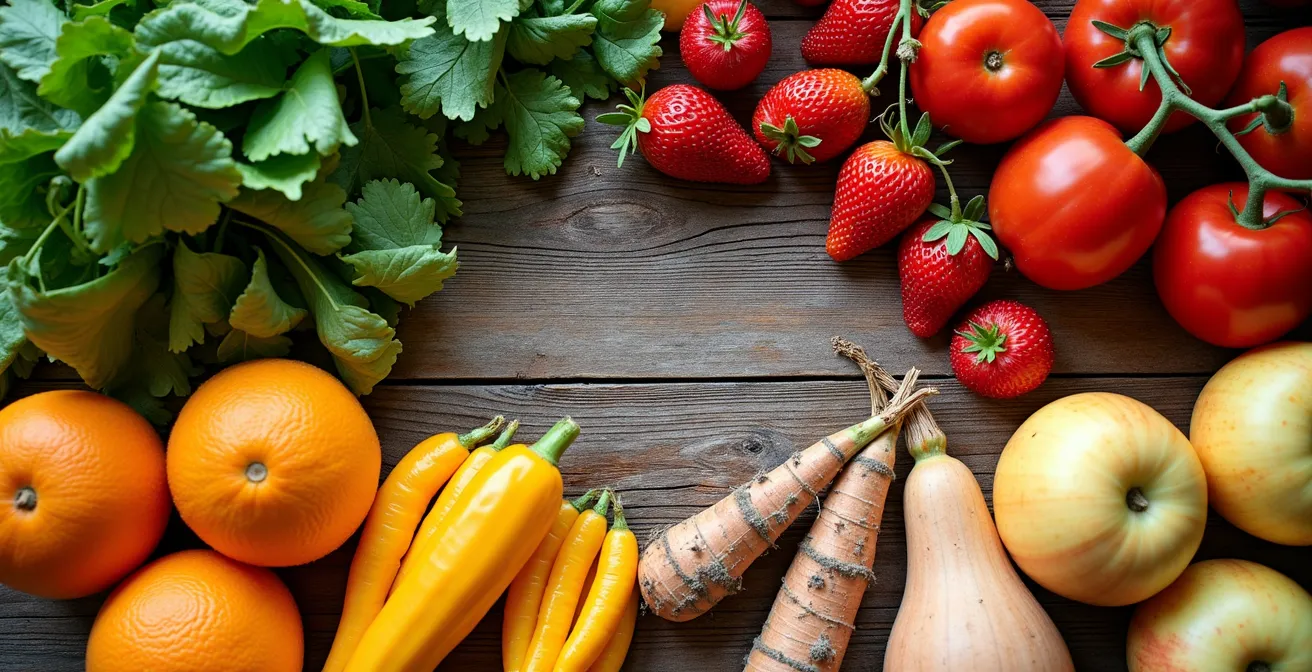
To make this tangible, here is a general guide based on a typical North American climate, similar to the harvest schedule observed in regions like San Diego. Use this as a starting point and seek out a specific seasonal calendar for your exact location.
- Spring (March-May): This is the season of tender greens and early fruits. Look for asparagus, radishes, peas, spinach, kale, and the first strawberries.
- Summer (June-August): The time of abundance and peak sweetness. This is when to indulge in stone fruits (peaches, plums, cherries), berries, tomatoes, corn, cucumbers, and zucchini.
- Fall (September-November): The harvest season brings hearty and robust flavors. Focus on winter squash, pumpkins, apples, pears, broccoli, cauliflower, and sweet potatoes.
- Winter (December-February): The season for storage crops and hardy greens. This is the time for root vegetables (carrots, parsnips, turnips), citrus fruits (oranges, lemons, grapefruit), and durable greens like kale and chard.
Seasonal vs Greenhouse: Which Is Cheaper for a Family of Four ?
A persistent myth is that eating seasonally and locally is an expensive luxury. While a single, out-of-season organic heirloom tomato might be costly, a diet consistently built around seasonal abundance is almost always more economical. The reason lies in the simple economics of supply and demand and the hidden costs baked into out-of-season produce. When a fruit or vegetable is in season locally, it is plentiful, reducing its base cost. Furthermore, it avoids the significant expenses associated with long-distance logistics.
As economic analysis shows, out-of-season foods cost more primarily due to transportation fees, complex refrigeration requirements during shipping and storage, and spoilage losses that are factored into the final retail price. A greenhouse-grown tomato in winter must also account for the massive energy inputs required for heating and lighting. These accumulated costs are passed directly to the consumer. By purchasing what is naturally abundant, you are opting out of paying for this energy-intensive and inefficient supply chain.
The table below offers a hypothetical weekly budget comparison for a family of four, illustrating the potential savings and value differences between a seasonal approach and one reliant on greenhouse-grown or imported goods. The figures represent averages and will vary by location, but the principle holds true: you pay a premium for food grown out of sync with nature.
| Category | Seasonal Approach | Greenhouse/Imported |
|---|---|---|
| Average Weekly Cost | $45-60 | $75-95 |
| Nutrient Density | Higher (freshly harvested retains more vitamins) | Lower (storage/transport losses) |
| Variety | Changes seasonally | Consistent year-round |
| Flavor Quality | More flavorful at peak | Often bland |
CSA Boxes vs Supermarkets: Which Offers Better Value in Summer ?
During the peak of summer, consumers have two primary models for sourcing produce: the conventional supermarket and a Community Supported Agriculture (CSA) program. While the supermarket offers choice and convenience, a CSA offers a fundamentally different value proposition. By paying a farm upfront for a “share” of the season’s harvest, you receive a weekly box of whatever is at its peak. This model provides the farmer with financial stability and gives the consumer direct access to the freshest, most nutrient-dense food possible.
The value of a CSA extends far beyond the price per pound. It’s an investment in a food system that prioritizes nutrition and flavor. Produce in a CSA box is often harvested the same day it is delivered, a level of freshness supermarkets cannot possibly match. This “vine-ripened” advantage is critical for nutritional content. As experts from Johns Hopkins Medicine explain, this immediate farm-to-table transit time is key.
Produce from local farmers has spent more time on the vine, on the tree or in the ground, so you get better taste and more nutrients.
– Melinda Cater, RD, Johns Hopkins Medicine
In a direct comparison, a CSA often provides a greater volume and variety of produce for a similar or lower cost than buying the equivalent items individually at a supermarket, especially if one opts for organic. However, the trade-off is a loss of choice; you get what the farm is harvesting that week. This can be a culinary adventure, encouraging you to cook with new vegetables and break out of dietary ruts. For those seeking maximum nutritional value and a direct relationship with their food source, the CSA model offers unparalleled benefits during the summer months.
Optimizing Your Organic Budget: Which 5 Foods Must You Buy Organic ?
The debate between conventional and organic produce is complex, but one of its core tenets relates to soil health, which is the foundation of a plant’s nutritional content. As research from the University of Colorado indicates, organic and regenerative organic farming practices support the most nutrient-rich, microbially-diverse soils. Healthier soils grow healthier plants, which in turn are better equipped to nourish us. However, buying everything organic can be a significant financial strain. A strategic approach is necessary.
The key to an optimized organic budget is to prioritize. Not all fruits and vegetables carry the same pesticide load. Some, due to their thick, inedible peels or natural resilience, are less susceptible to pesticide contamination. Others, with soft, porous skins, act like sponges for chemical treatments. Focusing your organic dollars on these high-risk items allows you to minimize your exposure to pesticide residues without breaking the bank. This targeted approach offers the best return on investment for your health.
To help you allocate your budget effectively, here is a priority list based on which foods tend to retain the most pesticides versus those that are naturally better protected. This allows you to make smart, cost-effective choices in the produce aisle.
- Priority 1: Soft-Skinned Fruits. Items like strawberries, nectarines, and peaches consistently top lists for high pesticide retention due to their delicate, edible skins. Always buy these organic if possible.
- Priority 2: Leafy Greens. Spinach and kale have large surface areas that can easily trap pesticide sprays. They are a high-priority organic purchase.
- Priority 3: Peppers. Both bell peppers and hot peppers have thinner skins and are often treated with systemic pesticides, which are absorbed into the plant itself.
- Skip Organic: Produce with tough, inedible skins like avocados, onions, and pineapples, as well as sweet corn, offer a natural barrier that protects the flesh from most pesticide residues.
- Consider Frozen Organic: For high-priority items like berries, frozen organic versions are often cheaper than fresh and are flash-frozen at peak ripeness, preserving their nutrient content.
Key Takeaways
- Out-of-season produce is harvested prematurely, leading to a significant loss of vitamins and phytochemicals, a concept known as compromised nutritional integrity.
- The true environmental impact of imported food goes beyond carbon to include critical factors like regional water stress, soil degradation from monoculture, and loss of biodiversity.
- Eating seasonally is often more cost-effective because it avoids the built-in expenses of long-distance transport, complex refrigeration, and energy-intensive greenhouse production.
Why Switching to Home Cooking Saves You $200/Month ?
Adopting a seasonal eating strategy culminates in one final, crucial step: home cooking. This is where the potential for both nutritional and financial savings is fully unlocked. While the title’s “$200/month” is an illustrative average, the principle is sound. Cooking at home fundamentally shifts your spending away from the high markups of the restaurant and prepared-food industries and toward raw, high-value ingredients. This is especially true as more consumers embrace local food systems; as USDA data reveals that over $22.4 million in SNAP benefits were redeemed at farmers markets in 2017, showing a growing integration of fresh produce into home budgets.
The financial savings from home cooking come from several sources. First, you are no longer paying for labor, overhead, and profit margins, which constitute the bulk of a restaurant meal’s cost. Second, buying whole, seasonal ingredients is inherently cheaper than buying pre-cut, processed, or out-of-season versions. Finally, cooking at home gives you control over portion sizes and leftovers, drastically reducing food waste—a major, often-hidden household expense. By planning meals around your seasonal CSA box or farmers market haul, you ensure every ingredient is used at its peak.
Beyond the budget, cooking at home is the best way to preserve the superior nutritional value of your carefully sourced ingredients. Gentle cooking methods like steaming or stir-frying retain more heat-sensitive vitamins than the high-heat, mass-production methods often used in commercial kitchens. As research from Rutgers University points out, locally grown produce picked at its peak is at its highest nutritional potential, and immediate, mindful preparation at home ensures that potential ends up on your plate, not lost in a complex supply chain. It is the final act in transforming a smart purchase into a truly nourishing meal.
By consciously choosing to align your plate with the seasons, you are making a powerful statement. You are prioritizing nutrient density over cosmetic perfection, ecological balance over year-round convenience, and long-term health over short-term cravings. Begin today by taking stock of your own kitchen and taking the first step towards a more sensible, sustainable, and satisfying way of eating.